
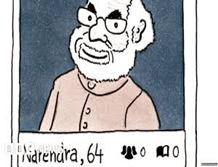
Indian Democracy – Wither it Moves. Indian Democracy is derived from the Constitution of India. It is the panache of all ills that arise due to political parties’ priorities to vote bank politics. Political leaders supported by the affiliated parties, hell-bent upon to brush aside the democratic principles enshrined in the Constitution to gain power.
Power is fragile so are the leaders. They try their destinies but soon dissolve into diminutive world of no return.
Look at the Indian Democracy. The present gubernatorial governance is sliding waywardly.
The instrument of anti-incumbency sharpens, the ruling junta enjoys brute majority, opposing forces are not strong, civil society is stirred against the rulers. They incur mental in stability, indulge in derailing the democracy. Indira Gandhi imposed emergency was of this nature in 1975 under Article 352 of the Constitution of India. That was over used, misused and suppression was the order of the day, banning elections, arresting political leaders, suspending civil liberties, censoring media. She lost power, fame and prestige. That is history.
Narendra Modi, a product of RSS, is known baiter of Indian minorities in Gujarat.
The Indian democracy does not mean that the think- tank of BJP led by Rajnath Singh misjudged Modi, that he would resurrect the power mongering BJP. He was brought to Delhi to head the dwindling party. He grabbed the BJP and the power from the demoralised Congress. He, single- handedly, churned the manna from the tumultuous waters of vacuum created and presented to him. He started revamping the system and democratic institutions and Constitutional authorities to his likes and imaginations. He did not formally impose emergency, he made subservient all the agencies, CBI, IT, ED and other likeminded institutions and authorities, judiciary for a short while, including Election Commission of India. Wither democracy in India, the world questions.
The verdict on Ram Janam Bhoomi Verdict, the chief votary of the verdict, is in Rajya Sabha. The then Director, ED got extensions till the Supreme Court of India ended it. India is now in an autocracy in disguise and dictatorship undeclared. Narendra Modi devastates opposition ruled State governments by using money, might and mermaid enforcement agencies. Maharashtra, Karnataka, Madhya Pradesh are reckoning examples of this kind.
He thwarts and wrought uncompromising opposition leaders to dance to his tunes of dictatorial numbers. He succeeded a lot but failed miserably and now at the altar of annihilation. He lost elections in Himachal Pradesh and Karnataka and many by-elections at a stretch. Modi is in despair and stress; he might succumb to a devastating defeat in the ensuring State and Parliamentary Elections as well.
His dictatorial ways, high prices, un employment, pressure on national media, opposition unity under INDIA banner, desertion of friends, great elimination of his own colleagues, witch-hunt of his foes, curtailment of civil liberties, dis-harmony in society, suppression of minorities, caste census, un- ethical and unfriendly laws, pomp and glory are the basic elements his would be down fall.
The bulwarks Indian democracy are:
1) The Judiciary
2) The Legislature
3)The Executive
4) The bureaucracy
5) The Press & Media
6) The Institutions
All of the pillars of Indian Democracy are in commotion. The executive has over-powered all of them and all of a sudden. The Judiciary is being pressurised to act in tandem with the Executive, since they represent people and it is in the fitness of things that they adjudicate in its favour. But, the Judiciary, of late, stick to its independence. But the Executive is adamant and continue to have its own ways to dictate the legislatures.
The media is monitored to focus on the Executive, its leader, government policies and programmes. No space is given to the voices of the opposition fearing the government onslaught. All the Institutions are captured to witch-hunt the opposition leaders and parties to join the ruling dispensation or to support its leader. Leadership cult, character building and worship has become order of the day. Wither Democracy in India people wonder.
Narendra Modi bent upon to trample upon the Constitution of India to make it a Hindu Rashtra and minorities have no place in it. Akhand Bharat is his aim and the Constitution has to be amended accordingly in his life-time. Affixing Sengol is one such step to establish a Hindu state and the Ram Mandir construction is another step in this direction. He built a new parliament building representing a cow-head shape, prophesied to be a good omen to his future prospects of becoming Prime Minister again and again.
Are Indian Minorities demoralised?
Indian Democracy is under attack. Look at the Muslims. Terrorising Muslims, mob lynching, love-jihad propaganda, property-jihad slogans, communal riots, demoralising campaigns, shaming minority kids, closing down Madarasas, purdah hatred, shooting sensations and smear canvassing are a few examples of Modiocracy experiencing in India. Wither Indian democracy, India asks. India is at the cross roads, is at the verge of slow decay, save Indian democracy, cries India.
In 2019, with the passage of the Citizenship Amendment Act by Parliament, a legal framework for discrimination against Muslims was established. This Act explicitly excluded Muslim refugees from a more streamlined citizenship process. Many observers believe that this Act, combined with the planned creation of a national register of citizens, could potentially be employed in tandem to disenfranchise Muslim voters who may lack the necessary documentation to prove their citizenship.
Indian Democracy – Wither it moves. Narendra Modi aspires Global Leadership -does he deserve it?
Indian Democracy – Wither it moves. Modi aspires for a global leadership when India is being marginalised from various fronts. Dwindling democratic institutions, disenfranchisement of political leaders, diminishing civil liberties, detaining of opposing political leaders, dismantling political parties, disproportionate disbursement of money for gigantic pomp and show of election show-blitz campaigns, mobilisation of masses for election meetings etc. would negate his aspirations. Global leadership is not built on sham and shanty surfaces. If India grows in all fronts, Global leadership would crown India and its leader. Based on the precariously declining Indian Democracy and its democratic values, Modi would hardly claim the global leadership with bare hands and weak democracy.
Two Industrialists control 70 percent of India’s wealth and one of them, is grown to the third wealthiest person (for a while), during Modi’s tenure is no democracy.
Indian Democracy – Wither it moves. Modi grabs most of the donations, does he not?
Indian Democrcay – Wither it moves. Modi’s Bhartiya Janata Party grabs ninety percent of donations is no democracy. PM Cares’ Fund is obscure and non-transparent. Bank debtors have fled India and loans of many have been waved. Gautam Adani is omnipresent and omnipotent. Two Industrialists control media houses and the media eulogies Modi and his government policies and programmes.
Banks have been bulldozed. They do not help general public but big businesses. Banks have become centres of digital money transactions engines and have less work to do in bank premises.
Media falls flats under Modi
In India, the media technically has the freedom to voice dissent, but reality is quite different. Independent journalists often face harassment, and media ownership tends to be concentrated in a way that limits diverse perspectives. This has led to a culture of self-censorship among journalists and individuals. The checks on executive power are eroding rapidly.
Members of civil society who criticize policymakers are at risk of surveillance, harassment, intimidation, imprisonment, injury and so on.
Laws are enforced to mend opponents
Indian democracy is modified to suit the ruling. The frequent strengthening laws are a relatively recent phenomenon and has had a chilling effect on dissent. The government has branded criticism of its policies as “anti-national,” using this label to stare opposition. An army of volunteers has been employed to identify online dissenters.
Firstly, academics were targeted, with university administrators and faculty facing investigations, discipline, or forced resignations due to their perceived political views.
Government critics subjected to administrative harassment
Critics of the government within civil society often find themselves subjected to administrative harassment. In 2020, the Modi government tightened its grip on civil society independence by amending the Foreign Contribution Regulation Act (FCRA). These amendments targeted the logistics of foreign-fund transfers, imposed limits on the nature of spending and the sharing of funds between non-governmental organizations (NGOs), granted central and state governments discretionary powers to suspend NGOs, and prohibited public servants from affiliating with such organizations.
Government authorities have consistently utilized financial audits and tax-related raids, operating within the bounds of legality, against a broad spectrum of civil society groups.
Journalists threatened
Indian journalists often find themselves in precarious situations, facing threats to their lives and enduring relentless online harassment orchestrated by troll farms linked to the government. This grim reality has created a cascading effect on major media networks, stifling their ability to criticize the Modi government openly.
Prime Minister Narendra Modi himself has notably refrained from engaging with the media in any substantive manner, having not held a single press conference in the last nine years. This lack of direct engagement with journalists further restricts transparency and accountability in the government’s actions and policies.
Media independence eroded
The spirit of Indian Democracy would never tolerate the erosion of media independence in India which extends beyond biased coverage and non-engagement with critical voices. Practices such as selective licensing and the acquisition of independent media networks by individuals affiliated with the Modi government have further compromised the diversity of voices in the media landscape. Independent outlets that dare to challenge the government’s narrative often face harassment and intimidation. The Delhi Police on Tuesday, 3 October, 2023 conducted raids on 30 locations, including the residence of journalists, in connection with a probe into the funding of news portal NewsClick.
The raids reportedly took place in the residences of NewsClick Editor Prabir Purkayastha, video journalist Abhisar Sharma, political commentator and senior journalist Aunindyo Chakravarty, veteran journalist Paranjoy Guha Thakurta, Bhasha Singh, Bhasha Sinha, and Urmilesh.
Business tycoons control India’s media
Mukesh Ambani, a prominent businessman directly wields control over media. Gautam Adani, acquired India’s last major independent television network, NDTV, in December 2022. The government has consistently targeted international news organizations that offer critical perspectives, often portraying such foreign news reports as part of a conspiracy to hinder India’s global ascent.
In a concerning incident, the Indian offices of the British Broadcasting Corporation (BBC) were subjected to raids in February 2023, occurring shortly after the news organization released a documentary critical of the Modi government.
Thoughtless announcements and policy decisions
In recent years, India has witnessed the enactment of some of its most significant laws and political decisions without meaningful parliamentary consultation and amid opposition protests. These decisions include the sudden imposition of a national lockdown with just four hours’ notice, the controversial demonetization move, and the introduction of farm laws.
The Supreme Courts favourable verdicts
The Indian Democracy in pain to see the Supreme Court’s decisions on various pivotal political matters, such as the Ayodhya temple dispute, the Aadhar biometric ID system, habeas corpus in Kashmir, electoral bonds, and the Prevention of Money Laundering Act, have consistently favoured the Modi government. This represents a departure from the past in Indian democracy. India’s democratic erosion takes a different form now.
Autocratic leaders have become adept at using democratic rhetoric while simultaneously wielding autocratic powers. They maintain the facade of a functioning democracy while stifling opposition and constraining space for dissenting voices. In essence, some argue that what we are witnessing today can be seen as an “undeclared” state of emergency, with little practical distinction from the era of the official Emergency. The Modi government has introduced a series of legal amendments aimed at weakening whistleblower protection, raising concerns about transparency and accountability. The Women’s Reservation Act 2023 is a mirage in futility.
A ray of hope, a star might twinkle on the Indian sky
The India democracy do see some hope. The recent state assembly elections in Karnataka, a southern state known for hosting India’s Silicon Valley, have highlighted the BJP’s continuing electoral challenges. This success for the Congress party may be attributed in part to Rahul Gandhi’s grassroots campaign known as the “Bharat Jodo Yatra.”
PS: Narendra Modi, as Prime Minister of India did some thing good for the country
[…] ఎల్లప్పుడూ భారత ఎన్నికల సంఘం (ECI) ని స్వేచ్ఛాయుత మరియు న్యాయమైన ఎన్నికలు నిర్వహించమని నిరంతరం […]
[…] a decade now. It has inflicted almost all the sectors dear to Indians and the MAAA has crippled the Indian democracy – its Constitution, its institutions, its agencies, the economy, industry, share market, and […]
[…] […]