
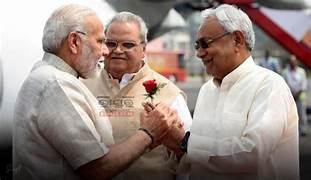
Prime Minister Narendra Modi has made several policy changes during his tenure, some of which have been viewed as “U-turns” in response to public opinion, political pressure, or practical challenges.
The Modi government tried to amend the Right to Fair Compensation and Transparency in Land Acquisition, Rehabilitation, and Resettlement Act of 2013 to make land acquisition easier for industries and infrastructure projects. However, this move faced stiff opposition from farmers’ groups, civil society, and political parties. After widespread protests and a lack of consensus, the government withdrew the amendments.
In September 2020, the government introduced three agricultural laws aimed at reforming the agricultural sector by promoting private market participation. However, these laws sparked massive protests from farmers, particularly in Punjab, Haryana, and Uttar Pradesh. Despite initial resistance, the government repealed these laws in November 2021 due to sustained protests and pressure from farmer unions and political opponents.
The government faced criticism over rising fuel prices amid the global surge in crude oil prices. Despite its initial stand that fuel prices should be market-driven, the government later reduced excise duties on petrol and diesel in November 2021 and May 2022, easing the burden on consumers.
GST was implemented in 2017, it initially included higher tax slabs for several essential goods, such as sanitary napkins and certain food items. After facing backlash from the public and political opposition, the government revised GST rates, reducing taxes on many of these essential goods.
U-Turns of Narendra Modi under the state of funk and fear-psychosis – Nitish Kumar, the kind of U-turns.
Initially, the BJP and Nitish Kumar’s Janata Dal United shared a complicated relationship. Nitish Kumar was initially an ally of the BJP but broke ties in 2013, primarily due to differences over Narendra Modi’s leadership and the BJP’s ideological direction.
However, in 2017, Nitish Kumar made a significant political U-turn by severing his alliance with Lalu Prasad Yadav’s Rastriya Janata Dal and rejoining forces with the BJP to form the government in Bihar. It was seen as a strategic move for Nitish to maintain power, especially given the increasing corruption allegations against the RJD.
Amit Shah’s earlier statement declaring “no place for Nitish Kumar in the BJP” may have been reflective of the BJP’s reluctance to embrace Nitish at that time due to the strained history.
However, the BJP later decided to support Nitish’s return to the coalition, as it recognized the need to strengthen its presence in Bihar, where Nitish Kumar still wielded significant influence.
This change, therefore indicates that the BJP was willing to accommodate Nitish when it suited their political agenda, particularly when the coalition would ensure stability in Bihar and fortify the BJP’s influence ahead of upcoming elections.
Politics, particularly in a diverse country like India, often necessitates compromise. The U-turn was more about pragmatism and political gain for the BJP, aiming to consolidate power and mitigate challenges in Bihar.
Hence, Modi and the BJP chose to align with Nitish Kumar when it became clear that his partnership could serve their longer-term electoral and governance objectives.
U-Turns of Narendra Modi under the state of funk and fear-psychosis – The Waqf Board Amendment Bill
The Waqf Amendment Bill, 2024, was referred to a Joint Parliamentary Committee for extensive scrutiny after opposition uproar in Parliament. The bill aims to alter the composition of the Central Waqf Council and state Waqf boards, ensuring representation of Muslim women and non-Muslims.
It seeks to clarify the definition of Waqf property, streamline registration processes, and address inheritance rights for women. The referral to the committee allows for a broader discussion and input from various stakeholders
The key features of the Waqf Board Bill, 2024, are:
1. Broad-based Composition: It aims to alter the Central Waqf Council and state Waqf boards to include Muslim women and non-Muslims.
2. Omission of Section 40: Proposes removing the section that gave Waqf boards the power to determine if a property is Waqf.
3. Representation: Includes Shias, Sunnis, Bohras, Agakhanis, and other Muslim communities.
4. Central Portal for Registration: Introduces a central database for Waqf properties and streamlines the registration and mutation process.
The Muslim community’s reservations about the Waqf Board Bill include concerns that it may interfere with the autonomy of Waqf properties and religious freedom. Opposition members have labelled it as unconstitutional and an attack on federalism.
There are apprehensions about the government’s involvement in Waqf-related matters, especially regarding changes to the composition of Waqf boards and the omission of certain powers previously held by the boards, which could impact how Waqf properties are managed
U-Turns of Narendra Modi under the state of funk and fear-psychosis – The Broadcasting Services (Regulation) Bill 2024
The Broadcasting Services (Regulation) Bill 2024, was withdrawn by the Indian government due to significant concerns raised by online content creators and media representatives. The bill proposed treating content creators similarly to OTT or digital news broadcasters, which faced criticism for potentially restricting freedom of speech and harming the economic viability of independent creators.
The Broadcasting Services (Regulation) Bill 2024 aims at:
1. Encompass TV, radio, and digital media under one regulatory framework.
2. Establish guidelines and standards for broadcasting content, including online platforms and content creators.
3. Introduce a licensing system for broadcasters, both traditional and digital.
4. Propose the establishment of a regulatory body to monitor and enforce compliance.
5. Implement penalties for content violations and non-compliance.
Following the controversy, the government indicated its willingness to review the bill’s clauses in light of the feedback received. Critics argued that this would infringe on freedom of speech and the economic viability of independent creators.
Opposition parties labelled the bill as a threat to media independence, leading to its withdrawal and the government’s willingness to review its clauses in response to the backlash
U-Turns of Narendra Modi under the state of funk and fear-psychosis – The Demonetization Impact
Although not a direct U-turn, the aftermath of the 2016 demonetization led to significant adjustments in banking and financial policies to handle cash shortages and economic fallout. The government introduced various measures to alleviate public hardship and modified rules to facilitate cash flow, which indicated a reactive shift from its initial strong stance.
U-Turns of Narendra Modi under the state of funk and fear-psychosis – Privatization of Public Sector Units (PSUs)
The government announced a large-scale privatization of PSUs, but several times, it has had to delay or reconsider its plans due to political backlash and labour union opposition. For example, the privatization of Bharat Petroleum Corporation Limited (BPCL) and other entities faced delays, showing an adjustment from the initial plan.
U-Turns of Narendra Modi under the state of funk and fear-psychosis – Hasty Announcement – The Unified Pension Scheme (UPS)
The Unified Pension Scheme (UPS) introduces several monetary benefits designed to provide better financial security for a wider range of beneficiaries, particularly those in the informal sector, low-income groups, and women. While specific monetary details can vary based on regional implementations and updates at the national level, the new scheme generally includes the following enhancements:
The new scheme often proposes a higher minimum pension amount than previous pension plans. For example, some variations of the scheme may offer a monthly pension ranging from ₹1,000 to ₹3,000, depending on factors such as the beneficiary’s age and contributions, to ensure a more substantial financial cushion during retirement.
Under the new scheme, the government may match the contributions made by the beneficiaries, especially for economically weaker sections. This contribution might range from 50% to 100% of what the beneficiary contributes, up to a specified limit, significantly enhancing the pension corpus over time.
In certain cases, the scheme provides additional government contributions or subsidies for women beneficiaries to promote their financial independence and security in old age.
The UPS offers flexibility in contribution amounts, allowing beneficiaries to choose how much they wish to contribute based on their income and financial capability. This flexibility is particularly beneficial for those in the informal sector or with fluctuating incomes.
To encourage broader participation, the scheme typically has low minimum contribution requirements. For instance, some variations might allow contributions starting as low as ₹100 per month, making the scheme accessible to individuals from lower-income groups.
After reaching the specified age (usually 60), beneficiaries are eligible to receive a guaranteed monthly pension. The amount depends on the total contributions made and the government’s matching contributions. This guaranteed pension ensures a steady income stream for the beneficiary’s lifetime.
If a beneficiary wishes to exit the scheme prematurely or if the beneficiary passes away, the scheme may offer a lump-sum withdrawal of the accumulated corpus (contributed amount plus interest), which can be passed on to the nominee.
The scheme allows for partial withdrawals in specific circumstances, such as health emergencies, education, or housing needs. This provision provides financial flexibility and emergency support, which was not as readily available in previous pension schemes.
The contributions in the unified pension scheme may accrue interest, ensuring that the funds grow over time. Depending on the scheme’s investment policies, the interest rates could vary but generally aim to provide a reasonable return on investment.
If the scheme includes market-linked investment options (similar to the National Pension System), the corpus could benefit from potential market growth, resulting in a higher pension payout upon maturity.
Some versions of the scheme may offer special incentives for those who enrol early or start contributing at a younger age. For example, the government might provide a one-time bonus contribution or a higher matching rate for early enrolees.
In some implementations, the scheme includes built-in life insurance and disability benefits. For instance, in the event of the beneficiary’s death before the pension commencement age, the accumulated amount could be paid to the nominee along with an additional insurance benefit, offering extra financial security for the beneficiary’s family.
Recently, there has been growing demand from various sections of government employees and political parties for the restoration of the OPS. The government, facing pressure, has hinted at reviewing NPS to possibly include elements of the OPS, indicating a strategic move to balance fiscal prudence with political and social demands.
U-Turns of Narendra Modi under the state of funk and fear-psychosis – The Conclusion
The hurried U-turns have been for political reasons, particularly as elections for the States of Haryana, Jammu & Kashmir, Maharashtra and Jharkhand approach.
These examples illustrate instances where the government has adjusted its policies, often described as U-turns by opposition parties, in response to public or political pressure.
Prime Minister Narendra Modi and his government have shown signs of rethinking on several major policy matters, including the caste-based census and pension schemes.
This rethink can be seen as a strategic response to the demands of social justice and the desire to gain electoral support among backward and marginalized communities. While there has been no official U-turn on the central government conducting a caste census yet, the openness to discussing the issue signals a significant change in tone.
Narendra Modi though had hesitance to go for restoring the old pension scheme, has taken a U-turn in hurriedly announcing the new pension in the name of Unified Pension Scheme due to political compulsions and growing charisma of Rahul Gandhi.
Pension reforms and welfare schemes are popular measures to attract voters, particularly the elderly, farmers, and those in the informal economy. By positioning such a scheme, the government might aim to secure support from these key demographics.
With growing economic uncertainties, inflation, and post-pandemic recovery challenges, there has been increasing demand for stronger social security measures. A unified pension scheme could provide a sense of financial security to a larger section of the population.
Some state governments have been proactive in announcing their pension schemes, creating pressure on the central government to respond with a comprehensive national strategy to avoid being seen as lagging in welfare provisions.
Global trends toward social security and pension reforms may have influenced the central government’s move to announce a unified pension system. Being seen as adopting best practices can enhance the government’s image on both national and international platforms.
There may have been a growing dissatisfaction with existing fragmented and often underfunded pension schemes. Announcing a unified scheme could be a quick way to address this dissatisfaction and showcase the government’s commitment to social welfare.
The hurried nature of the announcement might reflect a strategic response to political, economic, and social pressures rather than a fully fleshed-out plan, necessitating further details and implementation strategies in the future.