
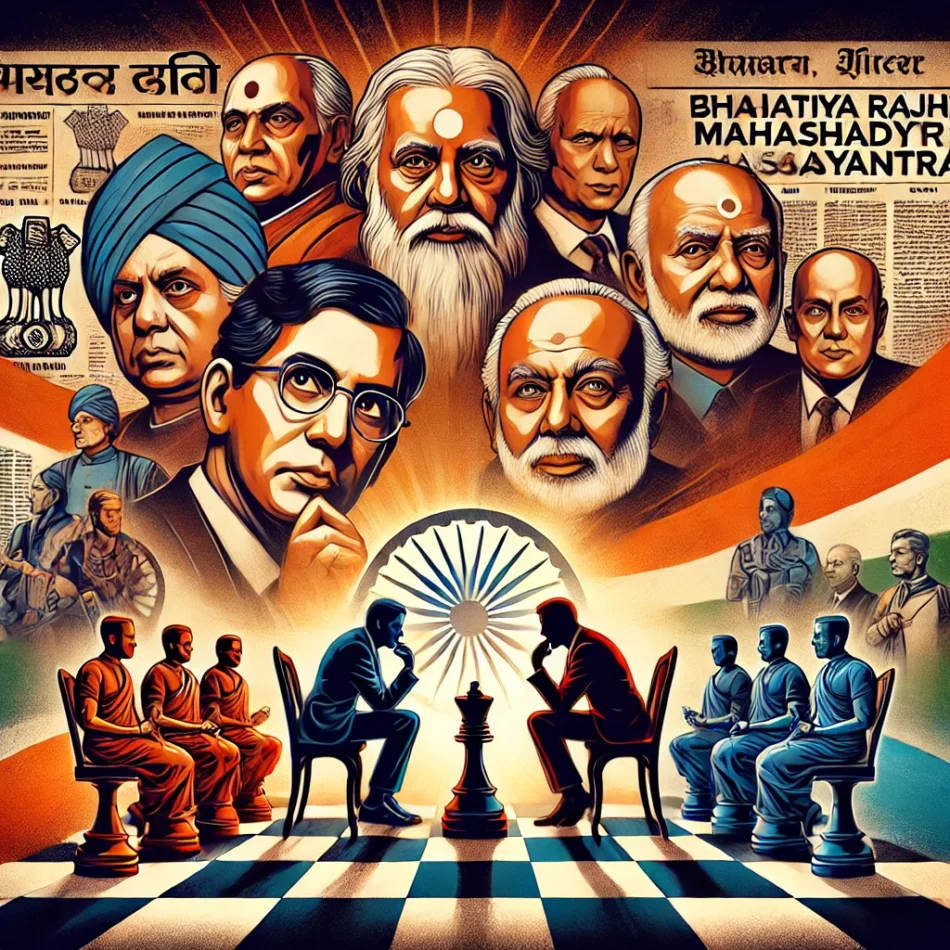
India’s Great Political Conspiracy of the era – revenge, avenge and the game of vengeance – an all-in-one drama. Amit Shah was jailed on Sohrabuddin case and Narendra Modi was heckled in Gujrat riots in 2002 by UPA government under Sonia Gandhi. To avenge and to revenge both Amit Shah and Narendra Modi hatched a great conspiracy to bring down the UPA government and install a BJP government to dismantle the citadels of the Congress Party. The Anna Hazare agitation, the 2G spectrum imbroglio, the Commonwealth Games Corruption case etc. and the happenings of Delhi, shifting of Shah to UP, the coronation of Narendra Modi by his gimmicks, maverick speeches and the behind the scene planning of Amit Shah etc. could be considered as the World’s Greatest Political Conspiracy of the Era.
The BJP’s rise from the ashes of the Gujarat riots (2002) to the overwhelming 2014 Lok Sabha victory is one of modern India’s the most conspired political events. It involved not just Modi and Shah’s planning but also the systemic failures of the Congress-led UPA government, anti-incumbency, and the shifting role of media, judiciary, and corporate support.
The BJP’s War Room Strategy and the emergence of Amit Shah and Narendra Modi in Delhi
Amit Shah – A Midas Touch to Indian Politics sprouted his political life in 1983 with Akhil Bhartiya Vidyarthi Parishad. Shah made a debut in BJP in 1987. He actively participated in Bhartiya Janata Yuva Morcha. His rise was meteoric and a Midas touch to Indian politics and Iron Leg to BJP. In Bhartiya Jana Yuva Morcha, Shah held different posts like Ward Secretary, Taluka Secretary, State Secretary, Vice-President and General Secretary.
Narendra Modi joined BJP in 1988. The duo of Amit Shah and Narendra Modi would rewrite the political history of Gujarat and India. In 1991, Shah was made the election campaign manager for Lal Krishna Advani in Gandhinagar for Lok Sabha elections. Keshu Bhai Patel dawned a first BJP government in Gujarat in1995 as Chief Minister.
Amit Shah along with Narendra Modi vowed to eliminate the Congress Party from the rural areas of Gujarat. The duo had sailed together since then. They searched second-most influential leaders in every village and brain washed them to embrace BJP. Modi and Shah had the same bio-chemistry to decipher Congress hold over the Co-operatives bodies in the State. In 1999, Shah was installed the President of the Ahmedabad District Cooperative Bank.
The next target of the duo was to decimate the Congress from the sports bodies in the state. Shah became the President of the Gujarat State Chess Association. In 2009, he was the Vice-President of the Gujarat Cricket Association, while Modi was as its President. When Narendra Modi was State BJP General Secretary, Modi succeeded to anoint Shah as the Chairman of the Gujarat State Financial Corporation. In 1997, with Modi’s efforts Amit Shah got a BJP ticket for the Gujarat Legislative Assembly by-election in Sarkhej. Shah won and became an MLA. He retained his seat in the 1998 Assembly elections.
In 2001, Narendra Modi was installed as the Chief Minister of Gujarat. Since then, it was a nightmare to their political opponents. Shah’s steep rise was un stoppable since then. He won all the elections that he contested. Under Narendra Modi, Shah was adorned with a number of Ministries from Home, Law and Justice, Prison, Border Security, Civil Defence, Excise, Transport, Prohibition, Home Guards, Gram Rakshak Dal, Police Housing and Legislative and Parliamentary Affairs etc. As State Home Minister Shah introduced the Gujarat Control of Organised Crime (Amendment) Bill in the Gujarat State Assembly. Shah made a pivotal role to pass the Gujarat Freedom of Religion Bill, against religious conversions in the state of Gujarat.
India’s Great Political Conspiracy of the era – revenge, avenge and the game of vengeance – an all-in-one drama – Sohrabuddin Encounter and the Snoop gate
In July 2010, the Central Bureau of Investigations filed a charge sheet against Shah in the Sohrabuddin fake encounter case. He was arrested and placed in detention for several months. It was alleged that Shah as Home Minister of the Gujarat State had ordered the phone tapping of a young woman as she moved around Gujarat and even Bangaluru. Sohrabuddin Encounter and Snoopgate cases were tumbled when the Narendra Modi became Prime Minister. In September 2012, the Supreme Court granted bail to Shah in the Sohrabuddin case.
Shah was accused of sidelining the police officers who testified against the Gujarat government in cases related to the fake encounters and the 2002 riots. Shah was accused of manipulating the electoral constituency delimitation exercise in Gujarat to favour the BJP. When these duo’s grit concretised a lot, many Gujrat leaders opposed to their roles in the party. The leadership moved Modi to the BJP headquarters in Delhi.
Shah was appointed as a BJP General Secretary and given charge of Uttar Pradesh by Rajnath Singh on 12 June 2013. Shah spent considerable time in Uttar Pradesh to understand the reasons for the Samajwadi Party’s victory in the 2012 UP Assembly elections. The following months also saw the BJP register handsome electoral victories in Maharashtra, Haryana, Jharkhand and Jammu and Kashmir.
Shah was behind to revamp BJP using diversified tools and techniques to instil a militia like force in the BJP to achieve its agenda. Shah used a concept of Panna Pramukh which helped to strengthen the party cadre from grass root level. Shah worked upon winning spree and his efforts brought laurels to the party. The BJP won 18 seats in West Bengal in the 2019 Lok Sabha. It was a historic. The BJP won Tripura and the entire Northeast became a BJP stronghold. Under Shah’s stewardship BJP bagged Maharashtra and Jharkhand in 2015. In 2017 Uttar Pradesh, Uttarakhand and Himachal Pradesh fell to BJP.
Amit Shah was arrogant and dictatorial was clear in the BJP as the cadre between the Party and volunteers was dismantled by him. He did not listen but commands were given. This attitude was contributed to the defeats of Bihar and Delhi. He learnt not to relent and rebuild the party in his second term. Of course, he had some in built faculties like unmatched political strategy, organisational skills and election management capabilities developed during his political career. With these traits, he could make the party as the largest political party of the world.
Narendra Modi assured himself that the Party was in safe hands, while he minded the governance of the country. But Amit Shah was insatiate in his hunger for dominance when he declared he would make the country free from the Congress for next many decades while Narendra Modi dreamt realms in the sky, notwithstanding the bare truth that India is a democracy which will rely on the mercy of the people. They have been in trance but people would trounce them at any moment. After 2019’s big win, Shah was made Home Minister. Shah’s landmark decisions were scrapping of Article 370, the Citizenship (Amendment) Act, the RTI (Amendment) Act and the Triple Talaq law. He made all these landmark laws sail through the Rajya Sabha despite the BJP-NDA having no clear majority in the Upper House.
The Muzaffarnagar riots in September 2013 were one of the most violent communal clashes in Uttar Pradesh (UP) in recent history. The violence broke out between Hindus (mostly Jats) and Muslims in Muzaffarnagar and surrounding districts in Western UP. The immediate trigger was an alleged incident of sexual harassment of a Hindu Jat girl by a Muslim youth, leading to violent retaliations. However, the underlying causes were deep-rooted socio-political tensions and polarizing tendencies.
The Jat community, traditionally a mix of Rashtriya Lok Dal and BJP supporters, saw a slant towards the BJP due to their perception that the Samajwadi Party (SP) led by Akhilesh Yadav had mishandled the crisis and was favouring Muslims. Many non-Yadav OBCs and upper-caste Hindus also attracted towards the BJP as the Hindu-Muslim divide deepened. Historically, Jats and Muslims had been allies in UP’s rural politics, particularly under Charan Singh’s RLD. The riots permanently damaged this alliance, pushing Jats towards Hindutva politics. The RLD lost its traditional Jat vote bank, benefiting the BJP.
Narendra Modi’s campaign in 2014 capitalized on Hindu consolidation, with strong support in Western UP. The BJP won 71 out of 80 Lok Sabha seats in UP, completely sidelining the SP, BSP, and Congress. The 2017 UP Assembly elections saw a similar pattern, with the BJP winning 312 out of 403 seats, further cementing Hindu vote consolidation. The Jat-Muslim division from the Muzaffarnagar riots has continued to shape UP politics, with Hindutva replacing caste-based alliances as the dominant electoral strategy.
The 2013 Muzaffarnagar riots were not just a communal flashpoint but a turning point in Uttar Pradesh’s political history. They played a crucial role in eroding traditional caste-based politics and fostering a pan-Hindu identity that significantly helped the BJP’s electoral success in UP from 2014 onwards.
India’s Great Political Conspiracy of the era – revenge, avenge and the game of vengeance – an all-in-one drama – The Rise of Narendra Modi as PM Candidate
Narendra Modi’s rise as the Prime Ministerial candidate in 2014 was a result of a combination of factors, including his governance record in Gujarat, his strong leadership persona, and the internal dynamics within the BJP and the RSS.
Modi became Chief Minister of Gujarat in 2001, initially replacing Keshubhai Patel. Under his leadership, Gujarat saw rapid economic growth, industrial development, and infrastructure expansion. The 2002 Gujarat riots created a strong polarization—while his critics accused him of mishandling the situation, his supporters saw him as a decisive leader. Modi successfully projected the “Vibrant Gujarat” model, attracting investment and creating a pro-business image.
By 2013, the BJP was struggling to challenge the Congress-led UPA government, which was facing anti-incumbency due to corruption scandals (like 2G scam, CWG scam, and Coalgate). Modi had strong backing from the RSS and a section of the BJP, especially younger leaders and the cadre who wanted a fresh face. Senior BJP leaders like L.K. Advani and Sushma Swaraj were initially reluctant, preferring a more consensus-based leadership.
The Rashtriya Swayamsevak Sangh (RSS) played a major role in pushing for Modi, seeing him as a strong Hindutva leader who could galvanize voters. Modi’s “Hindutva plus Development” approach made him appealing to both the core Hindutva voter base and the middle class looking for economic growth.
Modi emerged as a national leader through aggressive social media and public outreach. His “Chai Pe Charcha” campaign and mass rallies created direct voter engagement. The BJP, under Amit Shah’s strategy, used data-driven election campaigning, especially targeting youth and first-time voters. On June 9, 2013, in Goa, the BJP officially appointed Modi as the chairman of the election campaign committee. This was seen as the first step toward making him the PM candidate.
L.K. Advani resigned from key BJP posts in protest, signalling internal resistance. Despite opposition from some senior leaders, the BJP officially declared Narendra Modi as its Prime Ministerial candidate for the 2014 Lok Sabha elections. Advani and some senior leaders reluctantly accepted the decision after persuasion from the RSS. Modi ran an aggressive “Abki Baar, Modi Sarkar” campaign, attacking the Congress for corruption and weak leadership. His campaign focused on economic growth, nationalism, and strong governance. The BJP secured a historic victory with 282 seats, becoming the first party since 1984 to win a majority on its own. Modi took oath as India’s 14th Prime Minister on May 26, 2014.
Modi’s rise as the PM candidate was a mix of his governance record, political manoeuvrings, RSS support, and public sentiment against the Congress. His 2014 campaign revolutionized Indian electioneering, setting the stage for a new era in Indian politics. Modi’s aggressive speeches, his social media strategy, and Amit Shah’s backroom operations positioned him as the ‘messiah of development.’ The corporate sector openly shifted its backing, as Modi was seen as the solution to economic stagnation.
India’s Great Political Conspiracy of the era – revenge, avenge and the game of vengeance – an all-in-one drama- The Conspiracy succeeds
A highly coordinated media campaign, funded heavily by corporate interests, painted Modi as the future. BJP’s social media teams outperformed the Congress, making Modi’s vision of ‘Achhe Din’ go viral. Rahul Gandhi’s lacklustre performance, Sonia Gandhi’s declining influence, and the failure to counter Modi’s rhetoric sealed UPA’s fate.
The CBI, ED, and judiciary came under immense pressure, with various Congress leaders facing investigations. Corporate-Backed Funding and BJP’s unprecedented spending, electoral bonds and funding from industrial giants ensured BJP’s financial supremacy. If one views this entire sequence as a pre-planned, grand conspiracy, revenge, avenge and the game of vengeance an all-in-one drama.
India’s Great Political Conspiracy of the era – revenge, avenge and the game of vengeance – an all-in-one drama- The Conclusion
However, it was opined that Modi and Shah were political masterminds, but not necessarily conspirators—they capitalized on opportunities at the cost of the Congress. The Congress failed to adapt to changing electoral dynamics. Whether this was the “World’s Greatest Conspiracy” or a masterclass in political strategy depends on interpretation. The BJP’s rise was undoubtedly a mix of Systematic dismantling through corruption scandals, judicial interventions, and media pressure. Hindutva groups built a grassroots-level campaign for Modi. The Congress was taken aback by the emergence of the duo Amit Shah and Narendra Modi. It was a nightmare to Regional Parties and the dismemberment of the regional leaders.
Good article