
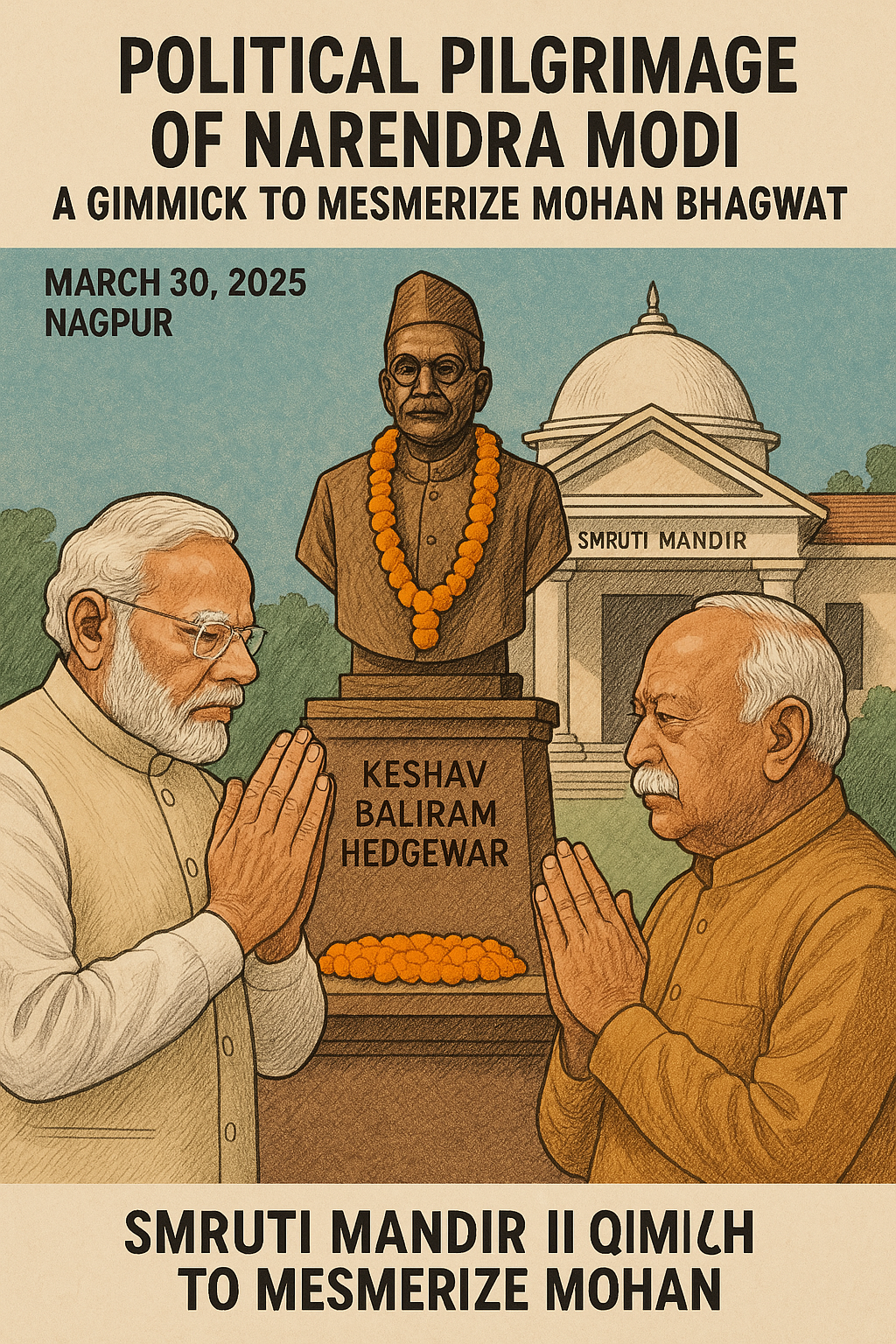
Political pilgrimage of Narendra Modi: A gimmick to mesmerize Mohan Bhagwat. Narendra Modi’s visit to Nagpur on March 30, 2025, to pay homage to Keshav Baliram Hedgewar, the founder of the Rashtriya Swayamsevak Sangh (RSS), alongside RSS chief Mohan Bhagwat, carries significant political, ideological, and symbolic significance. The visit, the first, a sitting a Prime Minister ever visited the RSS headquarters at Smruti Mandir. It a strategic outreach, cultural affirmation, and a reconfirmation of ties between the Bharatiya Janata Party (BJP) and its parent body, the RSS. The visit could be slated to be a political pilgrimage of Narendra Modi: A gimmick to mesmerize Mohan Bhagwat.
The Waqf (Amendment) Bill, passed by Parliament on April 4, 2025, is a satisfying moment and Modi’s gift to RSS. Modi called it as a “watershed moment” for transparency and socio-economic justice, targeting mismanagement in Waqf properties—India’s third-largest landholder with 870,000 properties spanning 940,000 acres. Critics, including the Congress and AIMIM, decry it as an assault on Muslim autonomy, violating constitutional rights under Articles 14, 25, and 26. The bill’s provisions—mandating non-Muslim and women members on Waqf boards, centralizing registration, and scrapping the 1923 Mussalman Wakf Act—signal a vengeful intervention into a historically independent institution.
In the name homage, Modi neutralises the percept of the RSS
The visit comes at a time when the relationship between the BJP and RSS has been under strain, particularly after the 2024 Lok Sabha elections, where the BJP fell short of a majority (240 seats) and relied on crutches. Tensions had surfaced, with RSS chief Mohan Bhagwat unhappy with the BJP’s leadership style, notably Modi’s perceived “personality cult” and comments about his “non-biological” origins. Modi’s presence at Smruti Mandir, sharing a stage with Bhagwat, signals an effort to mend fences and reaffirm unity. The casual interaction between the two leaders, as noted by observers, underscores a public display of harmony, dismissing narratives of a rift.
The timing aligns with the RSS’s 100th anniversary, a milestone year for the organization founded in 1925. Modi’s visit serves as a nod to the RSS’s historical role in shaping India’s nationalist discourse and its influence on the BJP. By honouring Hedgewar and M.S. Golwalkar, the second RSS chief, Modi reinforces the ideological continuity between the Sangh’s vision and his government’s policies, framing the RSS as a “modern akshay vat vriksh” (eternal banyan tree) of India’s culture, as he stated during the event – showcasing centenary celebration of RSS Modi overpowers Mohan Bhagwat.
The visit coincides with the BJP’s preparations to elect a new national president, expected in April 2025, following J.P. Nadda’s extended term. The RSS has historically played a pivotal role in such decisions, and Modi’s engagement with Bhagwat in Nagpur suggests consultations on aligning the party’s leadership with the Sangh’s expectations. This move could ensure the BJP remains rooted in its ideological base while floating with future electoral challenges, including Bihar and Uttar Pradesh polls and the 2029 general elections a political messaging ahead of leadership transition.
Beyond the RSS tribute, Modi’s itinerary included paying respects to B.R. Ambedkar at Deekshabhoomi, where Ambedkar embraced Buddhism in 1956. This dual homage—to Hedgewar and Ambedkar—projects a broader narrative of inclusivity, blending Hindu nationalism with social justice. It also counters opposition criticism that the BJP-RSS combine neglects marginalized communities, positioning Modi as a leader bridging diverse legacies – a cultural and social outreach.
During the visit, Modi laid the foundation stone for the Madhav Netralaya Premium Centre, a 250-bed eye hospital tied to the RSS’s service ethos. He praised the RSS as a “synonym of service,” linking its volunteerism to his government’s development agenda. This reinforces the Sangh’s role in nation-building beyond politics – to imply a service and development agenda.
Modi’s visit elicits the organization’s status in India’s political mainstream. His handwritten note at Smruti Mandir, calling it a “sacred place” inspiring national service, and his description of Hedgewar and Golwalkar as “strong pillars” energizing millions of swayamsevaks, affirms the personal and ideological bond he shares with the RSS, rooted in his own past as a pracharak (campaigner) – a historic symbolism.
Modi’s visit, while outwardly a tribute to the RSS’s centenary and its founders, could be interpreted as a masterstroke to redefine his relationship with the Sangh. By stepping into the RSS heartland as Prime Minister—unprecedented for a sitting PM—he positions himself not just as a product of the RSS but as a leader who resurrects it – a subtle assertion of autonomy.
Modi’s firm governance style—emphasizing “Sabka Saath, Sabka Vikas” (Together with All, Development for All)—hints at a departure from the RSS’s traditional uniformity-driven philosophy – Hindutva. By paying obeisance Modi impressing upon the RSS a “live and let live” ethos—urging it to adapt to a pluralistic India where ideological purity takes a backseat to mutual coexistence. By doing so, he impresses the RSS toward a softer, more accommodative image that fits with his political persona, all while keeping its core cadre mobilized for his political ends – a clear message to the RSS to yield to the times.
Post-2024 elections, the BJP’s dependence on coalition partners exposed vulnerabilities, and RSS critiques of Modi’s centralized style. The visit serves as a reminder of this adage- live and let live. Modi might be signalling to the RSS that internal discord weakens their shared goals. By aligning publicly with Bhagwat, he reinforces unity, but on his terms. The hidden agenda here could be to neutralize dissent within the Sangh Parivar, ensuring the RSS remains a loyal force multiplier rather than a rival power centre checking his authority.
Modi has undeniably been a propagator of RSS ideals—cultural nationalism, discipline, and Hindutva—but he has redefined them into a Modiocracy. His visit underscores this duality – he honours the RSS’s roots while claiming ownership of its ideology’s modern evolution. The “Viksit Bharat” vision he tied to the RSS’s service ethos during the Madhav Netralaya launch. This suggests he is not just executing RSS directives but reshaping them to fit his legacy, reducing the Sangh to a foundational entity while he holds the reins of its practical application – propagating RSS Ideology, yet owning its narrative – a rare quality of Modi.
Political pilgrimage of Narendra Modi: A gimmick to mesmerize Mohan Bhagwat – Pre-empt RSS Influence.
With the BJP presidency transition looming in April 2025, Modi’s engagement with Bhagwat in Nagpur could be a pre-emptive strike. The RSS traditionally influences such decisions, but Modi’s high-profile visit—doubled with his stature as the party’s grand leader—might aim to limit the Sangh’s indulgence. By projecting unity and paying homage, he ensures the RSS feels respected, yet his grandeur presence clearly asserts that the BJP’s direction, including its next president, will align with his vision, not just the Sangh’s – a strategic alliance.
Long-Term Play for Legacy: Modi is a great strategist
Every Modi move is strategically and calculatedly laid. It was the move of the ultimate swayamsevak-turned-national politician’s move. The hidden agenda might be to outgrow the RSS’s shadow. By imprinting “live and let live” and unity tactic, he is bridging an impression where he is not just an RSS disciple but a reformed figure who diversified its mission for a 21st-century India—potentially positioning himself above the organization in the pages of Hindutva.
Modi’s Masterful Humility
Modi’s act—bowing to Hedgewar’s legacy, sharing a stage with Bhagwat, and scribbling reverent words at Smruti Mandir—could indeed have mollified the RSS leadership. His submissiveness, whether genuine or dramatic, goes with the Sangh’s ethos of discipline and selflessness, yet it is blended with the sharpness of a mesmerised politician. Bhagwat, in these imagined inner dialogues of “you at the helm, I am at ease,” might see Modi’s gestures as a reassurance that the RSS’s ideological prodigy has not moved away too far. This satisfaction could stem from Modi’s ability to display his dominance with a deference, a move that resonates with the RSS’s pride while keeping him firmly in control.
A Green Signal for BJP Presidentship
If Bhagwat and the RSS were indeed “mesmerized” by Modi’s outreach, the visit might have doubled as a negotiation. Bhagwat effectively believed to have been said, “Go ahead, pick the BJP president as per your wish. Post-2024 election tensions had hinted at RSS displeasure with Modi’s centralized style, and the Sangh’s influence over the BJP presidency (due in April 2025) was a potential flashpoint. Modi’s Nagpur pilgrimage, framed as a homecoming, might have convinced Bhagwat to step back, trusting Modi to select a president—perhaps a loyalist like a Vinod Tawde or a Sunil Bansal or K.Annamalai (to equate the youthfulness of Rahul Gandhi)—who balances party dynamics without challenging Modi’s supremacy.
The RSS’s Price assured: Cadre Presence in Governance:
The RSS expecting a “perceptible presence of its cadres in government positions” is a critical opening. While Modi gains autonomy in party affairs, the Sangh secures a quid pro quo—ensuring its swayamsevaks remain embedded in key bureaucratic, advisory, and policy roles. This could mean more RSS-aligned figures in ministries, think tanks like NITI Aayog, or even cultural bodies like the ICCR. It is a compromise where Modi gets operational freedom, but the RSS retains its ideological footprint, ensuring its perceptible presence in governance without direct interference. Bhagwat’s ease might hinge on this assurance: Modi can steer the ship, but the crew reflects Sangh values.
A Pact for Mutual advantage:
The RSS pledging to “ensure your success and continuance at the helm” suggests a strategic alliance reborn. After the 2024 electoral setback, where RSS grassroots mobilization was reportedly lackluster, Modi’s visit could be the restart key. By alluring Bhagwat with humility and unity, Modi secures a promise of renewed Sangh support—crucial for state elections of Bihar, West Bengal, Uttar Pradesh etc. (like Maharashtra, Haryana and Delhi in 2025) and the long game toward 2029. The RSS, in turn, bets on Modi as its best bet to mainstream Hindutva, trusting his charisma and governance record to deliver a “Viksit Bharat” that doubles as their triumph.
Bhagwat’s Quiet Confidence -“do whatever you want” sentiment.
Bhagwat’s satisfaction might also reflect a strategic calculation. Modi, at 74 in 2025, remains the BJP’s un-disputed face, but his tenure has a horizon. By stepping back from micromanaging the BJP or government, Bhagwat preserves the RSS’s long-term influence, grooming future leaders within its ranks while letting Modi refine his legacy. The “do whatever you want” sentiment could be less a surrender and more a delegation—Bhagwat at ease knowing the RSS’s foundational role is secure, even as Modi takes the spotlight.
Political pilgrimage of Narendra Modi – A gimmick to mesmerize Mohan Bhagwat – The Hidden agenda remains un affected.
The silent reproachment reveals a fascinating equilibrium. Modi’s gestures—visiting Nagpur, honouring Ambedkar, launching service projects—cast him as a unifier who transcends the RSS while rooting himself in it. The RSS, mesmerized or not, sees value in letting Modi lead, provided its cadres thrive and its ideology endures. It’s a win-win masked as a tribute – Modi gains independence to shape the BJP and government, while the RSS ensures its DNA remains in the system, ready to assert itself when the Modi era eventually fades.
Political pilgrimage of Narendra Modi: A gimmick to mesmerize Mohan Bhagwat – The concluding deliberations
Modi’s visit was not just a ceremonial nod to Hedgewar or a reconciliation with Bhagwat. It was a well calculated manoeuvre to assert dominance while paying tribute, to preach coexistence while wielding control, and to unite the Sangh Parivar under his leadership rather than the RSS’s. The “live and let live” and “united we stand” messages aren’t just platitudes—they’re a quiet challenge to the RSS to evolve with him or risk irrelevance. Modi’s magic lies in masking this agenda as devotion, ensuring the RSS feels honoured even as he charts a path toward greater independence. However, Mohan Bhagwat is silenced.
The Waqf (Amendment) Bill, 2025, with Narendra Modi’s broader political strategy, hinting at a calculated push to cement his ideology and dominance, particularly with the Bihar elections on the horizon.
Modi’s visit on March 30, 2025, was a calculated move to consolidate his leadership within the Sangh Parivar. It reflects a calculated blend of reverence for Hedgewar’s foundational vision and a forward-looking partnership with Bhagwat.
Modi riding the Waqf wave to Bihar and beyond, hell-bent on a legacy of ideological triumph. The RSS, post-Nagpur, seems a willing partner, not a brake. For secularists, it’s a grim horizon—less a battle of ideas than a siege on their turf, with Modi holding the high ground. Whether this depends on Bihar’s voters and the courts, but for now, Modi’s script is resonating in all directions.