
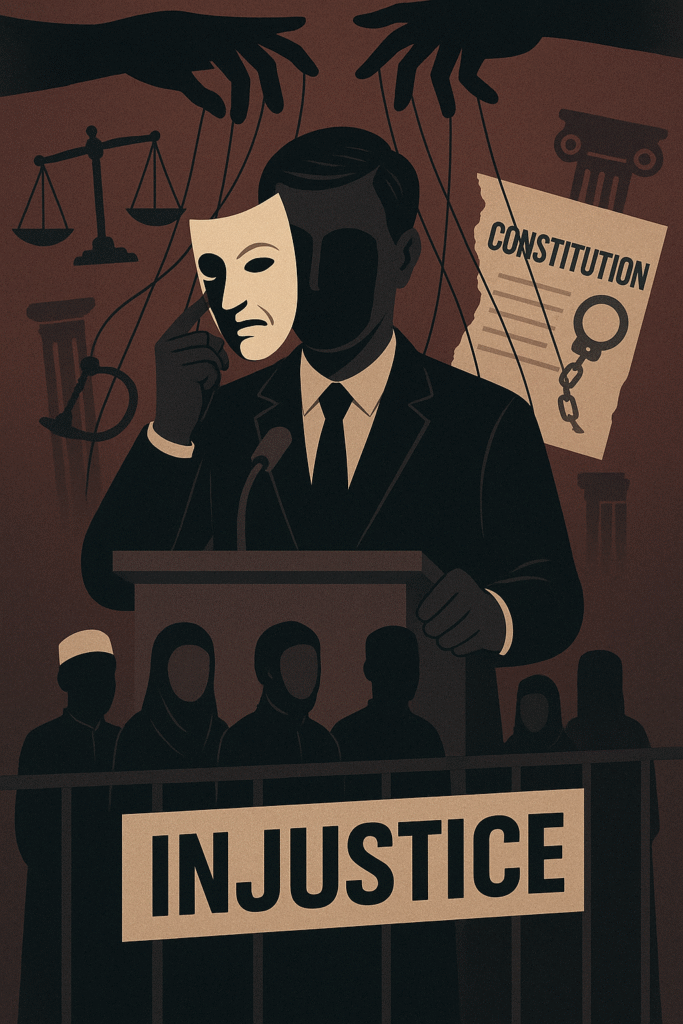
Indian Prime Minister in disguise – His hidden agenda to deprive Muslims of their Constitutional rights and dignity of life. Hindu leaders and religious heads have indeed made inflammatory statements. Yogi Adityanath, Uttar Pradesh’s Chief Minister, has said things like “Muslims did no favour by staying in India” (2020) and, more recently in 2025, “50 Hindus cannot feel safe among 100 Muslim families.” These remarks, are interpreted by critics as invoking anti-Muslim sentiment. Other leaders from Vishwa Hindu Parishad (VHP) and Bajrang Dal have been linked to calls for violence or boycotts against Muslim. T. Raja Singh, a BJP MLA from Telangana, often delivers hate speeches in Maharashtra (2023), urging economic boycott.
Gujarat 2002 under Modi’s regime as Chief Minister saw over 1,000 deaths, mostly Muslims, with allegations of state inaction—exonerated legally, but the imprints remain. Delhi 2020 (53 dead, mostly Muslim) after CAA protests, or Mewat, Haryana 2023 riots (6 dead) after a VHP procession clashed with Muslims in Nuh. Reports—like the Citizens and Lawyers Initiative’s 2023 study—suggest some riots follow a pattern – Hindu processions with provocative slogans (“Jai Shri Ram” as a war cry) sparking violence, often in BJP-ruled states. The recurrence—9 of 32 riots in 2023 tied to Ram Navami processions—raises eyebrows.
Mob lynchings have spiked, especially cow-related vigilantism. IndiaSpend tracked 44 deaths, 280 injuries from 2015-2018, with 86% of victims Muslim. In 2023 alone, 21 lynchings were reported by the Centre for Study of Society and Secularism—all Muslim victims. Cases like Akhlaq (2015) or Pehlu Khan (2017) show a trend- suspicion of beef triggers mobs, often with BJP affiliates later garlanding the accused. Modi condemned some incidents, but critics say his silence outweighs his words.
In Bhavnagar, Gujarat, Hindus have displayed banners barring Muslims from buying property—Reuters caught this in 2014, and it’s persisted informally. During 2023 Ram Navami marches, slogans on boards called for Muslim boycotts or worse—“Pakistan or Qabristan.” It may not be the States’s policy, but it’s public, and it’s intimidating.
Gyanvapi Mosque in Varanasi (2024) saw surveys for Hindu relics after BJP-backed claims it was a temple—Archaeological Survey of India reports confirmed prior Hindu structures, escalating tensions. Sambhal (2024) had similar digs, with clashes killing 4. Allahabad to Prayagraj (2018), Mughal Gardens to Amrit Udyan (2023)—tie to a broader BJP push to erase Mughal legacies, seen by Muslims as cultural eradication.
Modi’s own speeches—like in 2024, linking Congress to Aurangzeb’s “jizya”—cast Mughals as oppressors. Textbooks under BJP rule have trimmed Mughal history, emphasizing Hindu kings instead. Historian Audrey Truschke notes this as a deliberate rewrite to vilify Muslim rule, fuelling present-day division.
Muslims, 14% of India’s 1.4 billion, feel scared. Hate crimes jumped—90% of religious hate crimes from 2009-2019 hit after 2014, per Ballard Brief. Muslims face bias—Juhapura in Ahmedabad, a Muslim habitat, shows even the middle class struggles to buy outside. Demolitions of Muslim homes post-riots (e.g., Madhya Pradesh 2022) and Uttar Pradesh’s 2024 shop-naming rules (blocked by the Supreme Court) add to the suffering. Pew surveys show 64% of Hindus now tie Indian identity to Hinduism—up from decades past—leaving minorities jittery.
Eleven years of Modi rule (2014-2025) have seen BJP’s Hindu nationalist agenda—Ram Temple, CAA, Article 370—amplify these trends. Supporters argue it’s about Hindu pride and security, not oppression; economic growth (GDP up 6-7% annually pre-COVID) benefits all, they say. Critics counter: the data—hate speech up 500% (NDTV, 2014-2018), Muslim MP share at 5% despite 15% population—shows a deliberate attempt.
Indian Prime Minister in disguise – His hidden agenda to deprive Muslims of their Constitutional rights and dignity of life – Attempts to delegate Muslims to the second-class citizens – deprive of their Constitutional rights
Economically, Muslims lag—Sachar Committee (2006) fixed their poverty rate at 31% vs. 19% for Hindus, with lower literacy (59% vs. 65%) and job representation (3% in IAS vs. 14% population share). Post-Modi, updates like the 2021 NFHS show some gains, but Muslims still trail: 17% urban poverty vs. 12% for Hindus. Critics argue Modi’s policies—like cutting minority scholarships (axed in 2022) or neglecting Muslim-heavy slums in schemes like Smart Cities—widen this gap, keeping them dependent.
The BJP fielded zero Muslim candidates in 2024’s Lok Sabha polls (per Election Commission data), a first for a ruling party, while Muslim voter turnout dipped in key states—Uttar Pradesh fell from 61% (2014) to 58% (2024), per CSDS. Laws like the CAA or anti-conversion statutes (e.g., Uttar Pradesh’s 2021 “love jihad” ordinance) do not ban Muslims outright but shrink their cultural space. The Waqf amendments might strip Muslim institutions of autonomy, forcing reliance on state.
Lynchings—63% of hate-crime victims since 2014 were Muslim, per Hate Crime Watcher—enforce a chilling effect. When BJP leaders garland lynchers (e.g., Jayant Sinha in 2018; Bilkis Bano rapists in 2024) and Modi stays mum, it is hard to argue Muslims are not being pushed down. Demolitions of Muslim homes post-riots—like in Madhya Pradesh (2022)—dubbed “bulldozer raj” by Amnesty, are not matched by similar Hindu crackdowns.
The “mangalsutra” jibe (2024) or “shamshan-kabristan” remark (2017)—implying Muslims get undue favour—casts them as parasites on Hindu generosity, though Muslim-specific welfare is negligible post-2014, with minority budgets slashed 38% by 2023 (Ministry of Minority Affairs.
His “Sabka Saath” line pushes back, and BJP points to generic upliftment (e.g., Ujjwala gas for all). But actions—silence on violence, laws curbing Muslim agency, a party ecosystem cheering Hindu supremacy—align with Modi’s silence.
The Arab photo-ops of Modi is a global PR while domestic Muslims get the bad experience. India’s if Modi wants them neutralized and humbled, the trend—economic lag, political erasure, social fear—suggests Modi is on his agenda.
Indian Prime Minister in disguise – His hidden agenda to deprive Muslims of their Constitutional rights and dignity of life – Hindu nationalism via majoritarianism ideology
Modi’s strategy is a long game—strengthening Hindu majoritarianism not just for votes, but to cement a Hindu-centric India that keeps Muslims politically sidelined. Modi’s rise with the BJP, rooted in the RSS’s Hindu nationalist vision. Unlike past Hindu leaders like Vajpayee, Modi leans hard into cultural symbolism. The Ram Temple inauguration in Ayodhya (2024), built on a razed mosque’s site after decades of dispute, nationalist jingoism. He officiated it personally, mixing state and religion in a way Nehru or even Advani never dared. Critics call it a triumph of Hindutva over secularism; supporters see it as reclaiming Hindu pride after centuries of Mughal and colonial rule.
The CAA (2019) excludes Muslim migrants from citizenship perks, subtly framing them as outsiders. The triple talaq ban (2019), sold as women’s rights, was cheered by Hindus but seen by many Muslims as meddling in their personal law—another signal of who defines the nation. Add the abrogation of Article 370 in Kashmir (2019), stripping a Muslim-majority state’s autonomy, have been the moves that flex Hindu dominance while shrinking Muslim leverage and now Waqf Board Amendment Act which is to deprive the Muslim community of their Waqf properties and places of worship but many of the provisions have since been suspended by interim orders of the Supreme Court
Hindus are 80% of India’s 1.4 billion (2021 census est.), Muslims 14-15%. But Muslim population growth outpaces Hindus—16.7% vs. 12.8% decadal increase (2001-2011)—stoking BJP warnings of a demographic “threat.” Modi’s 2024 speeches, like calling Muslims “infiltrators” or hinting at wealth grabs, tap this fear, positioning Hindus as a unified bloc against a future Muslim “power grab.” No prior Hindu leader exhorted this so consistently.
Indian Prime Minister in disguise – His hidden agenda to deprive Muslims of their Constitutional rights and dignity of life – Indian history thrashed
Leaders like Bal Gangadhar Tilak or Madan Mohan Malaviya pushed Hindu identity, but within anti-colonial frames, not state power. Gandhi fused Hindu ethos with inclusivity; Nehru bet on secularism. Modi’s different—he is not just raising sentiments; but institutionalizing them. The BJP’s 400+ seats in parliament (projected post-2024) dwarf past Hindu outfits, and state-level wins amplify this. Laws, temples, and rhetoric are locking in a Hindu superstructure—think Yogi Adityanath’s Uttar Pradesh, where “love jihad” laws and bulldozers keep Muslims on edge. The Muslim political clout is already waning. Post-2014, Muslim MPs in Lok Sabha dropped to 4-5% (vs. 9% in 1980), per PRS data, as BJP sweeps Hindu votes. Modi’s not banning Muslims from power but by galvanizing Hindus, he is making their numbers irrelevant for decades, barring a generation shift.
In 2002, during the Gujarat riots under Modi’s watch as Chief Minister, Bilkis Banu, a pregnant Muslim woman, was gang-raped, and 14 of her family members were killed. In 2022, the Gujarat government—BJP-ruled—released the 11 convicted men after they served 15 years, citing “good behaviour.” This move, approved by the state and upheld by the Supreme Court initially, sparked outrage. Critics, including opposition leaders like Rahul Gandhi, called it a travesty of justice, arguing it signalled impunity for crimes against Muslims. The Supreme Court later reversed the release in January 2024, ordering the men back to prison, but the initial decision fed perceptions of bias. Modi did not comment directly, still, releasing rapists from an infamous anti-Muslim riot—fuel the “atrocities” narrative.
In Gujarat, over 1,000 died, mostly Muslims, and Modi’s alleged inaction (or complicity, per critics) remains contentious. The Supreme Court cleared him in 2012, but distrust lingers—Muslim survivors still recall police inaction. Delhi 2020 saw 53 deaths, again mostly Muslims, after protests against the Citizenship Amendment Act (CAA). BJP leader Kapil Mishra’s inflammatory remarks preceded the violence, yet Modi’s response was a belated call for peace.
Mob lynchings have surged since 2014, often tied to cow vigilantism—a cause dear to Hindu nationalists. Data from IndiaSpend shows 97% of cow-related hate crimes between 2012 and 2017 occurred after Modi’s rise, with Muslims comprising 86% of victims. Cases like Mohammad Akhlaq’s 2015 lynching over beef rumours, or Pehlu Khan’s 2017 killing, highlight this trend. Modi condemned some incidents—like in 2017, saying killing over cows is “unacceptable”—but critics argue his sporadic statements don’t match the scale of violence, and BJP affiliates often garland the accused, suggesting tacit support.
His speeches—like the 2024 campaign references to “maans” (meat), “machili” (fish), “mangalsutra” (Hindu women’s jewelry), and “bhains” (buffalo)—stirred controversy. In Rajasthan, Modi claimed Congress would redistribute wealth to “infiltrators”, even taking Hindu women’s mangalsutra. The rhetoric painted Muslims as threats. Similarly, his digs at opposition eating meat during Hindu festivals or losing buffaloes to Muslims, amplifying Hindu-Muslim divides for votes.
The “digging of mosques, burial grounds, mazhars, dargahs” likely ties to BJP’s push against alleged encroachments. In 2023-2024, states like Uttar Pradesh and Uttarakhand demolished Muslim structures—mosques in Haldwani, shrines in Delhi—claiming illegality. Critics, including Amnesty International, call it “bulldozer justice,” targeting Muslims disproportionately after communal clashes.
Waqf Board amendment Act 2025, aims to overhaul Muslim endowment management, increasing government oversight. Muslim groups see it as an attack on autonomy, fearing land grabs, while the BJP insists it’s about transparency.
Contrast this with Modi’s Arab outreach—hugging UAE’s Sheikh Mohamed, visiting mosques in Abu Dhabi (2024), or getting Saudi honours (2016). It’s strategic diplomacy, securing oil, investments, and counter-terrorism ties is nothing but hypocrisy- embracing Muslims abroad while alienating them at home
Indian Prime Minister in disguise – His hidden agenda to deprive Muslims of their Constitutional rights and dignity of life – Does this add up to religious jingoism and atrocities?
Modi’s defenders say he is a nationalist, not a bigot—policies like CAA or Waqf reforms target governance, not faith, and violence predates him. Critics counter that his silence, BJP’s Hindutva roots, and the data—rising hate crimes, riot deaths, inflammatory rhetoric—paint a leader who stokes division for power. The Bilkis case, lynchings, and demolitions aren’t abstract; they are lived traumas for Muslims. Yet, direct evidence of Modi ordering “atrocities” is thin—much hinges on perception and inference. It is a polarized lens: one side sees a strong Hindu leader; the other, a jingoist eroding secularism.
Modi is a member of the Bharatiya Janata Party (BJP), which is rooted in Hindu nationalist ideology via its parent organization, the Rashtriya Swayamsevak Sangh (RSS). Critics argue this background fuels policies and rhetoric that prioritize Hindu identity, potentially marginalizing minorities, especially Muslims.
Indian Prime Minister in disguise – His hidden agenda to deprive Muslims of their Constitutional rights and dignity of life – The Conclusion
Modi’s “Sabka Saath” nods to it, but the “ghuspaithiye” rhetoric and policies like CAA pull the other way. Muslims 200 million citizens now, yet face 63% of hate speech (per 2022 data) and underrepresentation (4.6% in Lok Sabha vs. 14% population). Welfare schemes reach some—2.37 million Muslim students got scholarships since 2014—but lynchings (over 100 incidents tied to cow vigilantism since 2017, per Human Rights Watch) and demolitions (thousands displaced) hit them hardest. The makers of the Constitution envisioned a pluralist state, not a majoritarian one. Modi’s balancing act—constitutional on paper, divisive in practice—challenges that. Thus, this article professes that Indian Prime Minister in disguise – His hidden agenda to deprive Muslims of their Constitutional rights and dignity of life.