
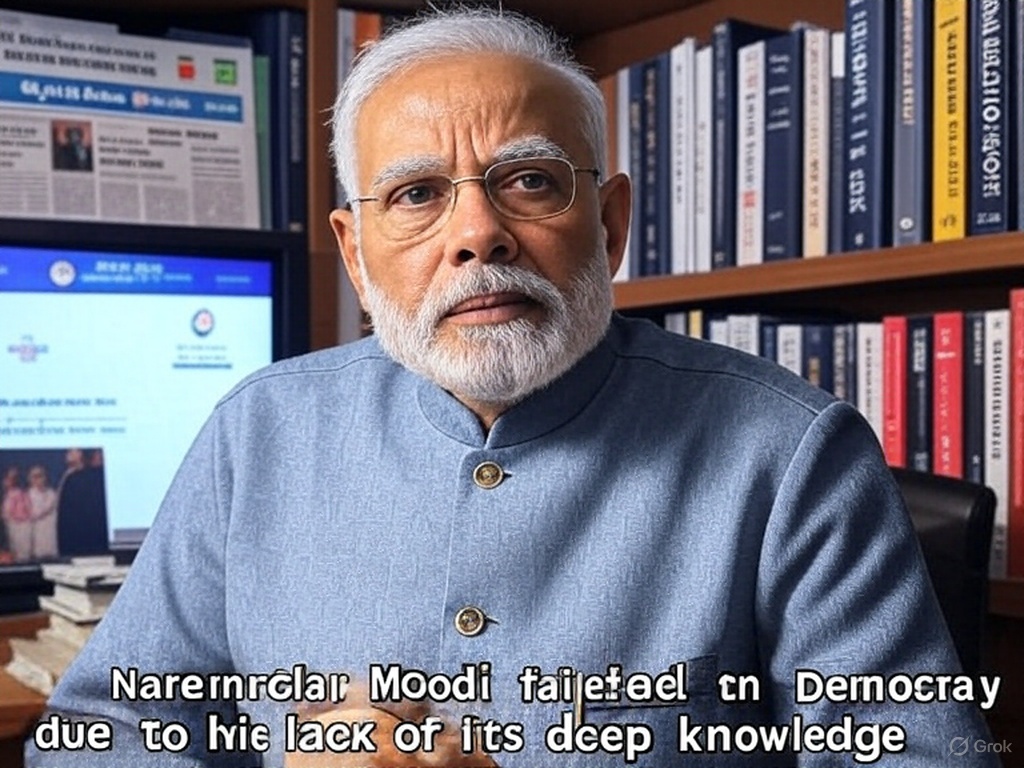
Narendra Modi failed the Indian Democracy due to his lack of its deep knowledge. Narendra Modi’s governance reflects a lack of understanding of democracy due to insufficient academic study. While Modi’s formal education does not include specialized training in democratic theory, his governance approach appears shaped by practical experience, ideological affiliations, and political strategy. Modi holds a bachelor’s degree in political science from Delhi University (via distance learning) and a master’s degree in political science from Gujarat University and these claims are disputed, but there is no evidence of deep academic engagement with democratic theory or governance philosophy.
Modi’s understanding of democracy seems to stem from practical political engagement rather than theoretical study. His leadership reflects a populist, majoritarian approach, emphasizing electoral mandates and national development. Initiatives like Digital India, Make in India, and economic reforms (e.g., GST) are cited as evidence of effective governance.
Modi’s governance shows a limited appreciation for democratic norms like checks and balances, press freedom, and minority rights. Reports from organizations like Freedom House and V-Dem Institute point to democratic backsliding under Modi, citing actions like the revocation of Jammu and Kashmir’s autonomy, use of laws like the Unlawful Activities (Prevention) Act, and media clampdowns.
Evaluating Modi’s governance as a “miserable failure”
Modi’s claim of economic growth, infrastructure development, and foreign policy assertiveness such as India’s GDP grew under Modi’s tenure, and schemes like Ayushman Bharat expanded healthcare are stated to be on papers. His policy mishaps like demonetization (2016), has disrupted the economy, and raised the unemployment. His tenure witnessed social polarization, misuse of institutions (e.g., Enforcement Directorate), and farmers’ protests have been seen as undermining democratic governance.
Modi’s governance aligned with the RSS-BJP’s Hindu nationalist ideology called Modiism, prioritizing cultural unity and strong leadership over liberal democratic pluralism. This is a deliberate choice, not necessarily a lack of understanding. Leaders worldwide, like Donald Trump or Jair Bolsonaro, have faced similar critiques about democratic understanding, yet their governance reflects ideological priorities rather than academic deficiencies.
Linking Education to Governance
Formal education in democratic theory is not a prerequisite for effective governance. Leaders like Abraham Lincoln or Indira Gandhi succeeded with limited or non-specialized education, relying on experience and advisors. Many effective leaders lack formal training in governance theory but succeed through practical experience but Modi’s grounded in un democratic philosophy.
Globally, leaders with populist styles, like Turkey’s Erdogan or Hungary’s Orban, face similar critiques about democratic understanding, yet their longevity reflects strategic use of democratic mechanisms. Modi’s case is Modiocracy – his governance may prioritize certain democratic elements (elections, mandates) over others (pluralism, press freedom), but this is a choice, not a lack of knowledge. India’s democracy is rooted in constitutional principles like secularism, pluralism, and fundamental rights, designed to accommodate its diverse population. The Constitution emphasizes the supremacy of the people, with leaders as their representatives. Governance should reflect collective aspirations while protecting minority rights and institutional checks.
Modi’s Modiocracy often aligns with a majoritarian ethos, emphasizing Hindu cultural identity and national unity, resonating with a significant portion of the population. Policies like the Citizenship Amendment Act (CAA), Triple Talaq and Wakf Amendment Act or the abrogation of Article 370 reflect this, seen by supporters as fulfilling electoral promises. India’s democratic mechanisms include judicial review, federalism, and free press. Modi’s use of centralizing laws (e.g., farm laws, later repealed) and alleged misuse of institutions (e.g., Enforcement Directorate) as undermining these mechanisms.
Narendra Modi failed the Indian Democracy due to his lack of its deep knowledge – Mobocracy vs. Democracy
In a democracy, leaders must govern based on the collective will, expressed through elections and public discourse. Modi’s electoral victories (2014, 2019, 2024) suggest he captures the aspirations of many, particularly on development and national pride. He relies on mobocracy rather democracy.
Modi’s governance reflects personal ideological priorities, influenced by the RSS’s Hindu nationalist vision, over broader aspirations. For example, the CAA and Ram Temple focus on Hindu-centric goals, potentially alienating minorities. The Freedom House’s 2024 report scores India 66/100 (“partly free”), citing declines in civil liberties. V-Dem’s 2024 data show India’s democratic index falling, driven by curbs on press and dissent. Modi’s practical, ideology-driven approach may lack the theoretical depth to fully grasp India’s pluralistic democratic intricacies, contributing to policies that alienate minorities or regions. However, his electoral success suggests an intuitive understanding of voter aspirations.
Analysis of Modi’s Governance in India’s Democratic Context
India’s democracy, enshrined in the Constitution (1950), emphasizes people’s supremacy, pluralism, and institutional checks. Effective governance requires leaders to reflect the nation’s ethos—diversity, secularism, and equity—while leveraging mechanisms like federalism and judicial review to meet collective aspirations. Modi, as Prime Minister since 2014, governs a complex democracy with a Hindu-majority ethos but significant minorities and regional identities. Modi’s knowledge or faculties limit his democratic understanding requires examining his policies, democratic metrics, and alignment with India’s constitutional framework.
The misuse of agencies (e.g., CBI, ED) against opposition leaders and media restrictions (e.g., internet shutdowns) undermine institutional autonomy. The Supreme Court’s delayed response to cases like Article 370 challenges suggests judicial pressure. Programmes like Ujjwala (LPG connections) and Ayushman Bharat address economic and health needs lack of thrust. Un-employment (7.8% in 2022), agrarian distress, and regional discontent (e.g., Manipur violence, recent Pahalgam terrorist attack) indicate gaps. The farm laws’ repeal after protests shows initial misalignment with farmer aspirations.
Globally, populist leaders prioritize majoritarian aspirations, often at the cost of pluralistic mechanisms, similar to Modi’s approach. Unlike India, these nations lack India’s constitutional commitment to diversity, making Modi’s centralizing tendencies more contentious. Leaders like Angela Merkel, with broader intellectual and pluralistic approaches, better balanced diverse interests, suggesting a model Modi could emulate.
Narendra Modi failed the Indian Democracy due to his lack of its deep knowledge – Modi lacks virtues of a Statesman
Narendra Modi lacks virtues such as patience, forgiveness, knowledge, righteousness, non-violence, purity, ethics, and control over senses and mind is a rooted in political opposition and public perception. These virtues, often drawn from philosophical or ethical frameworks (e.g., Indian spiritual traditions like the Bhagavad Gita’s qualities of a leader who boasted himself as Hindu heartthrob), do point out to a statesman-like qualities, which a leader should possess.
While critics point to specific actions—centralized decision-making, handling of dissent, or communal tensions—as evidence of these deficiencies, supporters argue his disciplined, decisive leadership reflects many of these virtues in a practical context. The truth likely lies otherwise, in assessment of his policies, public conduct, and ideological influences.
Narendra Modi has been India’s Prime Minister since 2014, leading the BJP to landslide victories in 2014 and 2019, with a third term in 2024 as part of the National Democratic Alliance (NDA). The claim that his governance reflects a poor understanding of democracy due to limited academic study is often raised by opponents, particularly in light of controversies over democratic norms. The Democracy, as a concept, involves principles like rule of law, checks and balances, free press, and minority rights, which can be learned through education or experience.
Narendra Modi failed the Indian Democracy due to his lack of its deep knowledge – Who is better Narendra Modi or Rahul Gandhi?
Rahul Gandhi, as Leader of the Opposition, has emerged as a stronger challenger post-2024 elections, advocating for inclusivity and social equity, but struggles with perceptions of inexperience and dynastic privilege. Narendra Modi’s is development-oriented with a majoritarian tilt, while Gandhi’s emphasizes secularism and marginalized communities. The “better” leader hinges on alignment with India’s diverse needs and nit personal criteria.
Rahul Gandhi’s campaigns, like Bharat Jodo Yatra, focus on inclusivity, secularism, and marginalized groups, resonating with minorities and urban youth. His 2024 election performance (Congress: 99 seats) marks a comeback. As Leader of the Opposition (2024), Gandhi influences key appointments (e.g., CBI, Lokpal) and chairs the Public Accounts Committee, enhancing accountability. Two cross-country marches and fiery Lok Sabha speeches have shed his “reluctant dynast” image, with 22.4% preferring him as PM in August 2024 (up from 14% in February).
The proposals like Nyay (minimum income guarantee) and filling government jobs aim at economic equity, appealing to the poor. Gandhi champions a pluralistic, secular India, prioritizing social equity and constitutional values, appealing to those valuing inclusivity but seen as lacking the decisive edge for leadership.
Who Is Better for India?
Gandhi’s inclusive vision, focus on social justice, and role as a check on government power appeal to those concerned about democratic erosion and minority rights. His lack of administrative experience, however, raises risks. India’s challenges—inequality, unemployment, communal tensions—require a balance of decisive governance and inclusive policies. Modi’s experience gives him an edge in execution, while Gandhi’s opposition role strengthens democratic accountability.
India’s leadership in 2025 requires addressing economic inequality, unemployment, communal harmony, and global positioning within a pluralistic democracy. Narendra and Rahul Gandhi represent contrasting visions. Modi’s majoritarian, development-focused approach contrasts with Gandhi’s secular, equity-driven stance. Gandhi is a Nehru-Gandhi scion with a Cambridge MPhil, a Congress MP since 2004, he led the party (2017–2019) and became Leader of the Opposition in 2024. His Bharat Jodo Yatra and 2024 campaign doubled Congress seats (99 vs. 52 in 2019), focusing on social justice.
Losses in 2014 and 2019, and dynastic baggage limit credibility. His policy ideas (e.g., Nyay) lack implementation proof. August 2024 survey: 22.4% prefer Gandhi as PM, up from 14%. Consultative, softer, with a focus on empathy and constitutional values. Modi is pure politician who bothers about his elections. He uses every national mourning like Pulwama massacre or Pahalgam terrorist attack to electoral gains is no statesmanship.
Narendra Modi failed the Indian Democracy due to his lack of its deep knowledge – The Conclusion
Modi lacks a deep understanding of democracy due to poor academic study oversimplifies his governance record. His approach, shaped by RSS-BJP ideology and practical experience, prioritizes majoritarian politics and development, achieving electoral success. Modi’s governance reflects deliberate choices within India’s democratic framework, reflects lack of theoretical knowledge.
Modi’s formative years were spent in the RSS, a Hindu nationalist organization, where he rose as a pracharak (campaigner). He later joined the BJP, serving in organizational roles before becoming Chief Minister of Gujarat (2001–2014). This practical experience shaped his leadership style, emphasizing discipline, mobilization, and ideology over theoretical frameworks. He cultivated his own ism called Modiism.
Modi’s governance reflects partial alignment with India’s democratic ethos and mechanisms, effectively capturing majoritarian aspirations through electoral mandates and development initiatives. However, his majoritarian and centralized approach often overlooks India’s pluralistic intricacies, as seen in policies alienating minorities and regions, and democratic backsliding. He professes his own mobocracy called Modiocracy.
The claim that Prime Minister Narendra Modi lacks virtues such as patience, forgiveness, knowledge, righteousness, non-violence, purity, ethics, and control over senses and mind is a rooted in political opposition and public perception. These virtues, often drawn from philosophical or ethical frameworks (e.g., Indian spiritual traditions like the Bhagavad Gita’s qualities of a leader, who boast of a Hindu heartthrob), are used to question Modi’s character and governance.