
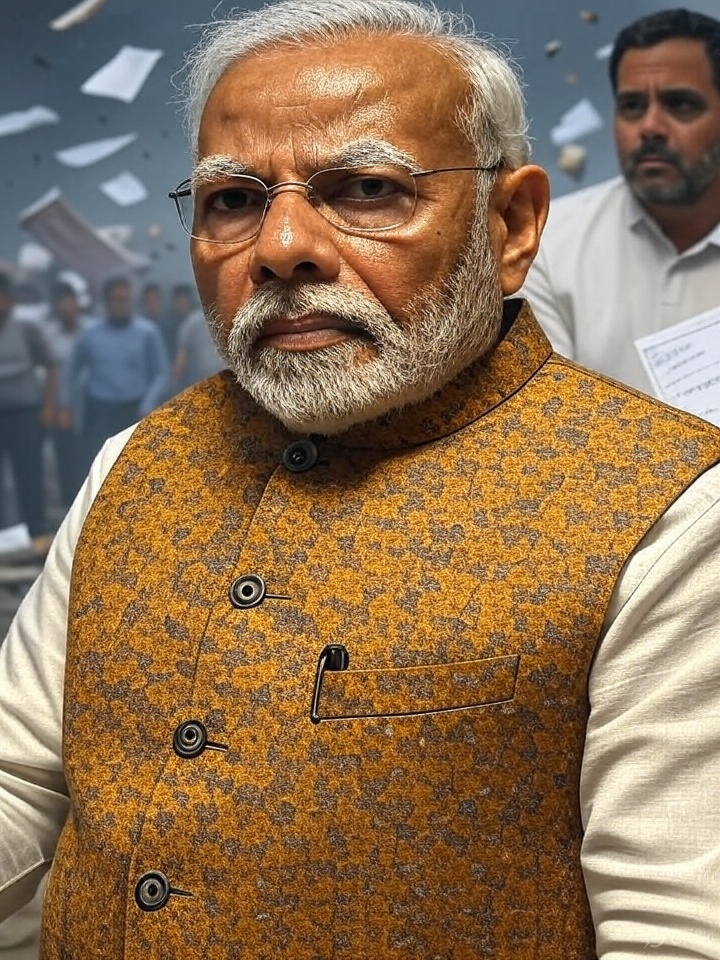
Narendra Modi’s dilemma of the worst kind. He is a trapped Abhimanyu. The revelations of Rahul Gandhi on voter-theft during the elections of 2024 have created ripples in the BJP circles and the people perception on the formation of Modi’s government. It is likely to create far reaching consequences on the stability of the present government and the supposition of Shah’s elevation.
Sharad Pawar added fuel to the fire when he declared that two persons had approached him with an offer two win 160 seats in the 2024 Assembly elections of Maharashtra for him. Pawar further added that he had arranged a meeting with Rahul Gandhi on the offer. After discussion of the matter, they both refused the offer saying they would like to win a fair election rather than a fake election. The march of 300 MPs to the Election of India on August 11 further escalated the clash between the opposition and the ruling party.
Modi’s rule has been autocraticThe Democracy of the 3-Ms of Narendra Modi – Modiism, Modiocracy, and Modicide at the expense of democratic institutions. His unilateral decision-making personality and authoritarian culture within the Bharatiya Janata Party is nothing but a Modiocratic governance in India. Modi’s tenure has been characterized by a strong, centralized leadership style. His rule weakened institutions, with media and judiciary facing pressure. The disqualification of opposition leader Rahul Gandhi from Parliament in 2023 further fuelled claims of authoritarianism. It is argued that Modi’s show of strong leadership image, bringing initiatives like Make in India and infrastructure growth has been on paper. While Modi’s leadership not achieved any measurable progress but centralization of power that raised concerns about the democratic erosion.
Modi’s another trait is ‘Modiism’. It is Hindu nationalism, economic liberalization, and a strongman image. It is a blend of populist nationalism and neoliberal policies that prioritize corporate interests and majoritarianism. Modi’s policies, such as liberalizing foreign direct investment in defence and railways, does not go with neoliberalism but corporatism. His association with the Rastriya Swayamsevak Sangh shapes perceptions of his ideological leanings. It is argued that Modi’s model combines with violent Hindu nationalism leaning towards the big businesses.
The “Modiism” is a pragmatic blend of cultural pride and economic reform, with initiatives like the Goods and Services Tax (GST) and Digital India that has not boosted India’s global standing. However, Modi’s frequent global engagements are seen as elevating India’s profile but Trump’s trade tariff and claim on the ceasefire between India and Pakistan Operation Sindhoor baffled India. Modi’s governance does reflect a distinct ideological mix, but “Modiism” as economic reforms have not driven growth, but the close ties with corporations raise questions particularly in light of the Adani controversy.
Modi’s dangerous trait is Modicide. The policies or actions under him lead to societal unrest. It’s often tied to suppressing dissent or marginalizing minorities. The decline in social welfare spendings is cited as neglectful of vulnerable populations. Critics also point out to the rising Islamophobia and violence against Muslims, such as the 2002 Gujarat riots, as evidence of societal disharmony. Schemes like PM Kisan Samman Nidhi provide financial support to farmers, suggesting a focus on welfare but agrarian distress and farmers agitations speak otherwise. However, his recent announcements create apprehensions among farmers, seafood exporting and small medium scale industry.
In Modi’s Modicide there has been evidence of democratic degradation and minority marginalization, attributing systemic erosion that led to any tangible achievements like infrastructure development and poverty alleviation programmes. Modi’s deliberate trait is Corporatism. The corporatism is his favouritism toward big business, particularly through policies benefiting industrialists like the Adanis, Ambani Brothers and their dependent crony Industrialists. It is a governance model prioritizing corporate interests over public welfare.
Modi’s relationship with Adani, evident since the 2002 Vibrant Gujarat summit, has drawn scrutiny. Adani’s wealth. The Hindenburg report accused Adani of corporate fraud, raising questions about government complicity. Electoral bonds, introduced in 2017, allowed anonymous corporate donations to the BJP, with nearly half of the top 30 donors contributing post-raids by investigative agencies, suggesting coercion.
Modi’s government elicits corporate-friendly policies, like deregulation of diesel prices and GST, drive economic growth. The Make in India initiative aimed to position India as a global manufacturing hub, benefiting the broader economy but domestic medium and small-scale industries have faced a gradual death. The balance between corporate growth and public welfare remains contentious.
Modi’s Hinduism as majoritarianism agenda
It is argued that Modi’s policies promote Hindu nationalism, marginalizing religious minorities, particularly Muslims. This is tied to his RSS roots and events like the 2002 Gujarat riots. Modi’s RSS background and the BJP’s Hindutva ideology are well-documented. Recent actions like the Amendments to Wakf Board Act is seen as advancing a Hindu-majoritarian agenda.
Modi’s praise of RSS from the ramparts of the Red Fort in 2025 while addressing the nation as the Prime Minister is against the spirit of the Constitution. He did it to impress the RSS but he would not able to save his chair in the future.
The worst ever Diplomatic Disaster of Modi
It is argued that Modi’s foreign policy is the worst ever diplomatic disaster for India. His foreign policy faltered, citing strained relations with neighbours when they did not come out in support of the Operation of Sindhoor. Relations with neighbours like Pakistan remain tense resulting in the Operation Sindhoor. Modi tried to elevate India’s global profile through extensive foreign shows, securing defence and energy deals.
Narendra Modi’s dilemma of the worst kind. He is a trapped Abhimanyu. Modi Paving the Way for Amit Shah?
Amit Shah has been Modi’s closest ally for over 40 years, serving as his confidant and executioner. As Home Minister, Shah wields significant power, controlling state apparatus and BJP strategy. Shah’s rise, from BJP President to India’s second-most powerful figure, fuels speculation that Modi is grooming him as his successor. Shah’s unique personality and strategist make him a natural successor to Modi’s legacy. Modi’s praise of Shah as the longest serving Home Minister surpassing LK Advani in his first ever meeting of the BJP Parliamentary Board meeting is an indication of his willing to elevate him to the post of the Prime Minister of India in case he desires to retire. Their successive meetings with the President of India need to be deliberated.
Modi’s cult status and third term indicates he remains the BJP’s central figure. Shah’s role may be complementary, not preparatory, as the BJP relies on Modi’s charisma for electoral success. While Shah’s influence and attachment with Modi’s vision make him a prospective successor. Recent developments are direct evidence that Modi is actively paving the way for him. Modi’s tenure is a mix of polarizing controversies – centralized power and corporate ties and his ideological roots, with tangible impacts on policy and minority relations. Modiocracy, Modicide Modiism and diplomatic disaster are no rhetorical but display of democratic decline and foreign policy missteps.
Strengths of Amit Shah
Shah is widely recognized for his political acumen and organizational skills. As BJP President (2014–2020), he expanded the party’s footprint, securing victories in states like Uttar Pradesh, Gujarat, and Assam by managing voters. His ability to micro-manage elections, build coalitions, and mobilize cadres has been pivotal to the BJP’s dominance based on voters list mismanagement.
As Union Home Minister since 2019, Shah has introduced controversial policies including the abrogation of Article 370 in Jammu and Kashmir, the introduction of the Citizenship Amendment Act (CAA), Wakf Board Amendment Act 2024. His handling of internal security, with claims of reducing naxalism and terrorism back fired with disasters like Pulwama, Manipur fiasco and Pehalgam massacre. Shah’s reputation for ruthlessness and efficiency, exemplified by his oversight of the 2019 Balakot airstrike response and Operation Sindhoor, matches with the strongman image that resonates with BJP’s voter base. Shah’s 40-year partnership as Modi’s enforcer suggests he could carry forward policies like Hindutva.
Comparison to Modi
Modi’s leadership is defined by a cult of personality, global diplomacy, and cultural revival, whereas Shah excels in operational execution and party management by inappropriate means. Modi’s public-facing charisma contrasts with Shah’s backroom strategizing, making Shah less suited to the role of Prime Minister.
Modi’s dramatized personal popularity has been central to BJP’s landslide victories (e.g., 303 seats in 2019 but boomeranged in 2024). Shah, while a master strategist, lacks the same voter connect, potentially weakening the BJP’s electoral performance in a post-Modi scenario. Both share a commitment to Hindutva and RSS ideology, but Shah’s more overt hardline stance could intensify social tensions compared to Modi’s broader rhetoric.
Shah though does not drive support within the BJP and RSS for his forceable loyalty and results-driven approach through his agencies. His role in consolidating power, as seen in the BJP’s control of state governments, enabled him being a successor to Modi, even if the RSS does not endorse. However, the public sentiment often portrays Shah as a polarizing figure. Supporters praise his decisiveness, while critics label him authoritarian.
Modi’s third term relies on coalition partners like JD(U) and TDP, indicating a less dominant BJP compared to 2014–2019 era. Shah’s ability to manage coalitions, as seen in his negotiations during government formation, positions him well, but his hardline image could strain alliances.
Shah’s proximity to Modi and control over the Home Ministry make him a frontrunner for succession, but internal rivals like Yogi Adityanath or Nitin Gadkari, who appeal to different BJP factions, could challenge him. The RSS’s influence in any leadership transition will be crucial, despite Shah’s long-standing ties. Shah’s potential elevation could involve Modi positioning him to counter opposition or regional leaders, as seen in his past strategies to weaken regional parties.
Shah’s lack of mass appeal, his polarizing image, and reliance on Modi’s legacy pose significant hurdles. While Shah could maintain policy continuity and party discipline, he may struggle to replicate Modi’s electoral charisma or unify diverse coalitions. As an alternative, Shah is suitable for the BJP’s core base but less so for broader national appeal, making his leadership a high-stakes gamble for India’s complex political landscape.
Narendra Modi’s dilemma of the worst kind. He is a trapped Abhimanyu. Shah’s challenges with in BJP
Nitin Gadkari
Nitin Gadkari, Union Minister for Road Transport and Highways has occasionally made remarks perceived as critical of Modi and Shah’s leadership, such as his 2018 comments on the BJP’s overconfidence, interpreted as a subtle jab. His sidelining from the BJP’s Parliamentary Board in 2022 suggests tensions with the Modi-Shah strategy. Gadkari is unlikely to openly rebel due to his RSS discipline and pragmatic approach, but he may not sit quiet. Gadkari’s RSS loyalty may temper open dissent, but his sidelining and independent stature suggest he could mobilize opposition, especially if Shah’s elevation threatens his portfolio or RSS interests.
Rajnath Singh
Rajnath Singh, Defence Minister and former BJP President, has been a steadfast defender of Modi’s government, avoiding public criticism. His retention in the Parliamentary Board and Modi Cabinet indicates sidelining with Modi, though his Thakur identity slants with Yogi Adityanath, a fierce rival to Shah. Singh is likely to remain loyal due to his RSS schooling and history of supporting Modi. His track record suggests he would avoid public confrontation, though he might express concerns privately within RSS or cabinet circles if Shah’s leadership threatens party unity.
Dr. Subramanian Swamy
Swamy has been vocal against Modi and Shah, calling Modi’s government brain dead. He has criticized the BJP’s 2024 election performance, claiming his suggestions could have secured 300 seats instead of 240. His 2015 refusal to join the BRICS Bank, despite Shah’s persuasion, highlights his defiance. He would not sit quiet if Shah replaced Modi.
He would openly criticize Shah’s elevation, likely framing it as a continuation of Modi’s dictatorial mindset. His legal background and RSS connections could force him to challenge Shah’s policies or legitimacy, though his limited organizational control within the BJP restricts his impact. Swamy’s track record ensures he would vocally oppose Shah to amplify dissent, though his influence may be confined to public discourse rather than party support.
Margdarshak Mandal
The Margdarshak Mandal, formed in 2014, includes senior BJP leaders like LK Advani, Murli Manohar Joshi and many other senior leaders and dissenters. Intended as an advisory body, it has been largely ceremonial, with little real power. Advani and Joshi, both sidelined by Modi and Shah, represent the pre-Modi BJP old guard. Advani opposed Modi’s 2013 PM candidacy, skipping the Parliamentary Board meeting where it was announced. Joshi also resisted Modi’s rise, reflecting tensions with the Modi-Shah combine. The Mandal has been inactive, with no significant role in BJP decision-making since 2014, as Modi and Shah have centralized power.
Advani and Joshi are unlikely to actively oppose Shah’s elevation due to their advanced age and marginalization. However, their symbolic weight as BJP veterans could inspire dissent among old-guard supporters or RSS factions wary of Shah’s hardline approach. The Mandal’s lack of formal authority limits its ability to act, but any statement from Advani or Joshi could encourage other dissenters. The Mandal’s irrelevance suggest they would remain quiet, though their legacy could indirectly fuel resistance from other quarters.
The RSS, critical of Modi and Shah’s centralization post-2024’s electoral setback favours leaders like Gadkari and Singh for their ideological alignment and less confrontational style. Tensions over the BJP President’s appointment highlight RSS concerns about Shah’s dominance, which could amplify dissent if he replaces Modi. Gadkari’s cross-party relationships and Singh’s consensus-driven approach make him more palatable to allies, potentially encouraging resistance to Shah.
The question of whether N. Chandrababu Naidu, as the leader of the Telugu Desam Party (TDP) and a key National Democratic Alliance (NDA) ally, would tilt the balance of power if Amit Shah were proposed as the next Prime Minister hinges on Naidu’s political influence, strategic priorities, and the evolving equations within the NDA, particularly in light of the Janata Dal reported instability.
Narendra Modi’s dilemma of the worst kind. He is a trapped Abhimanyu. The Conclusion
The revelations Rahul Gandhi on voter-theft in the elections of 2024 have created ripples in BJP circles and the people perception of the formation of Modi’s government. It is likely to create far reaching consequences of the stability of the present government and the supposition of Shah’s elevation. The march of 300 MPs to the Election of India on August 11 further escalated the clash between the opposition and the ruling party.
Modi’s praise of RSS from the ramparts of the Red Fort in 2025 while addressing the nation as the Prime Minister is against the spirit of the Constitution. He did it to impress the RSS but he would not be able to save his chair in the future
Nitin Gadkari is unlikely to sit quiet. He may resist Shah’s elevation discreetly through RSS and corporate networks, leveraging his independent stature and regional base, though open rebellion is unlikely due to party discipline. Rajnath Singh is likely to remain silent publicly, given his loyalty and RSS discipline, but may express concerns privately, if Shah’s leadership threatens party or coalition unity. Dr. Subramanian Swamy will not sit quietly. His history of public criticism ensures he would vocally oppose Shah.
Margdarshak Mandal is likely to remain silent due to its ceremonial role and the age of its members (Advani, Joshi), but their legacy could inspire dissent among old-guard or RSS factions. The RSS’s unease with Shah’s dominance and NDA coalition dynamics could amplify dissent, though Shah’s organizational control and Modi’s backing would make an open rebellion challenging.