
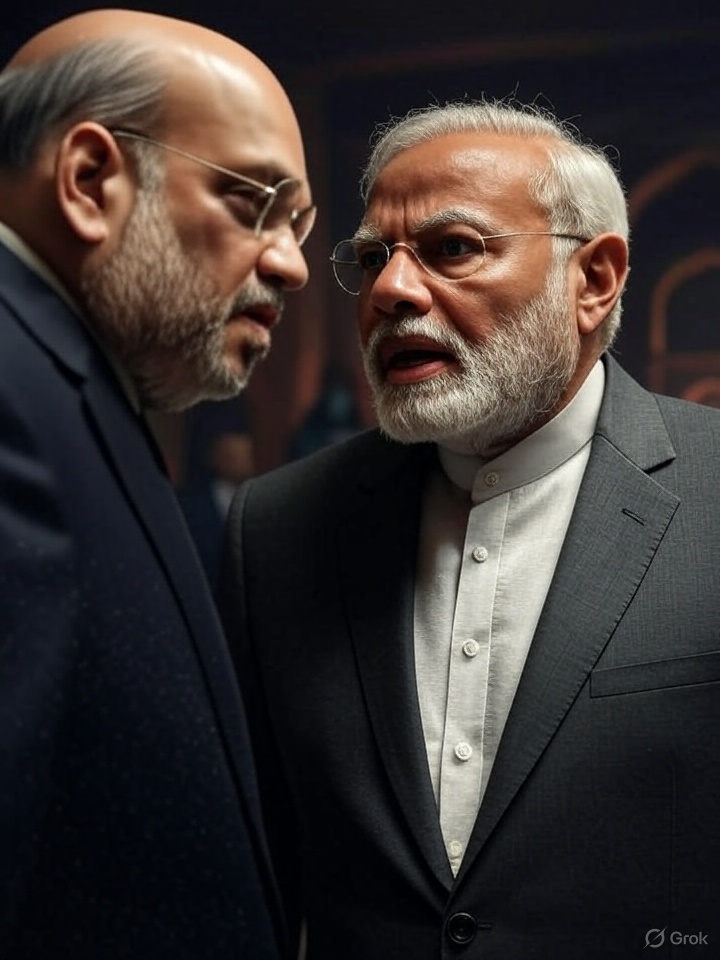
Modi proposes for Shah, but RSS disposes. Shah digs at the RSS politics to defame it and lays the way to the throne
Modi proposes for Shah, but RSS disposes. Shah digs at the RSS politics to defame it and lays the way to the throne. The political imbroglio being faced by Narendra Modi, Home Minister Amit Shah, and the Rastriya Swayamsevak Sangh (RSS) is nothing but a triangular political syndrome. The syndrome suggests internal power dithering where Modi eyes stepping down, the RSS blocks Shah’s path to succession, and Shah counters with his plans to dig a historical probe into agitations that took place in India since 1973 to undermine the RSS’s legacy and clear his route to the throne.
The syndrome matches with recent reports of tensions in the BJP-RSS relationship and Shah’s intentions. The proposition elicits that Modi wants to make way for Shah, on the pretext of fatigue, health, or a desire to firm his legacy before the 2029 elections. Shah has publicly dismissed a rigid 75-year retirement rule but has not ruled out a transition.
The recent BJP surveys and internal discussions highlight succession planning as a priority, especially after the party’s 2024 Lok Sabha setbacks. A 2025 poll by a BJP-affiliated outlet showed 28% favouring Amit Shah as Modi’s heir, with Yogi Adityanath close behind at 26%. The RSS Chief Mohan Bhagwat’s August 2025 speech signalled RSS frustration with prolonged Modi dominance.
Modi had made fun at retirement in past interviews but has been strengthening his grip in government as well in the party. Modi is a rare case of instance of any Prime Minister who had equal control on both government and party. However, with diplomatic strains and domestic challenges, Modi might be exploring the options. The RSS is blocking Shah’s coronation viewing him as authoritarian.
Tensions peaked in mid-2025 over the BJP President’s selection. RSS stalled endorsements for Modi-Shah preferences like Bhupender Yadav or Dharmendra Pradhan, demanding a democratic overhaul to dilute the duo’s grip. Sources describe RSS pushing for swayamsevaks in key roles, reviving the pre-2014 model where it held veto power. Bhagwat’s speeches emphasize consultative decision-making. Historical instances include RSS forcing BJP leader L.K. Advani’s 2005 resignation over his Jinnah episode.
Shah, 60 is Modi’s closest aide and de facto party boss, but RSS distrusts his unchallenged control. Unlike RSS breed like Nitin Gadkari, Shah’s Gujarat roots and aggressive style irk Nagpur. The veto could delay Shah’s PM bid, forcing a compromise candidate. Shah ordered a probe into agitations since 1973 to defame the RSS by exposing its role in movements it had led or supported, framing them as vested interest-driven chaos. Probe into Anna Hazare agitation could boomerang Shah but might systematically throw the blame on to the Congress as had been done by Modi ad Shah.
Modi proposes for Shah, but RSS disposes. Shah digs at the RSS politics to defame it and lays the way to the throne – Shah out to cut the RSS into size to accept his coronation.
In July 2025, at the Intelligence Bureau’s National Security Strategies Conference, Shah directed the Bureau of Police Research & Development (BPR&D) to study all post-Independence protests, focusing on those after 1974 to analyse causes, funding via ED, FIU-IND, CBDT outcomes, and behind-the-scenes players to draft ways preventing mass agitations by vested interests. This follows high-profile unrest like 2020-21 farmers’ protests, 2024 quota agitations, Shaheen Bagh etc. and now Ladakh and Uttarakhand.
The year 1974 marks the movement led by Jayaprakash Narayan, sparked by Gujarat’s 1973-74 anti-corruption student uprising. Shah, an RSS swayamsevaks during Emergency (1975-77), often invoked these as dark chapters of Congress authoritarianism—but RSS-Jana Sangh-BJP were key players in them.
RSS mobilized shakhas for JP’s anti-emergency campaign, with thousands arrested. A probe could reframe RSS as a disruptor, highlighting funding conduit or foreign hands. Critics noted that Jana Sangh led these movements. The proposed scrutiny might backfire or be selectively spun to target anti-national elements or Congress while shielding RSS. The Congress which is on the war path might turn the table against the RSS and BJP.
But in RSS-BJP duel, it could unearth records implicating RSS in anarchic mobilizations, eroding its moral authority. Shah’s history shows his adeptness at narrative control. If timed with BJP President polls, it might pressure RSS to concede on succession.
Shah will use the probe to neutralize RSS veto by questioning its historical sanctity, positioning himself as a reformer against outdated ideologies. With Modi’s nod, Shah eyes 2029 crown in a two-horse race against Gadkari or Yogi. The idea is to implicate Congress and impersonate the RSS to fall in line. It might also backfire Shah and Modi.
The RSS, as the BJP’s ideological backbone, holds significant sway over the cadre. Shah’s probe, if perceived as an attack on RSS’s legacy could boomerang, alienating the RSS risks fracturing BJP’s grassroots support.
Modi proposes for Shah, but RSS disposes. Shah digs at the RSS politics to defame it and lays the way to the throne – Shah to neutralise the challenge to his coronation.
Yogi Adityanath’s rising popularity and leaders like Shivraj Singh Chouhan challenge Shah’s succession bid. If the RSS vetoes Shah, Yogi or a compromise candidate could outmanoeuvre him.
The probe into agitations might be seen as a witch hunt, especially if it targets opposition movements (e.g., farmers’ protests or Shaheen Bagh). Public fatigue with Modiism could erode BJP’s vote bank by 2029. Shah’s power comes from Modiocracy. If Modi steps down Shah lacks the mass appeal to hold the party alone, unlike Modi’s 2014-19 wave.
At 76 Modi faces age-related issues and RSS pushes for a post-2029 transition. His legacy (e.g., Ram Mandir, Article 370) is on wane, but recent challenges like the Supreme Court stay on some of the amendments to the Wakf Board Amendment Act, SIR fiasco, Rahul Gandhi’s revelations in voter list manipulations, Manipur mess, economic brake down, foreign relations, trade tariff, Operation Sindhoor over action etc., weaken his invulnerability. A graceful exit might be his best play, but he is unlikely to leave abruptly unless health or party dynamics force it.
Without Modi, Shah’s gimmicks (probes, narrative control etc.) lack lustre. His Gujarat-style strong-arm tactics do not translate nationally, and RSS distrust limits his manoeuvrability. A misstep like the probe on the post 1973 agitations could make him a liability, forcing an earlier exit.
The party’s 2024 coalition dependence (NDA allies like JD(U), TDP) and RSS’s push for a post-Modi model signal a shift. Both leaders may face a slow fade as younger, RSS-aligned faces emerge. Nitin Gadkari seen as a moderate, practical leader with a presumed clean image. His RSS roots and personal timidity make him a counterweight to Modi-Shah’s dominance.
After Davender Fadnavis 2024 state poll success, he is considered as a regional heavyweight who could align with Gadkari for a national push, show casing Maratha and urban voter bases. RSS trust, administrative track record, and appeal to moderates wary of Shah’s fundamentalist pose or Yogi’s divisiveness. Gadkari lacks Modi’s charisma; Fadnavis faces anti-incumbency in Maharashtra and limited national appeal.
Rajnath Singh, Defence Minister, former BJP President, and a veteran with Thakur clout in Uttar Pradesh, a low-key style and RSS ties position him as a consensus builder. At 74, he is a transitional figure, not a long-term PM bet.
Yogi Adityanath, a Hindutva icon with a 26% approval rating in 2025 BJP surveys. His aggressive governance energizes the base but alienates moderates and allies like JD(U). He is a polarizing PM contender. Yogi’s mass appeal among Hindutva voters and Rajnath’s stability offer a potential mix of personalities. The UP’s 80 Lok Sabha seats make them critical to BJP’s 2029 math. Yogi’s divisiveness risks coalition fractures; Rajnath’s age and lack of dynamism limit his staying power.
Modi proposes for Shah, but RSS disposes. Shah digs at the RSS politics to defame it and lays the way to the throne – RSS push either for the BJP President or PM Chair for it.
Reports from mid-2025 confirm RSS’s push for a post-Modi-Shah leadership, with Gadkari and Rajnath as “safe” options due to their RSS loyalty and less authoritarian styles. Yogi’s rise reflects cadre enthusiasm, but his 2024 tensions with Shah (over UP candidate selection) suggest he is carving an independent path. Fadnavis, meanwhile, is quietly consolidating, with RSS signalling him as a future PM or national player post-2026 Maharashtra polls.
Modi, aware of the factional tussle and his waning grip, wants to delay his exit until supporters dwindle, then seek a new mandate to avoid ceding power to the opposition. At 76, Modi remains the BJP’s biggest vote-puller, despite 2024’s 240-seat debacle. His 2025 foreign trips (e.g., BRICS summit, visits to China and Japan meeting Putin and Xi Jinping) and focus on legacy projects signal intent to stay relevant. A 2023 interview hinted he’d never retire unless forced, and his rejection of the 75-year rule reinforces this.
Modi’s core voters remain loyal but cracks show in rural and minority-heavy areas. RSS’s push for succession allies’ demands) pressures him. Modi could push for snap polls before 2029 if internal strife peaks (e.g., post-2026 state elections) or external crises (e.g., China border tensions) bolster his strongman image. This mirrors his 2019 Pulwama-Balakot gamble, which consolidated votes. Modi’s reluctance to empower the opposition (Congress, revitalized under Rahul Gandhi’s 2024 gains) is consistent with his career. However, RSS’s influence and coalition fragility (TDP, JD(U)) could force his hand earlier, especially if Gadkari or Rajnath gain traction.
The BJP President race (post-Nadda, August 2025) is a proxy battle. Gadkari-Fadnavis may push a moderate like Bhupender Yadav, while Rajnath-Yogi back a hardliner like Vinod Tawde against Sanjay Joshi, a Modi’s baiter. Shah’s probe into agitations could tilt this by pressuring RSS, but risks uniting factions against him.
Modi proposes for Shah, but RSS disposes. Shah digs at the RSS politics to defame it and lays the way to the throne – Modi would not allow the Opposition to take over the government.
If Modi secures a strong mandate (e.g., via early polls or 2029), he could sideline factions, but at 78, health and fatigue may limit this. Shah’s influence wanes without Modi’s cover. RSS-backed, they could steer BJP toward moderation, appealing to NDA allies but risking Hindutva voter drift to Yogi’s camp.
A fractured BJP boosts Congress. The BJP’S 2024 tally (234 seats) shows they are closing the gap, especially if Modi’s exit leaves a leadership vacuum. Factionalism could erode BJP’s 2024-25 recovery. RSS may force a compromise (e.g., Gadkari as PM, Yogi as deputy) to avoid a 1989-style split (when BJP imploded post-Advani).
Rural distress, unemployment and Manipur-like, vote theft allegations by Rahul Gandhi and SIR crises swallow Modi’s base. RSS’s push for “new blood” signals his time is finite. If Gadkari and Rajnath align they could out-manoeuvre Modi-Shah, forcing an earlier exit (2027-28). Congress’s 2024 gains and regional players (e.g., Mamata Banerjee) could exploit BJP infighting, making a fresh mandate harder to secure.
Modi proposes for Shah, but RSS disposes. Shah digs at the RSS politics to defame it and lays the way to the throne – The Conclusion
The political imbroglio being faced by Narendra Modi, Home Minister Amit Shah, and the Rastriya Swayamsevak Sangh (RSS) is nothing but a triangular political syndrome. The syndrome suggests internal power dithering where Modi eyes stepping down, the RSS blocks Shah’s path to succession, and Shah counters by his plans to dig a historical probe into agitations took place in India since 1973 to undermine the RSS’s legacy and clear his route to the throne.
The Gadkari-Fadnavis vs. Rajnath-Yogi clash is a possible faulty line, with Modi playing a high-stakes game to delay his exit. He will likely drag his tenure through 2026-27, banking on events to justify a final mandate. However, RSS’s influence, factional ambition, and opposition momentum suggest both Modi and Shah face a tough road ahead. The 2026 state elections and RSS’s next moves on its Akhil Bharatiya Pratinidhi Sabha in 2026, will be crucial.