
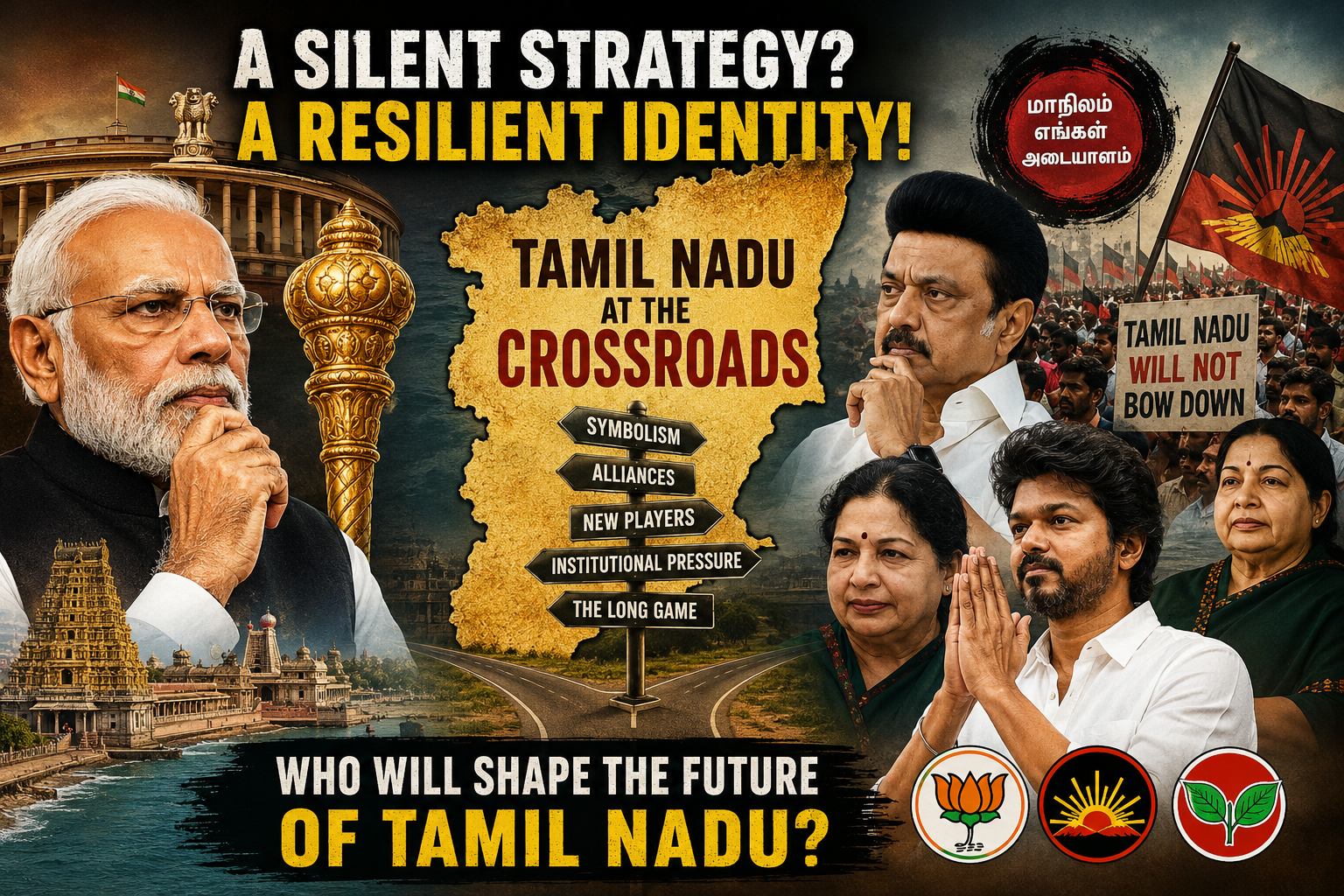
Introduction
An Untold Story of Tamil Nadu Politics: Strategy, Symbolism, and the Limits of Power. In Indian politics, power is not always captured through sudden waves—it is often cultivated through patient symbolism, silent alignments, and strategic persistence. Over the last decade, Narendra Modi has demonstrated an ability to reshape political landscapes across diverse regions of India. Yet, one state continues to resist full political integration into this national narrative—Tamil Nadu.
What we are witnessing today may not be an immediate political takeover, but a slow and calibrated attempt to enter, influence, and eventually reshape Tamil Nadu’s political terrain. Whether this is a masterstroke in the making or an overestimation of political control remains the central question.
Tamil Nadu—a state dominated for decades by Dravidian parties such as the DMK and AIADMK BJP faced a structural barrier when Narendra Modi assumed office in 2014. Tamil Nadu politics is deeply rooted in linguistic pride, anti-Hindi sentiment, rationalist and anti-Brahmin movements etc. Recognizing this, Modi’s early strategy was not direct confrontation—but symbolic cultural penetration.
Modi’s key moves have been the frequent references to Tamil language as “the oldest and greatest”, Participation in Tamil cultural events internationally and gradual outreach to Hindu religious institutions in the South. His Modi’s speeches increasingly included Tamil phrases, attempting emotional resonance rather than ideological imposition.
An Untold Story of Tamil Nadu Politics: Strategy, Symbolism, and the Limits of Power- Religious Symbolism and Cultural Messaging
The Sengol Installation (2023)
The installation of the Sengol in the new Parliament building was presented as a revival of a Tamil civilizational symbol. The Sengol was historically linked to the transfer of power in 1947 associated with Tamil Shaivite tradition. This move can be seen as an attempt to Integrate Tamil heritage into national symbolism and signal respect toward South Indian traditions. It was primarily aimed at appeasing Tamil Brahmins.
Ram Temple and Southern Linkages
The consecration of the Ram Mandir Ayodhya in 2024 was made a major political event. A South Indian priest’s involvement symbolic representation of Ram linked to southern traditions. Modi undertook a religious fast before the ceremony and later priests from multiple traditions were involved. It was specifically designed to politically target Tamil Nadu
Temple Diplomacy
Modi’s repeated visits to major South Indian temples such as Ramanathaswamy Temple, Sri Venkateswara Temple etc. Modi wanted to build a pan-Indian Hindu identity, normalize BJP’s presence in a non-traditional region.
An Untold Story of Tamil Nadu Politics: Strategy, Symbolism, and the Limits of Power-Political Alliances and Fragmentation
Modi made alliance with AIADMK after the decline of J. Jayalalitha. But the BJP remained a junior partner. However, the AIADMK tried to retain core voter base. But Modi did try to encroach upon AIADMK’s structure to expand the BJP footprint but failed miserably since he could not succeed an alignment with Vijay’s TVK that has trounced the Dravidian parties in its fifty years of Tamil Nadu politics.
An Untold Story of Tamil Nadu Politics: Strategy, Symbolism, and the Limits of Power- Rise of and fall of MK Stalin
MK. Stalin led the DMK to victory in 2021 making a strong alliance with Indian National Congress by consolidation of anti-BJP vote. It is a systematic attempt to “ensure his defeat” on the lines of Telangana, Andhra Pradesh. A hand in disguise has been in action in all these states. Modi will not tolerate anybody who do not fall in his line of agreement. It may be SIR tool or manipulation of EVMs as has been alleged in West Bengal, Odissa, Bihar, Haryana, Madhya Pradesh or Rajasthan.
An Untold Story of Tamil Nadu Politics: Strategy, Symbolism, and the Limits of Power- The Vijay Factor and New Political Entrants
The entry of actor Vijay and his party Tamilaga Vettri Kazhagam has introduced a new layer of uncertainty. While new political entrants often emerge from public dissatisfaction with established parties, their long-term impact depends on the organizational depth, ideological clarity and electoral strategy. At present, Vijay’s political role remains undefined—whether as a disruptor, a reformer, or a transient phenomenon.
Vijay launched his political party Tamilaga Vettri Kazhagam. His entry reflects public dissatisfaction with traditional Dravidian parties though not proven to be BJP-sponsored but attempt made to have a secret dealing with RSS/BJP.
Institutional Pressure Narrative
Agencies like Enforcement Directorate, Central Bureau of Investigation and Income Tax Department have been active to pressurise the TVK and its leader Vijay but they did not act strongly since it
The “Grand Strategy
Modi, a “political magician” has been orchestrating and manoeuvring the cultural fabric of Tamil Nadu engineering alliances, opposition fragmentation and institutional leverage to eventually capture Tamil Nadu. However, Tamil Nadu remained as one of the strongest regional political ecosystems in India resistant to national party dominance like the BJP led by Modi. One should know that Aa uniform “BJP expansion model” does not fully apply to Tamil Nadu.
An Untold Story of Tamil Nadu Politics: Strategy, Symbolism, and the Limits of Power- The Conclusion
Politics today operates through symbolism, narrative-building and long-term positioning. A long-term ideological and cultural outreach by the BJP in Tamil Nadu, facing structural resistance from Narendra Modi is undoubtedly a skilled political strategist—but Tamil Nadu is not an easy chessboard
The rise of M. K. Stalin and the electoral success of the DMK in 2021 reaffirmed the resilience of Dravidian politics. Tamil Nadu’s political culture is not merely electoral—it is ideological rooted in the linguistic pride, social justice movements and resistance to central dominance. The Dravidian framework continues to act as a formidable barrier to external political expansion.
Narendra Modi may indeed be attempting a long-term political expansion into Tamil Nadu—but the state’s history suggests that it cannot be easily reshaped by external strategy alone. Political narratives can be crafted, symbols can be elevated, alliances can be engineered—but identity, once deeply rooted, resists easy transformation but people have been waiting for alternatives. The future of Tamil Nadu will not be decided in corridors of power alone—it will be determined by the enduring will of its people.