
Special Intensive Revision
Will India fall into a great doom of democracy under Narendra Modi? Special Intensive Revision (SIR) undertaken by the Election Commission of India on June 24, 2025 in Bihar is a prelude to disenfranchise the larger electorate of India, which does not vote for Narendra Modi. The SIR has sparked significant controversy, with critics alleging it could disenfranchise large sections of the electorate, particularly those unlikely to support Prime Minister Narendra Modi’s Bharatiya Janata Party (BJP).
The ECI announced the SIR to revise Bihar’s electoral rolls ahead of the state assembly elections expected in November 2025, marking the first intensive revision since 2003. The exercise requires nearly 80 million voters to re-register by July 26, 2025, with stringent documentation requirements, including proof of citizenship and parental identity, excluding Aadhaar, voter ID, and ration cards. The ECI justifies this as necessary to ensure the integrity of the voter list by removing ineligible voters, citing issues like migration, urbanization, and alleged inclusion of “foreign illegal immigrants.”
The Opposition parties, civil society groups, and activists have raised concerns that the SIR could disenfranchise millions, particularly marginalized groups such as Scheduled Castes (SCs), Scheduled Tribes (STs), Muslims, and migrant workers.
The requirement for documents like birth certificates, especially for voters not on the 2003 rolls, is seen as impractical in Bihar, a state with high poverty and migration rates. The Association for Democratic Reforms (ADR) estimates that over 30 million voters, particularly from marginalized communities, could be excluded due to these constraints. The critics argue the SIR disproportionately affects Muslims (17% of Bihar’s population) and other vulnerable groups, as the documentation demands are harder for them to meet.
The opposition, including the Rashtriya Janata Dal (RJD), Congress, and others, claims the SIR’s timing—close to the elections—suggests an intent to manipulate voter rolls to favour the BJP-led National Democratic Alliance (NDA). The opposition leaders like Pawan Khera and Tejashwi Yadav have called it “votebandi,”.
Jagdeep Dhankhar removed from the post of Vice President of India
It was unprecedented in the history of India’s democracy that a Vice-President was formally removed. Dhankhar had long been a disciple of Narendra and a staunch opponent of Mamata Banerjee. It was his loyalty to Modi that made him the Vice President of India. Dhankhar’s dream of becoming the President of India was not unnatural.
However, it is Narendra Modi’s wish to approve or not to accept one’s dream depending on the circumstances and political expediency. When Dhankhar felt that his wish would no longer be fulfilled, he started showing his leniency towards the opposition and that was the end of his career. He was asked to resign lest he be removed. Thus, he was forced to resign and that was the end of his journey with Modi. He was thrown into oblivion on the lines of former Jammu and Kashmir Governor Satya Pal Malik.
Will India fall into a great doom of democracy under Narendra Modi? The great Indian Political Transformation
India is undergoing a political transformation under Narendra Modi in a “mind-boggling manner. India has experienced significant political upheavals since Narendra Modi and the Bharatiya Janata Party (BJP) took over in 2014. Modi consolidated the BJP as India’s dominant political force. BJP’s organizational strength, coupled with Modi’s personal charisma marginalized the Indian National Congress and other opposition parties. Policies like the abrogation of Article 370 in 2019 reflected his bold approach. The move sidelined regional autonomy and democratic processes, pointing to the confinement of elected representatives as evidence of authoritarian tendencies.
The BJP and the Rashtriya Swayamsevak Sangh advanced a Hindu nationalist agenda, reshaping India’s secular framework like the Citizenship Amendment Act (CAA) and the National Register of Citizens (NRC) sparked debates about inclusivity and secularism. Modi’s tenure saw an erosion of democratic norms, media suppression, restricted access for journalists, and centralized control over institutions.
The Congress accused Modi of neglecting domestic issues like Manipur’s unrest and infrastructure lapses while focusing on international diplomacy based on image building. Modi’s articulated India into a developed nation by 2047. Modi’s unprecedented three consecutive terms provide a rare period of political stability in disguise.
Potential for Surprise
Supporters viewed Modi’s leadership as a historic shift, with India’s global image, economic growth, and cultural assertion as evidence of a transformative era. Critics, however, see a dangerous consolidation of power, with accusations of autocracy and democratic backsliding. The centralization of power and Hindutva-driven policies have alienated sections of society, particularly minorities and non-Hindi-speaking regions.
A critical agreement between the Rashtriya Swayamsevak Sangh (RSS) and Prime Minister Narendra Modi is clear. The BJP’s governance since 2014, under Modi’s leadership, has aligned closely with the RSS’s Hindutva agenda. However, the BJP’s reduced majority in the 2024 Lok Sabha elections (240 seats, 32 short of a simple majority) has forced reliance on coalition partners like the JD(U) and TDP, prompting speculation about tensions and recalibrations in the RSS-BJP relationship.
Modi’s visit to the RSS’s Smruti Mandir in Nagpur in March 2025, his first as Prime Minister, signaled a strengthening of ties after reported tensions post-2024 elections. The bonhomie between Modi and RSS chief Mohan Bhagwat, coupled with Modi’s praise for the RSS’s centenary, suggests a mutual interest in maintaining their partnership.
The passage of the Waqf Amendment Bill in 2024, supported by coalition allies, indicates that the BJP, under Modi, continues to advance RSS-backed Hindutva policies despite its thin majority. This reflects a functional agreement to prioritize ideological goals.
In July 2024, the Modi government lifted a decades-old ban on government employees participating in RSS activities, a move praised by the RSS as reinforcing its nation-building role. This suggests a deepening alignment rather than a superficial one. Despite reported RSS reluctance during the 2024 elections, its cadres were active in states like Haryana, Maharashtra and Delhi, indicating continued grassroots support for the BJP’s electoral success.
After 2024 elections, RSS chief Mohan Bhagwat and other leaders like Indresh Kumar made remarks critical of the BJP’s campaign, citing Modi’s “arrogance” and “lack of decorum” (e.g., Islamophobic rhetoric) and the government’s failure to address issues like Manipur’s unrest. These statements were interpreted as indirect critiques of Modi. RSS ideologue Ratan Sharda wrote in Organiser that the 2024 results were a “reality check” for overconfident BJP workers, distancing the RSS from being a mere “field force” for the BJP.
The RSS’s public critiques may serve to maintain its image as a cultural, non-political entity, distancing itself from the BJP’s electoral setbacks while still supporting its broader agenda. The RSS’s history of avoiding overt political involvement, as seen during the Vajpayee era, supports this. By appearing critical, the RSS can appeal to its base and coalition partners who may be wary of Modi’s dominance.
Some sources suggest genuine friction, with Modi’s cult of personality overshadowing the RSS. For instance, Modi’s centralized leadership has sidelined RSS-affiliated leaders like Nitin Gadkari and Yogi Adityanath, leading to murmurs of rebellion within the Sangh Parivar. The RSS’s remarks about retirement at 75, coinciding with Modi’s upcoming 75th birthday in September 2025, fueled speculation about pressure on Modi to step aside, though BJP leaders like Amit Shah have dismissed this.
Despite tensions, the RSS and BJP need each other. The RSS relies on the BJP’s political power to advance Hindutva, while the BJP depends on the RSS’s organizational network for electoral success. This mutual dependence suggests that any public criticism is likely tempered by a shared commitment to their ideological goals.
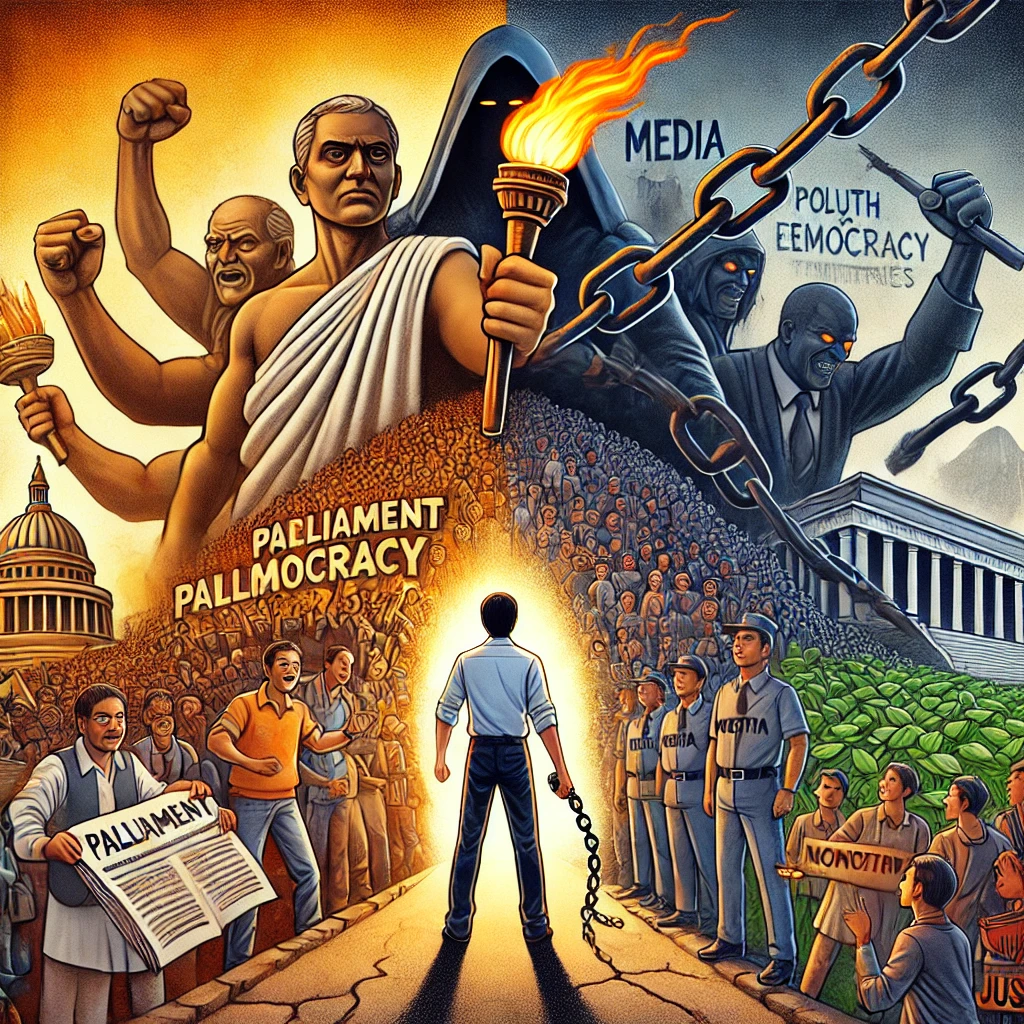
Will India fall into a great doom of democracy under Narendra Modi? Modiism, Modiocracy & Modicide
Modiism is the cult of personality around Modi, characterized by his charismatic leadership, centralized decision-making, and projection as the embodiment of Hindu nationalism (“Hindu Hridaysamrat”). It aligns with the RSS’s depiction of Modi as a redeemer of Hindu values, reinforced by his Gujarat model of development and Hindutva policies. Modi’s personal brand has often overshadowed the BJP and RSS, with his image dominating campaigns and policies. Modiism has led to a top-down governance style that sidelines intra-party democracy and RSS influence.
Modiocracy is a governance model where loyalty to Modi supersedes institutional norms, merit, or ideological purity. It implies a system where Modi and his close aides, like Amit Shah, centralize power, marginalizing dissenters within the BJP and RSS.
The sidelining of veteran BJP leaders like L.K. Advani, Murli Manohar Joshi, and Nitin Gadkari, and the appointment of RSS-affiliated but Modi-loyal figures to key posts, indicate a concentration of power. Critics describe this as a shift toward an illiberal democracy, with media suppression and institutional control as hallmarks.
Modicide is undermining of democratic norms, opposition, or alternative voices under Modi’s rule. It could also refer to the erosion of the RSS’s traditional influence in favor of Modi’s personal agenda. The Modicide has dismantled Opposition governments. Parties and their leaders. Critics point to actions like the CAA, NRC, and the handling of protests (e.g., Delhi riots in 2020) as evidence of suppressing dissent. The RSS’s own concerns about Modi’s “arrogance” and the BJP’s electoral setbacks in 2024 suggest unease with his approach, though not necessarily a complete break.
Will India fall into a great doom of democracy under Narendra Modi? Opposition Attacks and the Thin Majority
The BJP’s thin majority in 2024 (240 seats, requiring coalition support) has emboldened the opposition, particularly the INDIA alliance led by Congress and the Samajwadi Party. The Congress and leaders like Rahul Gandhi have capitalized on the BJP’s losses in states like Uttar Pradesh, Haryana, and Maharashtra, framing Modi’s leadership as divisive and authoritarian. They highlight issues like unemployment, rural distress, and governance failures (e.g., Manipur unrest, infrastructure lapses) to challenge Modi’s narrative of development.
The RSS has stepped in to bolster voter turnout and counter opposition narratives, as seen in its neighbourhood meetings during the 2024 elections. Its criticism of Modi may be partly strategic to deflect opposition claims of being a BJP puppet, while its cadres continue to support BJP campaigns. The BJP’s reliance on allies like JD(U) and TDP has constrained its ability to push contentious policies unilaterally, but the passage of the Waqf Bill shows that Modi can still advance RSS-aligned agendas with coalition support. This suggests a pragmatic agreement to maintain power despite public RSS critiques.
There is evidence of a strategic alignment between Modi and the RSS to advance Hindutva and maintain power, despite public critiques that serve to preserve the RSS’s cultural image and address internal BJP concerns. The terms “Modiism” and “Modiocracy” reflect Modi’s dominant leadership style. The RSS’s criticism is not mere pretense but a mix of genuine frustration and tactical posturing to navigate the BJP’s thin majority and opposition attacks
Will India fall into a great doom of democracy under Narendra Modi? Tirades of Rahul Gandhi
Rahul Gandhi’s vocal criticism of Modi’s alleged ties to industrialists like Gautam Adani has become a central plank of the opposition’s narrative, making him a prominent target for the BJP and its affiliates. Rahul Gandhi has consistently targeted Gautam Adani, accusing the Adani Group of crony capitalism, monopolistic practices, and benefiting from Modi’s policies at the expense of public interest. Gandhi quoted the Hindenburg Research report, which alleged stock manipulation and accounting fraud by the Adani Group to question Modi’s silence and demand investigations.
Gandhi has linked Adani’s rapid rise to government policies like privatization of airports, ports, and energy sectors, alleging favoritism. In 2024, he claimed Adani’s wealth grew due to “Modi’s policies,” citing examples like the Mumbai airport deal and coal contracts. Gandhi’s focus on Adani raised voters concerned about economic inequality, unemployment, and inflation, contributing to the BJP’s loss of seats in 2024 (from 303 to 240). His speeches in states like Uttar Pradesh and Maharashtra have drawn crowds, accelerating the opposition’s momentum.
RSS and Modi share a long-standing ideological and organizational bond, but their enforcements in countering the opposition, particularly Gandhi, is multidimensional. The RSS promotes Hindutva as a unifying cultural force, which contrasts with the Congress’s secularism and Gandhi’s focus on economic and social justice. The BJP and its supporters ascribe Gandhi as an ineffective leader, contrasting him with Modi’s self-imaginary personality. This image, articulated by BJP leaders and pro-government media, aims to discredit Gandhi’s Adani critiques as politically motivated.
The Adani Group has pursued defamation lawsuits against critics, though not directly against Gandhi. The government’s reluctance to order a Joint Parliamentary Committee (JPC) probe into Adani, as demanded by Gandhi. While the RSS publicly maintains a cultural focus, its affiliates, like the Vishva Hindu Parishad (VHP), have criticized Gandhi for “anti-Hindu” remarks, such as his comments on Hindutva during the 2024 campaign. This indirectly undermines Gandhi’s credibility among BJP-RSS supporters.
The BJP’s dependence on coalition partners like JD(U) and TDP after 2024 has constrained its ability to push controversial policies unilaterally. However, the RSS’s support ensures ideological cohesion, as seen in the passage of the Waqf Bill, which aligns with Hindutva goals and counters opposition narratives of minority appeasement.
Gandhi’s attacks on Adani put pressure on coalition partners, some of whom (e.g., TDP) have business-friendly outlooks. The RSS-BJP joint venture likely involves reassuring allies of economic stability while deflecting Gandhi’s critiques through counter-narratives of development and nationalism. Pro-BJP media and social media campaigns frequently mock Gandhi’s leadership and question his Adani allegations, framing them as attempts to derail India’s growth. This goes with RSS-BJP efforts to control the narrative.
In states where Gandhi campaigned heavily (e.g., Uttar Pradesh), the BJP and RSS intensified grassroots efforts, with RSS Shakhas reportedly countering opposition rallies. The BJP’s Haryana, Maharashtra and Delhi wins, despite Gandhi’s campaign, shows their ability to limit his impact. RSS and Modi are strategically united to counter the opposition’s advancement, particularly Gandhi’s, given his effective use of the Adani issue to highlight cronyism and inequality. This united front is less about a personal vendetta to “fail” Gandhi and more about preserving the BJP’s political dominance and Hindutva agenda against a resurgent opposition.
The RSS’s public attacks of Modi serve to maintain its cultural autonomy and appeal to coalition partners, but its continued support for BJP policies and campaigns suggests no significant rift. Gandhi’s Adani innuendos challenge the BJP’s economic agenda, but the RSS-BJP counter-strategy focuses on nationalism, development, and discrediting opposition leaders broadly, not just Gandhi. Gandhi’s prominence as the Leader of the Opposition and his Adani-centric campaign makes him a key target for narrative and electoral success.
Will India fall into a great doom of democracy under Narendra Modi? The Conclusion
Special Intensive Revision (SIR) undertaken by the Election Commission of India on June 24, 2025 in Bihar is a prelude to disenfranchise the larger electorate of India, which does not vote for Narendra Modi. The SIR has sparked significant controversy, with critics alleging it could disenfranchise large sections of the electorate, particularly those unlikely to support Prime Minister Narendra Modi’s Bharatiya Janata Party (BJP).
The RSS and Modi are aligned to counter the opposition, including Rahul Gandhi, through ideological reinforcement, electoral mobilization, and narrative control, particularly in response to Gandhi’s Adani critiques. While this alignment aims to limit the opposition’s gains, it’s driven by broader goals of consolidating power and advancing Hindutva, not solely “failing” Gandhi. The RSS’s occasional criticism of Modi is strategic, balancing its cultural image with political support. Gandhi’s Adani attacks have made him a focal point, but the RSS-BJP strategy targets the opposition holistically, leveraging economic achievements and cultural nationalism to maintain dominance despite a thin majority.