
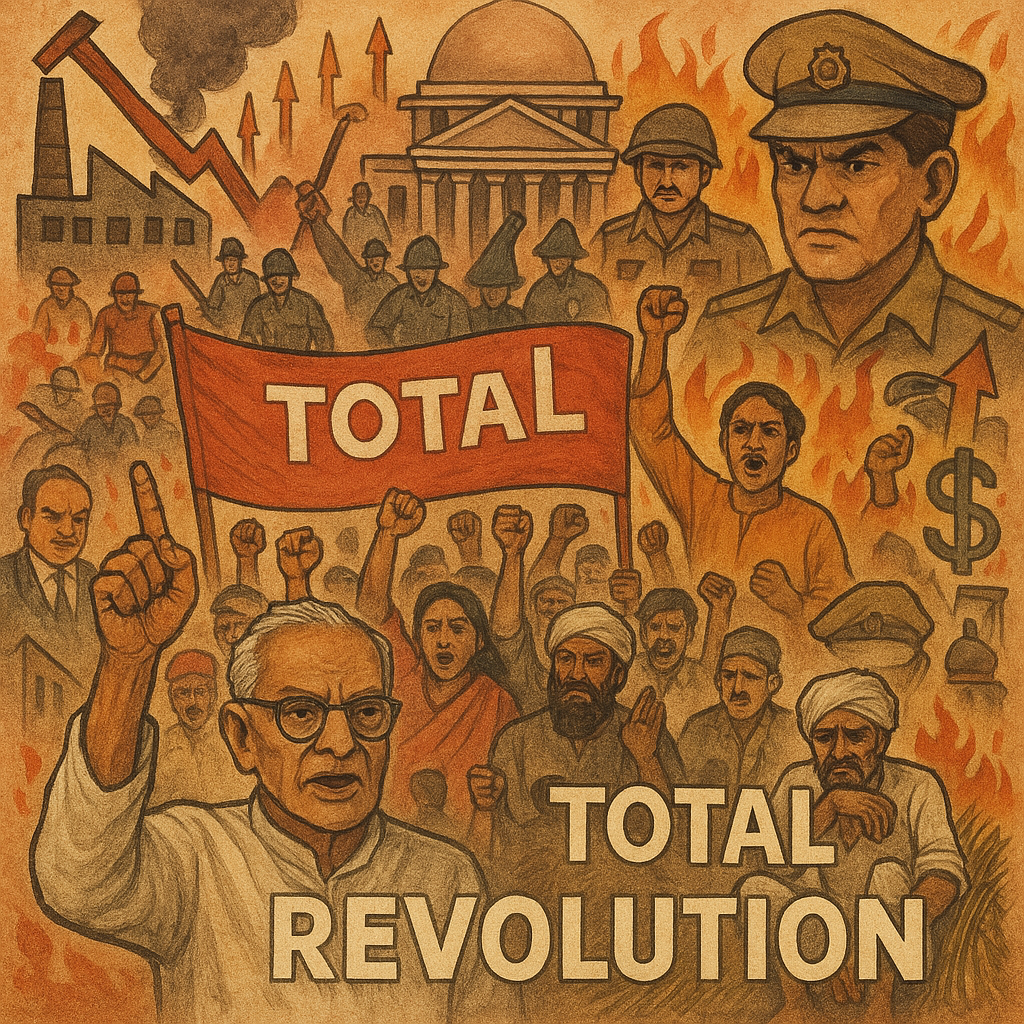
A Second Total Revolution is in the Offing as India is in disarray. Narendra Modi’s vision of India as a world leader—often articulated as “Vishwaguru” (world leader) or a global economic and cultural phub needs a dynamic economy. India’s GDP growth, projected at 6.8% for 2024-25 by the IMF, outpaces many peers, but it’s uneven—rural distress, unemployment (7-10%), and inflation (5-6%) dip its shine. The trade deficit ($29.9 billion in October 2024) and volatile markets scare off long-term investment. Compared to China’s industrial might or the U.S.’s innovation edge—India’s manufacturing push require a 13% of GDP, but corruption and red tape throttle it.
Modi’s weakened grip—240 seats in 2024, reliant on stretcher allies—undermines the strong image he has projected globally. Internal BJP-RSS friction and a emerging opposition (INDIA bloc at 234 seats) signal changing trends. India’s coalition bickering and in-house distress project susceptibility. Global leadership demands a unified front, not a government at crossroads.
Communal disharmony and farmer unrest undermine India’s soft power. The West watches warily as reports of minority tensions or protest crackdowns (e.g., UAPA arrests) clash with Modi’s democratic pitch. Judicial degradation and agency overreach—like ED cases against rivals—erode credibility. A world leader needs moral authority. India’s democracy, while alive, looks dented, not inspiring.
Modi’s foreign policy has had positive strides—hosting the G20 in 2023, balancing U.S.-Russia ties, and pushing the Global South narrative. However, India’s $3.9 trillion economy (5th largest) and military might (4th globally, per GFP 2024) give it thumps down. But mishandlings—like strained Canada ties over Sikh issues or Bangladesh border frictions—expose limits.
Modi’s personal brand is vanishing. Speeches at the UN or Davos still reverberate, but economic distribution lags behind. His dream of India as a technical hub (e.g., semiconductor bids) or green leader (net-zero by 2070) hinges on execution.
India has assets—1.4 billion people, a youthful demographic (median age 28), and cultural reach. Its IT sector, space programme (ISRO’s Mars mission), and pharma exports (e.g., COVID vaccines) show potential. But world leadership demands sustained 8-10% growth, social cohesion, and political stability.
Progress is possible if Modi (or a successor) stabilizes the BJP, tackles corruption, and evinces economic trust through jobs and rural relief. A united front could influence India’s scope and soft power to lead on climate, tech, or peacekeeping. But as of now, the gap between ambition and reality is alarming. India is too stuck in domestic distress to lead the world stage realistically. It might emerge post-2030, if the chaos clears—but not in these conditions.
India’s political atmosphere, is fraught with instability, particularly within the ruling BJP and its broader perspective, including the RSS. The Modi government seems to be faltering under internal strife, leadership vacuums, and a receding charisma, all while the country grapples with the economic and social pressures.
The novices’ selection of state leaders has been a sore point. Take Maharashtra, where Devendra Fadnavis’s return as CM post-2024 elections faced irritation from Eknath Shinde or Uttar Pradesh, where Yogi Adityanath’s assertiveness has clashed with the central leadership. The Rashtriya Swayamsevak Sangh is annoyed with Modi and Amit Shah’s authoritarianism. The RSS pushed its own agenda in the 2024 elections, yet felt sidelined when the BJP fell short of 272 seats, relying on Nitish Kumar and Chandrababu Naidu. RSS Chief Mohan Bhagwat’s June 2024 remarks on humility and consensus were seen as a slap at Modi’s style. This rift weakens the Sangh Parivar’s cohesion, a backbone of BJP’s dominance. However, Modi paid a visit to Nagpur to pay homage to Hegdewar on 30 June 2025 to express his continued allegiance to RSS.
Yogi Adityanath(not an RSS pracharak) and Nitin Gadkari, both with RSS backing, have openly challenged Modi. Shah’s iron grip on the Home Ministry alienates moderates, while allies like JD(U) and TDP flex their muscles, complicating decisions like Broadcasting Bill, One Nation One Election, Wakf Board Amendments etc. The BJP’s organizational machinery, stumbles with infighting and no clear succession plan.
Yogi Adityanath has a strong base but is too disturbing for coalition partners and RSS’s vision. Gadkari’s lacks the appeal to attract masses. Shah’s tough image does not transform to national leadership. The RSS resents but wary of antagonising a successor too soon, fearing backlash.
A Second Total Revolution is in the Offing as India is in disarray. The Modi government is at the crossroads.
Internal collapse coincides with public outrage, the opposition may bounce to power, but its own disunity, a weird regime, a restless populace, and no clear saviour, becomes a distance dream for it. A picture of India walking on a razor’s edge, with corruption, soaring prices, inflation, unemployment, volatile markets, and shrinking personal savings creating a tumult in the storm. These are indeed conducive for a “Second Total Revolution,” on the lies of Jayaprakash Narayan’s call in the 1970s.
Transparency International’s 2024 Corruption Perceptions Index likely still ranks India in the 80s out of 180 (it was 85 in 2023), reflecting public frustration with graft at all levels. High-profile scandal like those tied to infrastructure deals, electoral bonds, Kumbh Mela tenders to particular groups keep burning outrage.
Inflation has been a hiccup in India’s side, with the Consumer Price Index hovering around 5-6% in 2024-25, per RBI estimates, but food inflation often spikes higher (e.g., 10% for essentials like onions or pulses). This hits the poor and middle class hardest, weakening purchasing power and leading to protests..
Official data might claim 7-8% unemployment, but urban youth and rural workers feel it’s worse—CMIE pegged it closer to 10% in mid-2024. Graduates flood job fairs for scant openings, and social media buzzes with despair. This echoes the 1970s, when joblessness drove youth to JP’s movement.
The Sensex and Nifty have seen erratic swings—hitting 85,000 in late 2024 before sharp tickling tied to global uncertainty and FII sell-offs. Small investors, lured in during the post-COVID boom, are nursing losses, amplifying economic insecurity. With inflation overtaking wage growth, household savings rates have dipped—RBI data showed a drop from 20% of GDP in 2010 to under 15% by 2023, likely worse now. People are dipping into reserves or borrowing, a recipe for desperation.
These grievances have become prelude to JP’s Total Revolution – economic distress, distrust in elites, and a sense of betrayal by the system. In 1970s inflation hit double digits, corruption scandals (e.g., Nagarwala) rocked trust, and youth unemployment led to protests. Indira Gandhi’s Emergency was the final blow. Today, the Modi government’s dominance—despite its 2024 electoral setback—faces similar accusations of cronyism and authoritarianism, with agencies like the ED and CBI as tools of control. The 2024 elections showed breaches in the BJP’s big brother image, with the INDIA bloc capitalizing on economic discontent to deny Modi an outright majority. Farmers’ agitations (with more than 700 deaths), urban strikes (e.g., gig workers in 2024), and student unrest over jobs and exam leaks hint at a restless mass. Narendra Modi’s visit to Nagpur on 30th March, 2025 seems to have stabilised his relations with the RSS.
A Second Total Revolution emerging
But a Second Total Revolution needs more than conditions—it needs a catalyst and a leader. No figure has yet harnessed this anger like Jaya Prakash Narayan (JP) did. Rahul Gandhi’s yatras have momentum but lack the radical edge or mass spontaneity of 1974-75. Other players—Kejriwal, Mamata, Prashant Kishore, Akhilesh Yadav, Tejasvi Yadav or even a non-political activist—could step up, but none have bridged India’s regional and ideological divides. The digital age amplifies dissent, yet it also fragments it; social media has not fully matured into street power and most of the media house of India have been lap-locked by the government.
The economic pain, corruption fatigue, and a restless youth bulge (over 50% under 35). A Second Total Revolution could ignite if a spark hits – a major scandal, a policy blunder, or a crackdown that backfires. It’s simmering chaos, not yet a blown.
The conditions like—economic instability, social unrest, communal disharmony, farmers’ distress, judicial degradation, institutional misuse, overactive agencies, tough laws, industrial monopolies, trade deficits, and foreign policy missteps—mirror some of the systemic grievances that have historically fuelled revolutionary movements, including Jayaprakash Narayan’s “Total Revolution” in the 1970s. India’s economy has faced abnormalities—rising inflation, unemployment (hovering around 7-8% officially, higher unofficially), and a widening wealth gap. The IMF projected GDP growth at 6.8% for 2024-25, but critics argue this masks stagnation in rural incomes and job creation. The middle and lower classes feel squeezed, a classic precursor to unrest.
Fragmentation along religious and caste lines has intensified. Incidents of mob violence, debates over citizenship laws, and rhetoric from political figures have deepened mistrust. The 2020-2021 farmers’ protests against agricultural laws (later repealed) left a legacy of distrust. Despite government assurances, issues like low MSP (Minimum Support Price), debt, and climate-related crop failures persist. Farmer suicides remain a grim statistic, with over 10,000 reported annually, fuelling rural anger.
Perceptions of judicial overreach or bias—such as in high-profile cases involving, judges(bundles of currency was burnt in Verma’s house), ruling as well as opposition leaders—have grown. The misuse of agencies like the ED and CBI against political rivals (e.g., Rahul Gandhi, Arvind Kejriwal, Hemant Soren) is well-documented, with over 90% of cases since 2014 targeting opposition figures, per media reports. This erodes trust in democratic checks and balances. Laws like the UAPA and new criminal codes (e.g., Bharatiya Nyaya Sanhita, 2023) have been criticized for curbing dissent. Activists and journalists face arrests echoing Emergency-era grievances that JP exploited.
The dominance of corporates like Adani and Ambani in sectors from ports to telecoms, spectrums fuels resentment over crony capitalism. India’s trade deficit hit $29.9 billion in October 2024, driven by oil imports and weak exports, straining the rupee and public confidence.
Strained Internal Relations and Trade
Strained ties with neighbours (e.g., Canada over Sikh activism, Bangladesh over border issues; Maldives over tourism policies) and a balancing act between the U.S. and Russia amid the Ukraine war Israel – Palestine war have exposed diplomatic failures. Critics argue India’s global image has taken hits, feeding domestic discontent.
These conditions align with historical triggers for revolutions – economic hardship, elite overreach, and a sense of injustice. JP’s movement catapulted on similar discontent—corruption, inflation, and authoritarianism under Indira Gandhi. Today, the BJP’s dominance, with Modi and Shah at the helm, is seen by detractors as a modern parallel, with centralized power and suppressed dissent. The 2024 Lok Sabha elections, where the BJP lost its outright majority (winning 240 seats, needing NDA allies for 293), hint at public frustration bubbling up.
India’s diversity and federal structure often fragment unrest into regional pockets rather than a unified force. The opposition, despite gains (INDIA bloc at 234 seats in 2024), lacks a singular, charismatic leader like Jaya Prakash Narayan to galvanize this anger. Rahul Gandhi shows resolve but has not concretised a mass movement. Social media amplifies outrage but it is unclear if this translates beyond protests or sporadic violence.
A Second Total Revolution is in the Offing as India is in disarray – Emergency of Rahul Gandhi and the Congress Party
Rahul Gandhi has been a vociferous critic of the Modi government, often accusing the Prime Minister and Home Minister Amit Shah of undermining democracy, attacking the Constitution, and targeting opposition leaders through legal and institutional means. For instance, in June 2024, he publicly stated that Modi and Shah were “attacking the Constitution” and vowed that the opposition would not allow this, suggesting defiance rather than fear by displaying a copy of the Constitution in the Parliament, rallies and conferences.
His leadership in movements like the Bharat Jodo Yatra (2022-2023) and Bharat Jodo Nyay Yatra (2024)—long, public marches across India—demonstrates a willingness to engage with people directly, despite potential risks. These yatras were framed as efforts to unite the nation against divisiveness and misgovernance, hinting at a revolutionary intent to mobilize public sentiment, not a retreat from confrontation. The opposition should have actively participated or invited to these movements to give them a formidable challenge or result.
Security concerns have surfaced (some intruder entry was reported during the Yatra), though not explicitly from Gandhi admitting fear and statements from political allies, like Shiv Sena leader Sanjay Raut in September 2024, have claimed that conspiracies threaten Gandhi’s life, pointing to silence from Modi and Shah as implicit involvement. Congress leaders, including Priyanka Gandhi Vadra, have also accused the BJP of orchestrating campaigns to incite violence against him.
Gandhi’s security is currently at Z+ level, the same as Amit Shah but some supporters argue it should be upgraded to SPG cover, reflecting heightened worry. Yet, Gandhi continues his public engagements—like his planned campaign in Maharashtra for the 2024 elections—without visible signs of backing down.
BJP’s tirades against Rahul Gandhi and the Congress Party
The BJP, led by Modi and Shah, has indeed targeted Gandhi legally and lap-lock media. His 2023 defamation conviction over a 2019 remark about Modi’s surname led to a two-year jail sentence (later stayed by the Supreme Court), and he has faced Enforcement Directorate probes in the National Herald case. Shah has repeatedly called Gandhi “anti-national” for statements made abroad, like his 2024 U.S. remarks on reservations and religious freedom, accusing him of aligning with divisive forces. Still there are many on-going cases on Rahul Gandhi. These actions suggest a strategy to discredit or silence him, but Gandhi’s response has been weak, though he confronted the government for framing such moves as attacks on democracy.
Rahul’s behaviour—continued public criticism, mass presence, and his assertiveness in the Lok Sabha (e.g., his 2024 “Hindu violence” remark that provoked Modi and Shah)—infers resilience, not provocative. Fear might exist privately, given the stakes, but publicly, he projects determination. Whether he’s embarking on a “revolution” akin to Jayaprakash Narayan’s is debatable; his efforts lack the same grassroots spontaneity and scale so far. Still, he’s not shying away from the fight, even with Modi and Shah waiting for any misstep to pounce—legally or otherwise.
A Second Total Revolution is in the Offing as India is in disarray – India lacks Leading personality
Jayaprakash Narayan was a towering personality in Indian history, known for his role in mobilizing people against corruption and authoritarianism during the 1970s, particularly through the “JP Movement” that challenged the government of Indira Gandhi. His leadership was marked by a unique blend of grassroots activism, moral authority, and a call for “Total Revolution” (Sampoorna Kranti), which aimed at transforming society politically, socially, and economically. However, he is accused of a ‘sleeper cell’ agent of the RSS.
As of now, no single figure in India has emerged with the same combination of widespread moral credibility, revolutionary zeal, and mass mobilization capacity that JP possessed during his time. The political atmosphere in India today is varied and split, with leadership often revolves around established political parties, regional strongholds, or specific ideological agenda rather than a unifying revolutionary movement.
Narendra Modi commands a vast following and has driven nationalistic, emotional and polarising policies since 2014, such as economic reforms and nationalist initiatives. His leadership is front-facing and influential, but it operates within the framework of electoral politics and governance rather than a revolutionary upheaval against the system, though coercive. His approach consolidates power rather than decentralizes it, as JP advocated.
On the opposition side, figures like Rahul Gandhi have tried to assert themselves as voices for the marginalized, focusing on issues like unemployment and social justice, but their influence remains tied to the Indian National Congress and lacks the grassroots revolutionary momentum JP harnessed. Regional leaders like Mamata Banerjee, Akhilesh Yadav, Tejasvi Yadav, Arvind Kejriwal have shown strong leadership in their respective domains, often challenging the central government, but their impact is largely confined to state-level politics. Kejriwal accused of an RSS agent and a sleeper cell cop.
Outside traditional politics, social activists and movements—like those addressing farmers’ rights (e.g., the 2020-2021 farmers’ protests) or environmental concerns—have produced influential voices, but no single leader has yet unified these efforts into a national revolutionary cause akin to JP’s vision. The absence of a pan-India figure could be due to India’s current socio-political complexity, where social media, economic priorities, and regional diversity make it harder for one leader to emerge as a singular revolutionary iconic face since conditions stipulated in novel 1984 by George Orwell have been created in sector of governance the media.
A Second Total Revolution is in the Offing as India is in disarray – The Conclusion
India does not appear to have had a leader with the same revolutionary spirit and nationwide appeal as Jayaprakash Narayan. The nation’s challenges—corruption, inequality, and governance issues—persist, but the leadership to address them in a Jaya Prakash Narayan-like manner remains elusive, dispersed among various political and social actors rather than concentrated in one transformative figure. Whether such a leader, who can lead a second Total Revolution will depend on the evolving dynamics of India’s polity and society in the coming years.