
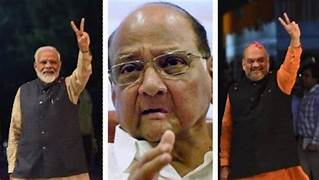
After grabbing power in Haryana in October, 2024, Amit Shah and Narendra Modi are out to usurp the Maharashtra electorate to their advantage by every means available to them. Losing Maharashtra would be detrimental to the stability of Modi’s government which is standing on crutches of the Chandra Babu Naidu and Nitish Kumar other NDA petty partners. Now, a clash of two master strategists – Amit Shah, Sharad Pawar, and the super strategist Narendra Modi to grab power in Maharashtra – the war of Lords
Both Amit Shah and Narendra Modi have the paraphernalia like the Enforcement Directorate, Central Bureau of Investigation, Income Tax, the Corporate lobby, money power, etc. notwithstanding the Election Commission of India. It is well known how the results of Haryana elections were reversed in their favour. No wonder they would not indulge in the same strategy to win Maharashtra by hook or crook.
Amit Shah, often referred to as the Chanakya of Indian politics, was instrumental in the rise of the Bharatiya Janata Party (BJP). His brilliance was evident in the 2014 Lok Sabha elections, where the BJP’s saw a landslide victory, particularly in Uttar Pradesh by winning 71 out of 80 seats. His ability to strengthen the party’s organizational structure was pivotal.
Shah introduced changes like encouraging veteran leaders to use the internet and adopting a more democratic roundtable style for meetings. His campaigns were known for their precision and effectiveness. During the 2019 Lok Sabha elections, he held over 100 political rallies, second only to Prime Minister Narendra Modi.
Sharad Pawar, the chief of the Nationalist Congress Party (NCP), is renowned for his negotiation skills and ability to build alliances. His political career spans several decades, during which he has navigated complex political landscapes with finesse. He played a crucial role in forming the MVA alliance in Maharashtra, bringing together the Congress, NCP, and Shiv Sena (UBT).
Pawar’s ability to mediate and negotiate seat-sharing agreements showcases his strategic acumen. In the 2024 Maharashtra Assembly elections, Pawar successfully brokered a seat-sharing formula among the MVA partners, ensuring a balanced distribution of seats and maintaining alliance unity. Pawar’s handling of political crises is wonderful. In 2019, Maharashtra political crisis, he managed to outsmart the BJP to form a government with the Shiv Sena and Congress.
Amit Shah is known for his data-driven, grassroots-focused strategies, Shah excels in organizing and executing large-scale election campaigns. His ability to mobilize volunteers and election campaigns on local issues has been key to the BJP’s success. Shah’s strategies have transformed the BJP into a formidable political force in India, particularly in states like Uttar Pradesh.
Sharad Pawar’s strength lies in his negotiation skills and ability to build and maintain alliances. His experience and political acumen enable him to solve complex political issues and manage crises effectively. Pawar’s influence extends beyond electoral victories. His ability to bring together diverse political parties and maintain alliance unity has had a significant impact on Maharashtra’s political fabric.
While both leaders are exceptional in their own right, Sharad Pawar’s unparalleled negotiation skills and ability to navigate political complexities make him a unique figure in Indian politics. His long-standing career and consistent ability to surprise opponents highlight his incomparable strategic brilliance.
Attacks Between Amit Shah and Sharad Pawar
Amit Shah has been vocal in his criticism of Sharad Pawar, often targeting him on issues of corruption and governance. Shah has labelled Pawar as the ringleader of corruption in Indian politics, accusing him of institutionalizing corruption. Shah’s attacks are not just limited to corruption; he has also criticized Pawar’s handling of the Maratha reservation issue, claiming that Pawar’s government neglected the reservation whenever they were in power.
Sharad Pawar has not been far behind in responding to Amit Shah’s attacks. He has reminded Shah of his past, particularly the time when Shah was banished from Gujarat by the Supreme Court in connection with the Sohrabuddin Sheikh encounter case. Pawar has also accused Shah of misusing the laws of Gujarat and questioned the direction in which Shah is leading the country.
Amit Shah’s Influence on Maharashtra Politics
Amit Shah’s strategic manipulations have significantly influenced the political scene of Maharashtra, particularly through the splitting of the Nationalist Congress Party (NCP) and Shiv Sena. In a dramatic turn of events, Ajit Pawar, Sharad Pawar’s nephew, defected from the NCP and joined hands with the BJP.
This move was seen as a masterstroke by Amit Shah, as it weakened the NCP’s position and created a rift within the party. The BJP, along with Ajit Pawar’s faction of the NCP and Eknath Shinde’s Shiv Sena, formed the Mahayuti alliance. This alliance has been crucial in strengthening power in Maharashtra and challenging the opposition Maha Vikas Aghadi (MVA) coalition.
Splitting the Shiv Sena
After the 2019 Maharashtra Assembly elections, the BJP and Shiv Sena failed to agree on power-sharing terms. This led to the formation of the MVA coalition (Shiv Sena, NCP, and Congress) under Uddhav Thackeray. However, Amit Shah’s strategic moves, including Ajit Pawar’s brief alliance with the BJP, showcased his ability to disrupt political equations.
Eknath Shinde, a senior leader of the Shiv Sena, effected a rebellion against Uddhav Thackeray’s leadership. Shinde’s faction eventually aligned with the BJP, further weakening the Shiv Sena and altering the political dynamics in Maharashtra. Amit Shah played a pivotal role in negotiating seat-sharing arrangements within the Mahayuti alliance, ensuring that the BJP retained a significant share of seats while accommodating the demands of its allies.
Splitting of the Nationalist Congress Party
BJP tapped into Ajit Pawar’s political ambitions. Ajit, the nephew of NCP chief Sharad Pawar, had been vying for a greater share of power within the NCP, especially given the growing influence of his uncle. By offering him a significant role in the government, the BJP was able to secure his defection, which weakened the NCP’s unity.
The BJP capitalized on existing factions within the NCP by focusing on members who felt marginalized or were frustrated with Sharad Pawar’s leadership style. This pre-existing factionalism made it easier for BJP to cause a rift and split the party.
The BJP used Enforcement Directorate (ED) and the Central Bureau of Investigation (CBI) to create pressure on certain NCP leaders by either opening or intensifying investigations into alleged irregularities. This created leverage over those facing scrutiny, making them more inclined to align with the BJP.
The BJP timed its move during a period of political instability in Maharashtra, following the Shiv Sena split. This created a moment where internal cohesion was already strained across parties, making NCP’s internal fracture more accessible.
By offering key positions in the Maharashtra government to leaders who defected, the BJP made their proposition more attractive. This included offering ministerial roles to Ajit Pawar and his supporters, which solidified their decision to join forces with the BJP and weakened the NCP further.
This strategy allowed the BJP to create a breakaway faction within the NCP, led by Ajit Pawar, which continues to play a role in Maharashtra’s complex political dynamics. Ajit Pawar was made Deputy Chief Minister and Finance Minister in the new dispensation.
Clash of two master strategists – Amit Shah, Sharad Pawar, and the super strategist Narendra Modi to grab power in Maharashtra – the war of Lords – Narendra Modi and Sharad Pawar
Narendra Modi, rose from humble beginnings to become the Prime Minister of India. His early association with the Rashtriya Swayamsevak Sangh (RSS) and later the Bhartiya Janata Party (BJP) laid the foundation for his political career
Modi is known for his dynamic and charismatic leadership. His ability to connect with the masses through powerful speeches and social media has been a significant factor in his political success. Modi’s leadership style is marked by decisive action and a focus on economic reforms and national security.
Modi’s tenure has seen significant economic initiatives like “Make in India,” “Digital India,” and the implementation of the Goods and Services Tax (GST). These reforms aim to boost manufacturing, digital infrastructure, and economic growth
Modi’s government has taken a strong stance on national security, evident in actions like the surgical strikes against Pakistan and the abrogation of Article 370, which granted special status to Jammu and Kashmir. Modi has enhanced India’s global standing through active diplomacy and participation in international forums. His visits to various countries and engagement with world leaders have strengthened India’s global ties.
Sharad Pawar: The Master Negotiator
Sharad Pawar has had a long and illustrious political career. He founded the Nationalist Congress Party (NCP) in 1999 after splitting from the Indian National Congress (INC). Pawar has served as the Chief Minister of Maharashtra and held key positions in the Union Cabinet.
Pawar is known for his pragmatic and strategic approach to politics. His ability to manage alliances and salvage complex political landscapes has earned him a reputation as a master negotiator. He leadership style is characterised by his deep understanding of grassroots politics and his ability to mediate and resolve disputes.
Pawar played a crucial role in forming the Maha Vikas Aghadi (MVA) alliance in Maharashtra, bringing together the Congress, NCP, and Shiv Sena (UBT). His negotiation skills were crucial in maintaining the alliance. His handling of political crises is noteworthy. During the 2019 Maharashtra political crisis, he thwarted the efforts of BJP and form a government with the Shiv Sena and Congress.
As the Union Minister of Agriculture, Pawar implemented several policies to support farmers and improve agricultural productivity. His tenure saw significant initiatives aimed at boosting the agricultural sector.
Narendra Modi excels in organizing and executing huge election campaigns. His ability to mobilize volunteers and dovetail campaigns to local issues has been key to the BJP’s success.
Pawar’s strength lies in his negotiation skills and ability to build and maintain alliances. His experience and political acumen enable him to navigate complex political landscapes and manage crises effectively.
Modi’s strategies have transformed the BJP into a dominant political force in India, particularly in states like Uttar Pradesh. His focus on economic reforms and national security has significantly shaped India’s political landscape.
Pawar’s influence extends beyond electoral victories. His ability to bring together diverse political parties and maintain alliance unity has had a significant impact on Maharashtra’s political landscape. His pragmatic approach and crisis management skills have made him a formidable figure in Indian politics.
While both leaders are exceptional in their own right, their distinct styles and approaches highlight the diversity of leadership in Indian politics. Modi’s dynamic and charismatic leadership contrasts with Pawar’s pragmatic and strategic approach, showcasing the varied paths to political success in India.
Clash of two master strategists – Amit Shah, Sharad Pawar, and the super strategist Narendra Modi to grab power in Maharashtra – the war of Lords – The Conclusion.
Amit Shah’s political career is marked by his expertise in covert operations and strategic brilliance. From his early days in the RSS to his role as the Union Home Minister, Shah has consistently demonstrated his ability to navigate complex political landscapes and achieve significant victories for the BJP. His data-driven campaigns, grassroots mobilization, and covert operations have solidified his reputation as one of India’s most formidable political strategists.
Amit Shah’s strategic brilliance and political manoeuvring have significantly reshaped Maharashtra’s political landscape. His ability to split key political parties like the NCP and Shiv Sena, coupled with his sharp attacks on leaders like Sharad Pawar, has cemented his position as a formidable political strategist.
The Pegasus spyware controversy highlights the complex interplay between technology, politics, and privacy. While the allegations against Amit Shah and the Modi government remain contentious, the controversy underscores the need for robust safeguards to protect citizens’ privacy and prevent the misuse of surveillance technology for political purposes.
Modi’s strategies have transformed the BJP into a dominant political force in India, particularly in states like Uttar Pradesh. His focus on economic reforms and national security has significantly shaped India’s political landscape.
On the other hand, Sharad Pawar’s resilience and counterattacks highlight the ongoing power struggle and the complex dynamics of Indian politics. It is well known how the results of the Haryana elections were reversed in their favour.
No wonder they would not indulge in the same strategy to win Maharashtra or Jharkhand by hook or crook since both Narendra Modi and Amit Shah have full confidence in the Election Commission of India which has taken oath to stand by them.
[…] के बाद, अमित शाह और नरेंद्र मोदी महाराष्ट्र के मतदाताओं को अपनी ओर करने के लिए हर […]