
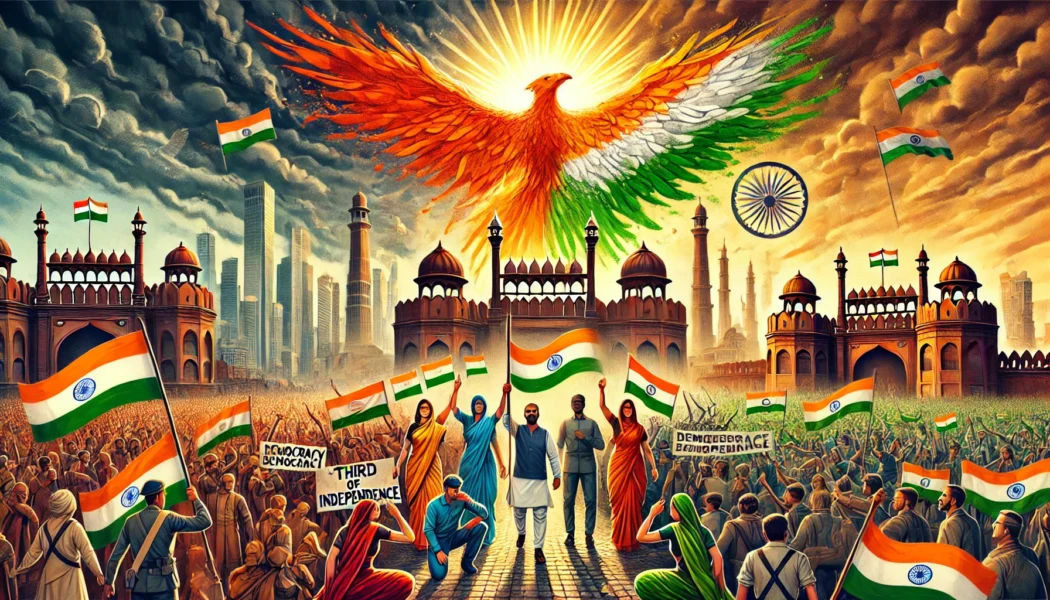
The call for Third War of Independence could a pivotal moment in the country’s political and social evolution. India, having achieved independence from colonial rule in 1947 (First Independence) and economic liberalization in 1991 (Second Independence), is now striving for a new form of liberation. This Third Independence might imply emancipation from internal systemic challenges such as authoritarianism, institutional erosion, and socio-economic disparities.
1) Need for a Third Independence
India’s democracy, once hailed as vibrant and inclusive, is facing several systemic challenges.
Federalism, a backbone of India’s democracy, is increasingly being overshadowed by excessive centralization. Allegations of executive interference in the judiciary, misuse of investigative agencies, and media subjugation are weakening the checks and balances.
The wealth gap has widened significantly, with the top 1% owning over 40.5% of the country’s wealth (Oxfam, 2023), leading to socio-economic distress. Polarization along religious lines has reached worrying levels, threatening social harmony.
If unchecked, these trends could undermine India’s democratic ethos and developmental aspirations, making the call for a transformative Third War of Independence urgent.
i) Dictatorial Tendencies
The rise of authoritarianism is manifest in the concentration of executive power, sidelining dissent, and undermining democratic principles. Laws restricting civil liberties, curbing freedom of expression, and targeting critics have contributed to fears of dictatorial governance. Leaders with an unchallenged mandate may overshadow parliamentary democracy that has been happening from 2014.
The frequent use of ordinances bypassing parliamentary debate reflects centralized decision-making. According to PRS Legislative Research, 76 ordinances were promulgated between 2014-2023, compared to 61 during 2004-2014
ii) Concentration of Power
India has witnessed an unprecedented centralization of authority, with key decisions made by a few individuals, sidelining state governments and regional voices. This concentration undermines the federal spirit of the Indian Constitution, tilting the balance toward unilateral control paving a way for unitary system of governance.
The abrogation of Article 370 in Jammu and Kashmir was executed without consultation with local stakeholders, centralizing decision-making in Delhi. The J & K was under President’s rule. The assent of the Governor was taken instead of the State Legislature. The Inter State Council which fosters federal coordination, has met only twice in the past decade, reflecting weakened federal dialogue
iii) Agencies Misused
Political opponents like Lalu Prasad Yadav, Sonia Gandhi, Arvind Kejriwal have faced investigations by agencies like the ED and CBI during election periods, raising concerns about selective targeting. Over 95% of raids by the ED from 2014-2022 targeted opposition leaders, as reported by Indian Express.
iv) Media Usurped
Mainstream media referred to as Godi Media (lap lock media) has been criticized for functioning as a sponsoring agent for the ruling establishment. Journalistic integrity is under threat, with debates being dominated by propaganda rather than independent analysis. The decline of investigative journalism poses risks to accountability and transparency.
The government cancelled NDTV founder Pranay Roy’s show after critical coverage, sparking allegations of suppressing free media. Later the NDTV was taken over by the Adani Group. India ranked 161 out of 180 countries in the 2023 World Press Freedom Index by 5eporters Without Borders
v) Image Building of the Leader and Unprecedented Publicity
The persona of the leader has been elevated to cult-like status through aggressive campaigns and a personality-cult narrative. This image-building diverts attention from systemic issues and promotes hero worship, undermining the democratic ideal of collective governance.
The Prime Minister’s Mann Ki Baat programme has cost taxpayers ₹800 crores since its inception, showcasing a massive publicity drive. The government spent over ₹3,700 crores on advertisements between 2014-2022, according to RTI responses
vi) Weedicide of the Opposition
Efforts to weaken the opposition, whether through defection, legal cases, or delegitimization, have created an environment of one-party dominance. A robust opposition is vital for democracy, and its erosion leads to unchecked governance.
The defection of 40 Congress MLAs in Goa and Karnataka to the BJP highlights the use of power to weaken opposition. BJP became the largest party in Rajya Sabha in 2021, largely due to defections and coalition politics.
The splitting of Shiv Sena by Eknath Shinde and Nationalist Congress Party by Ajit Pawar in Maharashtra are the fitting examples the weedicide effect.
It is reliably learnt from the sources of West Bengal that Abhishek Banerji, the nephew of Mamata Banerji, is on the radar of BJP. He is being advised to float a new party to damage Mamata Banerji popularity or to align with BJP lest he should face the brunt of the investigating agencies.
Mamata Banerji is on the back foot on the issue of Adani and she was advised to take up the leadership of INDIA alliance to side line Rahul Gandhi to stop him from throwing innuendoes at the Adani group, a move by the conglomerate to weaken Rahul Gandhi and occupy the opposition circles.
vii) Tampering of the Constitution of India
Frequent amendments or reinterpretations of constitutional provisions to serve political ends raise concerns about the dilution of democratic safeguards. Proposals affecting electoral processes, federalism, and individual rights are often seen as attempts to tamper with foundational principles.
The introduction of the Citizenship Amendment Act (CAA) in 2019 was criticized for deviating from the secular ethos of the Constitution. Over 200 petitions against the CAA were filed in the Supreme Court, reflecting widespread opposition.
viii) Capture of Institutions by the RSS
The increasing influence of the Rashtriya Swayamsevak Sangh (RSS) in governance, education, and cultural spheres has sparked debates about its ideological imposition on secular and democratic institutions. Critics argue that this challenges the pluralistic fabric of India.
Key appointments in education, like the Vice-Chancellors of universities, are increasingly drawn from RSS-affiliated organizations. The Ministry of Human Resource Development, Department of Education 2022 report indicates that over 200 textbooks were revised to align with Indian (Hinduism) values, reflecting ideological influence.
ix) Communal Frenzy
The rise in communal polarization, fuelled by hate speeches, mob lynchings, and identity politics, threatens social harmony. The politicization of religion creates a volatile atmosphere, alienating minorities and deepening societal schism.
The 2020 Delhi riots saw over 53 deaths, with allegations of political instigation and targeted attacks on minorities. Communal incidents increased by 96% from 2014 to 2022, as per the Ministry of Home Affairs data.
The Baroda communal pogrom, the unnecessary Sambhal incident and the infamous rape case of Sandesh Khali of West Bengal are the communal indulgences, and the Prime Minister’s communal speeches against the Muslims and slogans like Ek hai to Safe Hai and Yogi Adityanath’s slogan – Batenge to Kantenge have created a communal frenzy atmosphere in the country.
x) The Judiciary System Compromised
Perceived executive influence on the judiciary undermines its independence. Delayed judgments, selective priorities, and allegations of favouritism have raised concerns about the erosion of the rule of law.
Justice Arun Mishra’s praise of the PM during an event sparked concerns about judicial independence. The Prime Minister’s visit to the residence of the then Chief Justice of India, D.Y. Chandrachud on the occasion of the Dasara celebrations compromised the morale of the Judiciary.
As of 2023, over 70,000 cases were pending in the Supreme Court, and delays in critical judgments have raised questions about judicial efficiency and efficacy.
xi) Toothless Tiger Election Commission of India
It is crucial for democratic institutions to function without undue influence, and legislative action could pave the way for a prompt and fair electoral system.
The ECI has been accused of favouring the ruling party, particularly during the 2019 general elections. Opposition parties have claimed that the ECI’s decisions often benefit the ruling party, undermining its neutrality. There have been persistent allegations of EVM tampering and malfunctioning.
Despite the ECI’s assurances and court rulings affirming the reliability of EVMs, opposition parties remain sceptical. The ECI has been criticized for its handling of Model Code of Conduct violations, with accusations that it has been lenient towards the ruling party while being strict with the opposition. The resignation of Election Commissioners like Ashok Lavasa and Arun Goel has raised questions about the internal functioning and independence of the ECI and were forced to leave.
The process for the appointment of the Election Commission was altered by an ordinance by which the Chief Justice of the Supreme Court of India was remove from the selection panel. The Election Commission of India role in transforming the defeats in wins of the elections held in Madhya Pradesh, Chhattisgarh, Haryana and Maharashtra has eroded the credibility of the Election Commission. The people of Maharashtra are on the streets demanding re-elections. The demand of Congress for elections on the ballot paper is will be marching the nation towards the Third War of Independence.
xii) Electoral Malpractices and Money Power
Allegations of vote-buying, manipulation of electoral bonds, and misuse of EVMs have marred the democratic process. The growing role of corporate funding in elections raises questions about the neutrality of policies and governance.
In the 2020 Bihar elections, several complaints of EVM malfunction raised concerns over transparency. A survey by Lokniti-CSDS (2023) revealed that 56% of voters preferred ballot paper over EVMs
Electoral bonds worth over ₹12,000 crores were sold by 2022, with 75% of donations favouring the ruling party. ADR reported that BJP received 76% of total political donations in 2021-22.
The demand to revert to ballot paper stems from scepticism about the integrity of EVMs. Restoring trust in the electoral process is crucial to upholding democracy, and addressing these concerns transparently is vital.
xiii) Corporate Indulgence
The nexus between the corporate sector and political power has led to crony capitalism, with policies favouring a few conglomerates. This has widened economic disparities and destroyed competition.
The Adani Group’s meteoric rise in wealth, linked to policy favouritism, has drawn allegations of cronyism. Gautam Adani’s net worth increased by over 230% between 2020-2022, according to Bloomberg Billionaires Index.
xiv) Dwindling Economy
India’s economic challenges, including rising unemployment, inflation, and a widening fiscal deficit, indicate structural issues. Over-dependence on a few sectors and inadequate focus on equitable growth exacerbate disparities. India’s unemployment rate peaked at 7.8% in 2023, according to CMIE, reflecting inadequate job creation. GDP growth slowed to 4.5% in 2023, far below the projected 8% by the IMF.
xv) Agrarian Unrest and the MSP Demand
Farmers’ protests reflect the rural distress caused by inadequate policies and neglect of Minimum Support Price (MSP) guarantees. Addressing these grievances is critical to sustaining India’s agrarian economy.
The 2020-2021 farmers’ protests against the three farm laws were among the largest in history, involving over 250 million participants. 80% of Indian farmers operate on less than 2 hectares of land, making them dependent on MSP, according to the NSSO.
xvi) Public Apathy Towards the System
Public disillusionment with governance, driven by false promises and a perceived lack of accountability, leads to voter apathy. Reviving trust in institutions is essential to reinvigorate civic participation.
Voter turnout in urban constituencies like Mumbai was as low as 49% in the 2019 Lok Sabha elections. Surveys by Pew Research (2022) indicate a declining trust in the political system, with 64% believing corruption has increased.
xvii) I.N.D.I.A Marches Ahead
The Indian National Developmental Inclusive Alliance (I.N.D.I.A.) success depends on cohesive strategies, grassroots mobilization, and addressing the people’s concerns. The Bharat Jodo Yatra, led by Rahul Gandhi, united opposition parties on key issues like unemployment and communalism.
The I.N.D.I.A alliance governs over 11 states, representing 44% of India’s population (2024). After the debacle of Maharashtra, the opposition activism, and the Congress Party’s inclination to a nation-wide agitation on the electoral process and to bring back ballot paper may march India towards the Third War of Independence.
xviii) The Leader’s Elevation to the Presidency – The Modiocracy
Speculation about a potential elevation of the current leader to a titular or ceremonial role may signify strategic shifts within the ruling party. This move could alter power dynamics and influence future leadership culminating in to Modiocracy or Modism.
Speculation about the PM transitioning to a ceremonial role is often tied to legacy-building aspirations. It is learnt by the reliable sources, that RSS may be planning to give Narendra Modi a respectable exit by offering him the post of the next President of India to complete his ascendency to the last leg of his political salvation.
2) India marches towards its Third War of Independence – Road Ahead for India and the Conclusion
The notion of India’s Third war of Independence is both a call to action and a reflection of hope. It symbolizes the aspiration to overcome internal challenges and build a nation that adheres to its constitutional principles of justice, liberty, equality, and fraternity. While the journey is fraught with challenges, India’s history of resilience suggests that this march towards renewal is not only possible but inevitable.
In the words of Rabindranath Tagore:
“Where the mind is without fear and the head is held high;
Where knowledge is free;
…Into that heaven of freedom, my Father, let my country awake.”