
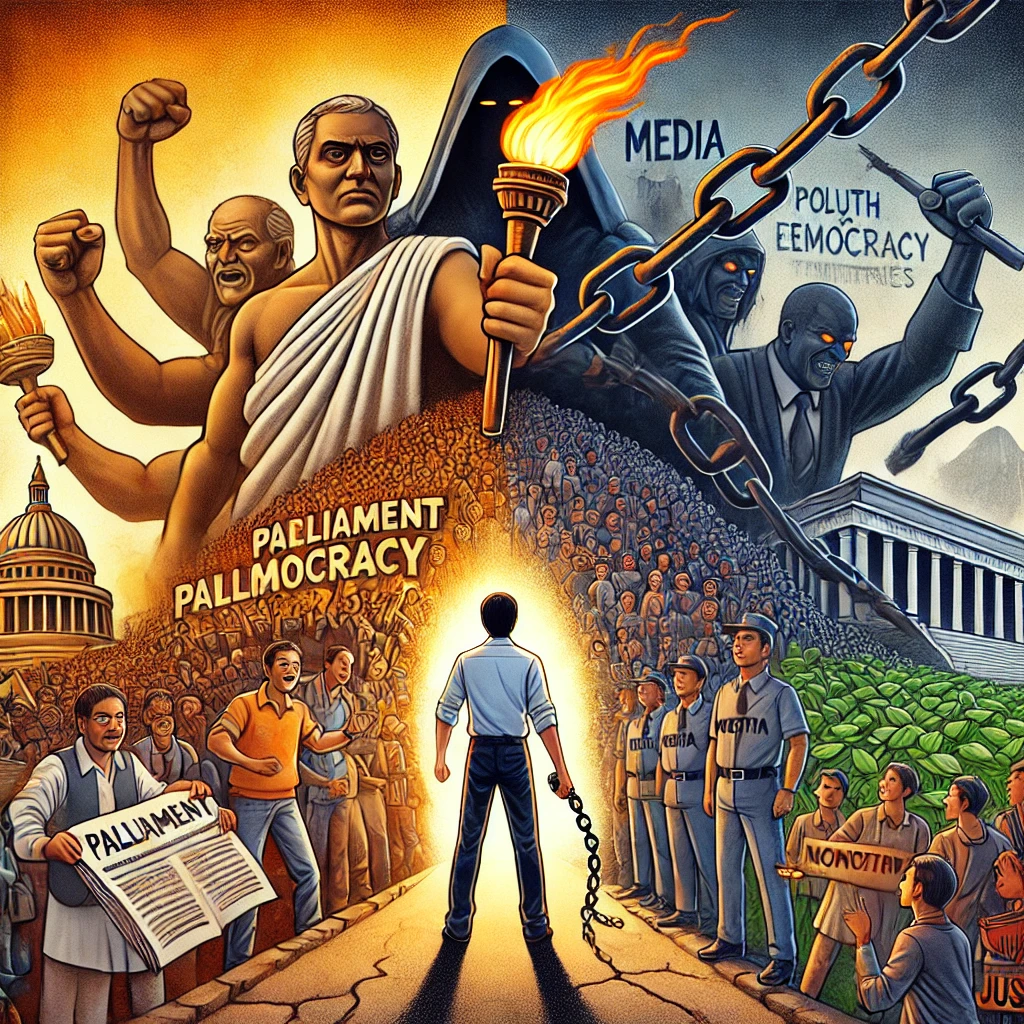
Mission Rahul Gandhi and the four Players – the MAAA. The MAAA (Modi, Amit Shah, Adani, and Ambani) factor has ruled India, for a decade now. It has inflicted almost all the sectors dear to Indians and the MAAA has crippled the Indian democracy – its Constitution, its institutions, its agencies, the economy, industry, share market, and international relations, trade & commerce, all of them are in pathetic conditions beyond repair.
India is pushed to thirty years back. Narendra Modi does not bother. He is on his pleasure trips enjoying electoral victories in Haryana, Maharashtra, and Delhi. He thinks that he is politically on a strong wicket and is least bothered about other developments in the country not to speak of price rise, unemployment, agrarian distress, etc. Rahul Gandhi seems to take him head-on in Gujarat first and later in the rest of the country
Rahul Gandhi’s ongoing political mission seems to be focused on countering the MAAA (Modi, Amit Shah, Adani, and Ambani) factor, which has held significant sway over India for the past decade. The dominance of these four figures has led to widespread concerns over the health of Indian democracy, the economy, and various institutions
Since 2014, the MAAA factor has controlled India’s governance model, economy, and institutional integrity, erosion of Constitutional Institution. The agencies like the Election Commission, Enforcement Directorate (ED), Central Bureau of Investigation (CBI), and Income Tax Department have been systematically applied to target opposition leaders while protecting BJP allies. The Supreme Court and other judicial bodies have often been seen taking soft stands on crucial matters, such as the electoral bonds case, EVM concerns, and constitutional amendments favouring the ruling party.
The meteoric rise of Adani and Ambani is not a coincidence but a direct result of crony capitalism. Adani’s wealth soared post-2014, with massive government contracts handed to his companies, including ports, airports, and coal mines. Demonetization (2016) and a flawed GST structure severely hurt MSMEs (Micro, Small, and Medium Enterprises), which form the backbone of Indian employment. Allegations surfaced that Adani manipulated stock prices in association with the then SEBI Chairperson Madhavi Butch, as exposed by the Hindenburg report. However, regulatory bodies like SEBI did little to investigate.
The 2020-21 farmer protests against the farm laws showed how the government was favouring corporate interests, primarily Ambani and Adani. The laws were repealed only after strong resistance. India faces one of its worst employment crises, with youth unemployment crossing 20% in urban areas. Rising fuel prices, GST hikes, and essential goods’ inflation have hit the middle class hard.
Despite Modi’s claims of a “56-inch chest,” China has occupied Indian territory in Ladakh and Arunachal Pradesh, with little response from the government. India’s influence in Sri Lanka, Nepal, Canada and the Maldives has waned, while China has gained more ground.
Rahul Gandhi’s Mission to Counter MAAA
Rahul Gandhi, after years of political oblivion, appears to have found his footing with two key initiatives. His mass contact movement Bharat Jodo Yatra across 4,000+ km aimed at restoring democratic values, Bharat Nyay Yatra East to West of about 6000+ km highlighting economic distress, and countering communal polarization. These Yatras made Rahul more relatable and countered BJP’s “Pappu” narrative by positioning him as a leader who listens to the people.
Rahul Gandhi’s focus on Gujarat, a BJP stronghold, is strategic. He will directly target Adani-Modi nexus, questioning how public sector industries are sold to Adani. This approach is expected to expand to Bihar, Uttar Pradesh, and West Bengal, where Congress and its allies can challenge BJP’s hold.
The Future of MAAA: Will It Survive?
After 10 years of power, BJP faces anti-incumbency over unemployment, inflation, and governance failures. Modi and Amit Shah dominate BJP, but there is no clear successor. If Modi’s health or popularity declines, the party could see a crisis. INDIA Alliance (Indian National Developmental Inclusive Alliance), despite its flaws, has brought Congress, AAP, Trinamool, and regional parties together. The Hindenburg report and international scrutiny could lead to global sanctions or financial restrictions on Adani’s businesses. If a non-BJP government comes to power, investigations into corporate-government nexus could intensify.
The MAAA factor is deeply rooted in India’s political and economic system, but breaches are beginning to show. Rahul Gandhi’s strategy of exposing corporate-political corruption, engaging with the masses, and reviving opposition unity could pose a serious challenge to MAAA. However, dismantling it will require concerted opposition unity without ego clashes and strong lessoning that connects with voters on issues like unemployment, inflation, and agrarian distress. The 2024 elections have shown that MAAA factor could be challenged.
Mission Rahul Gandhi and the four Players – the MAAA – The Modi Succession Question
Narendra Modi has dominated Indian politics for over a decade, shaping the BJP into a highly centralized party with no clear second-rung leadership. However, the question of who will lead after Modi has become more relevant after 2024 dismal performance.
The Modi-Shah relationship is not that of equals rather a strategic bond. Amit Shah has played the role of Modi’s enforcer—handling electoral strategy, managing party affairs, and crushing political opponents using central agencies like ED, CBI, and IT. Modi enjoys mass popularity, but Shah has worked behind the scenes to ensure BJP’s victories in state and national elections.
While Modi takes credit for policies, Shah has been instrumental in executing controversial moves like Article 370 abrogation, CAA, and political engineering in Maharashtra and Karnataka. However, the real question is whether Modi will willingly hand-over power to Amit Shah or leave BJP struggling to find a leader in his absence. Amit Shah is seen as Modi’s most trusted lieutenant, but he lacks Modi’s mass appeal. The BJP has always been an organization driven by a strong leader—first Vajpayee, then Modi. If Modi were to step down, several factors would come into play.
Modi’s Supreme Ego – Will He Accept a Successor?
Modi has crafted his image as a larger-than-life leader, a “Vishwaguru” (world leader). Unlike Vajpayee, who allowed L.K. Advani and others to have a say in leadership matters, Modi has systematically eliminated all potential challengers within BJP. Modi has repeatedly indicated that he sees himself ruling beyond 2029. His push for “One Nation, One Election” and prolonged centralization suggest he wants to create a Putin-like rule, where he continues to control power indirectly even if not formally in office.
Modi may continue to control government decisions from behind the scenes. Becoming President of India (Like Xi Jinping). He could take over as President of India, using constitutional loopholes to exercise power over the government. Modi could change laws to stay in power longer, just as Xi Jinping removed term limits in China. Given his hunger for power, Modi is unlikely to step aside unless forced by age, health issues, or political setbacks.
The BJP After Modi – Leadership Crisis Incoming?
Modi has eliminated senior leaders and prospective challengers and weakened BJP’s internal democracy. If he exits, BJP will face a leadership vacuum similar to Congress after Nehru’s death. Amit Shah is, a master tactician understands how BJP functions. He has control over the party organization, central agencies, and the RSS. Amit Shah lacks Modi’s blitzkrieg. He is scared, not loved, within the party and among voters.
If Modi does not name Amit Shah as his successor, BJP could face power struggles. Possible contenders could be Yogi Adityanath, a Hindutva hardliner and Chief Minister of Uttar Pradesh, but lacks RSS less backing; Nitin Gadkari, a blue-eyed boy of RSS, but sidelined by Modi and Shah; Rajnath Singh, a senior leader with experience but has scant respect by Modi and Shah. Modi may pick up a weak successor to ensure his indirect control continues. The lack of a clear leader could push BJP into personality fighting, similar to what happened in Congress post-Nehru and Indira Gandhi.
Mission Rahul Gandhi and the four Players – the MAAA – RSS’s Role – Will It Intervene?
The Rastriya Swayamsevak Sangh (RSS) has played a behind-the-scenes role in BJP’s affairs but has become less influential under Modi. If Modi exits, RSS will try to reassert control over BJP. RSS may push for a leader like Gadkari instead of Amit Shah, whom it sees as too harsh but close to Modi. However, RSS also fears BJP weakening if Modi leaves suddenly. If there is a leadership crisis, RSS may struggle to keep BJP united.
Will Modi Exit Leaving India in Crisis?
If Modi unexpectedly leaves power due to health, political loss, or other reasons, India will likely face a governance crisis. BJP’s vertical structure will collapse without a strong leader. An economic crisis like foreign investors, markets, and businesses rely on Modi’s stability. A political instability is imminent, if BJP is divided, opposition parties may gain strength. If Modi’s exit is not well-planned, India could face a period of uncertainty and political turmoil.
If Modi will likely continue ruling beyond 2029, either as PM or in another powerful role, Amit Shah will remain a formidable figure but may not be the next PM. Modi will ensure no strong successor emerges who can challenge his legacy. If Modi steps down voluntarily, Amit Shah is the most obvious choice, but he lacks Modi’s mass appeal. BJP could face resistance from RSS or rival factions.
If Modi is forced out, BJP will face internal divisions, with Yogi, Gadkari, and Shah fighting for control. RSS may try to reassert dominance, but BJP’s future will remain uncertain. Modi is not Vajpayee, who stepped aside for the next generation. He has built a cult empire that does not allow an easy transformation of power. Whether he stays or leaves, one thing is clear that Modi will not give Delhi to others. He will ensure that he remains India’s dominant force, directly or indirectly. If he exits without a proper plan, BJP, RSS, and India could face serious political turmoil—with Amit Shah, RSS, and regional leaders fighting to fill the power vacuum.
Can Rahul Gandhi dismantle the MAAA Brigade and revive India’s Democracy and Economy?
The MAAA brigade has dominated India over a decade, consolidating power over politics, economy, media, and institutions. Their influence has led to democratic declining, economic monopolization, mismanagement and institutional collapse. The Modi-Amit Shah-Adani-Ambani (MAAA) nexus has damaged India’s political and economic space.
Modi and Shah have centralized power, undermining democracy by weakening Parliament (bulldozing bills, suspending MPs); crippling opposition parties through ED, CBI, and IT raids. Adani and Ambani have expanded their wealth exponentially under Modi. Public sector companies like LIC, SBI, and ONGC have been forced to invest in Adani’s ventures.
Privatization of airports, ports, and railways has disproportionately benefited Adani. Agrarian distress and unemployment have worsened due to corporate favouritism. Almost all mainstream media (TV, print, digital) are owned or influenced by Ambani or Adani. The opposition is systematically supressed through media washouts and online content controls.
Rahul Gandhi has shown determination in taking on the Modi regime. His “Adani-Ambani” attacks during Bharat Jodo Yatra and display of copy of the Constitution during election rallies, his tirade on caste-based census have gained attention. His focus on jobs, farmers, and MSMEs goes well with general masses. He has successfully linked Modi to Adani’s corruption scandals
Bharat Jodo Yatra helped him refurbish his image and connect with public. He has worked on alliances with regional parties, despite frictions with some parties like TMC and AAP. Congress’s Himachal Pradesh, Telangana and Karnataka victories show that he is capable of leading electoral battles. While other opposition leaders like Mamata Banerjee, Arvind Kejriwal, and MK Stalin have their own regional bases, Rahul has positioned himself as a national alternative. His speeches in Parliament have boldly called out Modi’s dictatorial policies.
Congress remains organizationally weak in key states like Gujarat, UP, Bihar, and Bengal. The BJP’s electoral machinery, social media control, and corporate funding outmatch Congress. Ninety percent of mainstream media is pro-Modi, blocking Rahul’s message. Even when Rahul exposes BJP’s failures, propaganda machinery spins narratives against him. Paid trends, IT cell attacks, and fake news weaken his credibility.
Election Commission’s bias, EVM concerns, Electoral rolls fraud and voter suppression tactics pose significant challenges. BJP has weaponized agencies to cripple opposition parties financially. The judiciary has failed to act decisively against blatant election code violations. For Rahul to dismantle MAAA, he must overcome institutional capture, which requires a broad, sustained people’s movement beyond just elections.
If Rahul Gandhi succeeds in defeating the MAAA structure, the next challenge would be rebuilding India’s economy and democracy. If Rahul were to come to power, he would need to investigate; Adani’s frauds and reduce corporate-political nexus; strengthen MSMEs, agriculture, and local businesses to reduce dependence on crony capitalism; increase tax transparency and ensure fair competition in business and address unemployment and agrarian distress.
Strengthen Mahatma Gandhi National Rural Employment Guarantee Act (MGNREGA); increase investment in manufacturing and green energy industries; provide direct farm subsidies instead of corporate loan waivers; reform Taxation and boost social welfare; reduce GST burden on small businesses; increase wealth tax on billionaires to fund public welfare and increase public sector investment in health and education.
Democratic Revival
Rahul would need to restore institutional independence by reforming the Judiciary and Election Commission; ensure appointments of judges and Election Commission members independence; un lock political control over investigative agencies; end media monopolies by breaking up corporate-owned news empires; strengthen public-funded independent journalism and protect digital platforms from censorship.; strengthen state governments and local bodies and reduce PMO’s over-centralization of decision-making.
Future of MAAA – Will It Collapse or Reinvent Itself?
Even if Rahul Gandhi succeeds in weakening the MAAA structure, it is unlikely to disappear entirely. Instead, it could rebrand itself. Modi and Shah may prop up a new leader to maintain power; ensure tactics of Adani and Ambani align with a non-BJP government to protect their business interests and create new divisions. BJP could flare up communalism and Hindutva narratives to retain power through polarization. Rahul Gandhi’s real challenge is not just defeating MAAA in elections but ensuring a long-term structural change in India’s politics and economy.
Is Rahul Ready for the Big Battle?
Rahul Gandhi has the vision, ideological clarity, and increasing public support to challenge the MAAA structure. But he lacks the organizational strength, media control, and institutional backing needed for immediate success. he needs a strong national alliance, a grassroots movement beyond elections and a parallel media and communication strategy to counter propaganda.
Rahul Gandhi can dismantle MAAA but only if he plays a long-term game with a strong opposition alliance, mass mobilization, and structural economic reforms. The battle for India’s democracy and economy is not just about 2024 or 2029, it is about reclaiming the conscience of the nation from corporate-political control.
Mission Rahul Gandhi and the four Players – the MAAA – Will Donald Trump come to the rescue of India?
Donald Trump’s approach to India is ruled by geopolitical interests, economic deals, and personal equations with leaders rather than individual loyalty to Modi. If Rahul Gandhi replaces Modi, Trump’s stance will depend on three key factors – his “America First” policy, prioritizing trade, business deals, and defence agreements over personal relationships. His relationship with Modi was transactional, focused on arms deals, boosting US defence sales to India; trade negotiations, pressuring India to open its markets to American products and countering China or using India as a strategic partner in the Indo-Pacific.
However, regardless of who leads India, Trump will engage with any government that serves American interests. Trump prefers leaders who display strongman tendencies. He admired Modi, Putin, and Netanyahu for their authoritarian streaks.
Rahul Gandhi, on the other hand, represents democratic principles and social welfare policies; anti-corporate rhetoric, particularly against Adani and Ambani, who have business ties with American firms, a more balanced foreign policy that might not prioritize the US as aggressively as Modi did.
Trump may initially doubt Rahul’s leadership ability because of his softer, democratic approach. Trump could demand more trade favours from a Congress-led government, expecting them to be weaker negotiators than Modi. Unlike his enthusiastic endorsement of Modi – “Abki Baar, Trump Sarkar”, he may not extend such warm gestures to Rahul.
Trump will not oppose India diplomatically just because Modi is gone. He will not punish India economically unless Rahul enacts strongly anti-US policies. If Rahul Gandhi replaces Modi, India-US relations will shift, but not collapse. If Rahul restricts corporate monopolies, US businesses may push Trump to pressure India. The US needs India to counter China, regardless of leadership changes. US arms sales to India are too lucrative to halt. Trump may not have the same warmth toward Rahul as he did for Modi. If Rahul strengthens ties with Russia or takes an independent stance on US policies, Trump could become more aggressive in dealing with India.
Trump is transactional, not sentimental. He will engage with Rahul’s government if it aligns with American interests. US-India relations will continue, but with new dynamics—less personal camaraderie, more business-like dealings. While Trump might miss Modi’s personal friendship, he will prioritize America’s geopolitical interests and work with Rahul Gandhi, if he comes to power.
Mission Rahul Gandhi and the four Players – the MAAA – The Conclusion
The MAAA (Modi, Amit Shah, Adani, and Ambani) factor has ruled India, for a decade now. It has inflicted almost all the sectors dear to Indians and the MAAA has crippled the Indian democracy Since 2014, the MAAA factor has controlled India’s governance model, economy, and institutional integrity, erosion of Constitutional Institution. Rahul Gandhi, after years of political oblivion, appears to have found his footing with two key initiatives.
After 10 years of power, BJP faces anti-incumbency over unemployment, inflation, and governance failures. Modi and Amit Shah dominate BJP, but there is no clear successor. If Modi’s health or popularity declines, the party could see a crisis. Narendra Modi has dominated Indian politics for over a decade, shaping the BJP into a highly centralized party with no clear second-rung leadership. However, the question of who will lead after Modi has become more relevant after 2024 dismal performance.
If Rahul Gandhi succeeds in defeating the MAAA structure, the next challenge would be rebuilding India’s economy and democracy. For Rahul to dismantle MAAA, he must overcome institutional capture, which requires a broad, sustained people’s movement beyond just elections.
Modi has eliminated senior leaders and prospective challengers and weakened BJP’s internal democracy. Modi may continue to control government decisions from behind the scenes. Becoming President of India (Like Xi Jinping). If Modi exits, RSS will try to reassert control over BJP. RSS may push for a leader like Gadkari instead of Amit Shah, whom it sees as too harsh but close to Modi.
Donald Trump’s approach to India is ruled by geopolitical interests, economic deals, and personal equations with leaders rather than individual loyalty to Modi.