
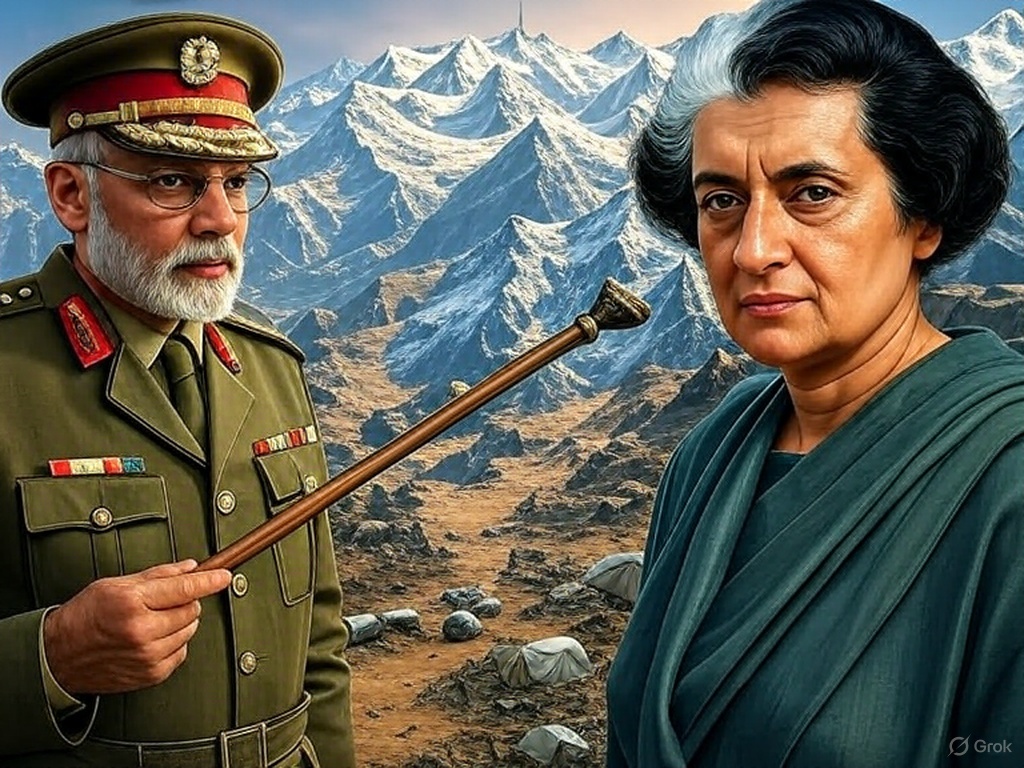
Narendra Modi is punctured by his misadventure and failed to excel Indira Gandhi’s adventure. The India-Pakistan ceasefire announced on May 10, 2025, following intense hostilities sparked by the April 22, 2025, Pahalgam terror attack in Kashmir, is a complex event driven by multiple factors. The role of the U.S.-China trade war, alleged blackmail by Pakistan’s military leadership, and Narendra Modi’s political calculations in India, as well as the claim that Modi’s strategy backfired due to opposition dynamics.
The ceasefire, mediated by the U.S. with contributions from the UK and others, halted the worst fighting since 1971, though violations were reported hours later. Modi’s move matches with his Bharatiya Janata Party’s (BJP) Hindutva ideology, which prioritizes territorial integrity, though he would want to excel Indira Gandhi, given the opportunity to act and it might be a right time for Modi which he would not like to mis but he missed badly.
Theories are afloat that American and Pakistan authorities held a secret meeting before the Pahalgam attack to chalk out business ventures. Trump’s pronouncements are based on these secret meetings.
Narendra Modi is punctured by his misadventure and failed to excel Indira Gandhi’s adventure- The Pakistan factor
Did Pakistan’s General Blackmail India and the U.S.?
Pakistan’s military, facing domestic unpopularity and economic crisis, could relate conflict with India to inflame its legitimacy, as it has historically done. Munir, under pressure to restore acceptability, might have heralded a willingness to escalate militarily, indirectly pressuring India or the U.S. to push for a ceasefire to avoid a fierce war. The ceasefire agreement involved military channels and hotlines, suggesting negotiation, may not necessarily a coercion but the hurry in announcing the ceasefire.
Did General Asim Munir Blackmail the Pakistan Government?
Asim Munir, holds significant control over the civilian government. Munir’s role in installing Prime Minister Shehbaz Sharif after a controversial 2024 election and his suppression of Imran Khan’s PTI party suggests he wields substantial influence. The ceasefire announcement, followed by immediate violations by Pakistan’s military raises questions about whether Munir agreed to the terms Sharif endorsed. Some sources speculate Munir may have resisted the ceasefire, as it offered no clear military gains, and his provocative outbursts before the Pahalgam attack indicates a hardline stance.
Did General Asim Munir underestimated India’s Military Might?
India’s military and advanced capabilities (e.g., Rafale jets, S-400 systems), significantly outmatches Pakistan’s aging equipment. India’s response to the Pahalgam attack, launching Operation Sindoor with apt strikes on Pakistani targets crippling Pakistan’s capabilities demonstrated operational superiority. Munir, aware of 1971 and the Kargil conflicts has anticipated India’s strength but may have misjudged its willingness to escalate decisively, especially under Modi’s aggressive posing. However, India’s superior response exposed Pakistan’s limitations.
Pakistan’s military relies heavily on Chinese equipment (e.g., JF-17 jets, Type 054A frigates) and Turkish drones (Bayraktar TB2), which are cost-effective but less advanced than India’s Western-sourced systems. Sources note Pakistan’s aging F-16 fleet and limited modernization due to economic constraints. India’s strikes reportedly exposed vulnerabilities in Pakistan’s air defences and equipment, as seen in the downing of Pakistani drones.
Munir, as a professional, would be aware of these limitations, given Pakistan’s weak position. The escalation may have highlighted the gap publicly. For example, a Pakistani F-16 crash in 2023 and JF-17’s limited combat record raise questions about air capabilities.
Could Pakistan’s People and Political Dispensation Bear the Burden of War?
Pakistan’s economy is in dire straits, with 40% inflation, and reliance on IMF loans and external aid. The public, facing food and fuel shortages, is scarry of conflict. A prolonged war would exacerbate these pressures, risking unrest.
The political dispensation, led by Prime Minister Shehbaz Sharif is delicate. Shehbaz’s government, installed with military backing, lacks popular legitimacy. Sources note Sharif’s quick ceasefire endorsement, likely to secure economic stability and avoid war’s costs. Financially, Pakistan cannot sustain war, with reserves barely covering imports and defence spending strained.
Was the Pahalgam Attack a Blunder by Munir?
India’s attribution of the Baisaram attack to Lashkar-e-Taiba and The Resistance Front, with Pakistan’s ISI links, suggests military complicity. Munir’s pre-attack pronouncements on Kashmir and the attack’s timing were intended to provoke India. However, the attack triggered an unexpectedly fierce Indian response, including strikes and treaty suspension, which Pakistan could not counter effectively. Sources describe India’s retaliation as crippling, suggesting Munir misjudged India’s resolve or international reaction. The attack was likely a miscalculation, as it provoked a disproportionate Indian response.
Did Pakistan’s “False Showmanship” Boomerang, Forcing the Ceasefire?
The false showmanship posing aligns with Pakistan’s pattern of projecting military might despite weaknesses, as seen in Munir’s comments on Kashmir issue. Pakistan’s aggressive posturing was unsustainable given its military and economic limitations. India’s response and international pressure forced the ceasefire. The false showmanship boomeranged by highlighting Pakistan’s weaknesses, though Munir’s violations suggest an attempt to maintain a face-saving exercise.
Is the “Ghost of Imran Khan” haunting Munir and Sharif?
Imran Khan, ousted as prime minister in April 2022 and imprisoned since 2023, remains Pakistan’s most popular political figure, leading the Pakistan Tehreek-e-Insaf (PTI) party. His anti-military stand and accusations of U.S.-military collusion in his removal is in consonance with Pakistan’s urban middle class and youth, challenging the military’s dominance and Sharif’s legitimacy. Sources confirm Munir manipulated Imran Khan’s downfall and his 14-year sentence on corruption charges, widely seen as politically motivated.
His supporters’ violent protests on May 9, 2023, targeting military installations, strained civil-military relations, and Munir’s vow to punish those involved indicates ongoing tension. Imran Khan’s calls for early elections threaten Sharif’s coalition, which depends on military backing, and Munir’s credibility, as PTI could sweep polls if held. Khan’s popularity and anti-establishment perspective significantly pressure Munir and Sharif, as witnessed by his enduring support and the military’s efforts to suppress PTI.
Have the Afghan Taliban and BLA Increased Pressure on Munir and Sharif?
The Tehreek Taliban-e-Pakistan (TTP), allied with the Afghan Taliban, has escalated attacks in Pakistan, with a 28% rise in 2022 and 79% in early 2023. Munir accuses the Afghan Taliban of sheltering TTP, straining Pakistan-Afghanistan relations. Pakistan’s 2024 deportation of 1.7 million Afghans reflects Munir’s hardline stance, but TTP attacks persist, targeting Khyber Pakhtunkhwa and Baluchistan. Munir’s refusal to negotiate with TTP, unlike his predecessor Bajwa, increases security challenges.
The Baluchistan Liberation Army, a secular separatist group, has intensified attacks on Pakistani forces and Chinese interests. Over 40 soldiers killed in April 2025. Pakistan’s military operations in Baluchistan, including 2024 airstrikes, have not curbed the BLA, which exploits local grievances against resource exploitation. The BLA’s attacks embarrass Munir, who prioritizes internal security, and strain Sharif’s government, reliant on foreign investment.
Both groups challenge Munir’s vision and Sharif’s economic stabilization efforts, as insecurity deters investment and IMF loans. The ceasefire could reflect a need to focus on internal threats, as Pakistan cannot afford a two-front conflict.
The TTP and BLA have significantly increased pressure on Munir and Sharif, as evidenced by rising attacks and Pakistan’s failed containment efforts. Munir’s oppressive Afghan policy and military operations have not curbed these groups, and Sharif’s government faces economic fallout. Pakistan’s internal instability likely contributed to the ceasefire, as Pakistan could not sustain external conflict.
Are Pakistan’s Nurtured Terrorist Outfits Operating Scot-Free?
Pakistan has historically supported groups like Lashkar-e-Taiba (LeT) and Jaish-e-Mohammed (JeM) for proxy warfare against India, with LeT and its proxy, The Resistance Front, linked to the Pahalgam attack. Despite global pressure, these groups operate with vengeance, often under ISI protection, as seen in LeT’s persistence post-2008 Mumbai attacks. Munir’s tough stand, unlike Bajwa’s geo-economic shift, embraces separatist elements, suggesting tolerance for anti-India groups. The Pahalgam attack, likely ISI-backed, indicates these outfits’ freedom, as Pakistan denied involvement but faced India’s retaliation.
The statement claiming that a combined air strategy of China and Pakistan overwhelmed the air superiority of Indian Rafale aircraft, with some being shot down or failing to take off during the May 2025 India-Pakistan conflict, may be speculative and unverified.
Narendra Modi is punctured by his misadventure and failed to excel Indira Gandhi’s adventure – The Trump factor
Trump announced the ceasefire on Truth Social, claiming credit for mediating after a night-long negotiations involving U.S. Secretary of State Marco Rubio and Vice President J.D. Vance. The U.S. role was significant, with Rubio engaging Modi, Sharif, Munir, and national security advisors.
Trump’s repeated announcement treated the ceasefire as a diplomatic win, in consonance with his pattern of seeking high-profile victories but Trump pre-empted him, practically stealing the spotlight. It is also claimed that Munir had informed Trump first, allowing the U.S. to take the credit. However, the idea that Modi was baffled or outsmarted is clear. India’s Foreign Secretary Vikram Misri confirmed the ceasefire indicating India’s active involvement.
Theories are afloat that American and Pakistan authorities held a secret meeting before the Pahalgam attack to chalk out business ventures. Trump’s pronouncements are based on these secret meetings.
International Monetary Fund?
Pakistan’s economy has been in crisis. The International Monetary Fund (IMF) has approved a fresh $2.3 billion (about 19,644 crores) package for Pakistan. Out of this, $1 billion (about 8,537 crores) was given immediately under the Extended Fund Facility (EFF), and $1.3 billion (about 11,094 crore) will come through a new Resilience and Sustainability Facility (RSF).
The ceasefire’s timing matches with Pakistan’s need for economic stability, as continued conflict could jeopardize aid. Sharif’s quick endorsement of the truce suggests a civilian priority to secure international goodwill, possibly tied to financial assistance. Pakistan’s economic criticality made financial aid am imperative. The ceasefire likely served Pakistan’s broader economic interests but Munir’s actions indicate military priorities overshadowed civilian economic goals
Was Modi Caught Napping While Trump Rejoiced?
India’s action like launching precise strikes, securing a ceasefire on its terms, and maintaining measures like the Indus Waters Treaty suspension indicate strategic intent. Modi’s domestic support, including from opposition leaders like Rahul Gandhi and Farooq Abdullah, further undermines the idea of political disunity.
Trump’s rejoicing on his many like-minded announcements, matches with his outbursts but Pakistan’s internal contradictions suggest limited U.S. success. Modi’s government, while definitely irritated by Trump’s media blitz, achieved its immediate goal of de-escalation without compromising its anti-terror stance.
Narendra Modi is punctured by his misadventure and failed to excel Indira Gandhi’s adventure -The China Factor
China and Pakistan have a well-documented military partnership, with China supplying advanced weaponry to Pakistan, including the Chengdu J-10C fighter jets and PL-15 long-range air-to-air missiles used in the conflict. Their strategy suggests coordinated efforts, potentially involving Chinese intelligence, surveillance, reconnaissance (ISR), or electronic warfare (EW) support, alongside Pakistan’s operational execution.
The U.S. officials confirmed that at least two Indian jets, including a Rafale, were downed by J-10Cs, marking a milestone for Chinese military technology. The PL-15, with a range of up to 145 km in its export version (PL-15E), allowed Pakistan to engage Indian jets from a safe distance, potentially outranging the European Meteor missiles carried by Rafales.
China’s AWACs helped Pakistan detect Indian Rafale movements in Kashmir, allowing J-10Cs to snipe them from a distance. While unverified, such support aligns with China’s strategic interest in bolstering Pakistan to counter India. Chinese state media, like Global Times, amplified Pakistan’s claims, framing the J-10C’s alleged success as a triumph for Chinese military technology.
The version of Pakistan and China overwhelming Rafale superiority was projected by Chinese media and social media, boosting the J-10C’s reputation. The conflict saw rampant disinformation, with both sides circulating manipulated images and false claims
China Wanted to Prolong the War?
Trump seem to have impressed upon Modi that China wanted to prolong the India-Pakistan war to weaken India, allowing China to dominate regional trade and diplomacy, catching Modi off-guard. China’s influence in South Asia, particularly through the China-Pakistan Economic Corridor (CPEC), gives it a stake in regional stability.
A prolonged India-Pakistan conflict could weaken India, diverting its resources from competing with China in trade and diplomacy, especially amid the U.S.-China trade war. Trump, wary of China’s growing influence, may have suggested the ceasefire as a way to counter China’s interests, appealing to Modi’s strategic concerns. India’s deployment of forces to the China border since 2020 shows its sensitivity to Chinese threats.
Modi’s government is surely aware of China’s regional ambitions, given the 2020 Ladakh clashes and India’s push to reduce economic dependence on China. The ceasefire matches with India’s interest in avoiding a two-front conflict, suggesting strategic calculation, is not surprise. If Trump discussed China, it reaffirmed India’s existing concerns rather than revealing new insights. The Indian Foreign Minister S. Jayashankar had opined in the past that India would never like to wage a war with China since it was huge country.
Was the Ceasefire a Result of the U.S.-China Trade War?
The U.S.-China trade war, intensified by Trump’s tariffs in 2025, has global economic implications. India, positioning itself as an alternative manufacturing hub to China, benefits from this shift, while Pakistan, economically strained and reliant on Chinese support (e.g., CPEC), faces pressure.
Some suggest the ceasefire reflects U.S. geopolitical manoeuvring to counter China’s influence over Pakistan, especially as the U.S. seeks to stabilize South Asia to focus on trade conflicts. The U.S. mediation, led by Marco Rubio and J.D. Vance, focused on de-escalating a nuclear-armed conflict and the Pakistan’s economic woes and China’s regional influence are background factors, but the ceasefire was primarily driven by the immediate risk of war.
Narendra Modi is punctured by his misadventure and failed to excel Indira Gandhi’s adventure – The Modi Politics
Modi’s emotive response to the Baisaran attack in Pahalgam vowing retaliation, granting the military a complete operational freedom. The attack, seen as a security failure, but all Indian including the Mod’s hard-core followers took a tough stand on Pakistan nearing Bihar elections. The Congress leaders like Rahul Gandhi and Digvijaya Singh, supported Modi’s anti-terrorism stance. It suggests political consensus.
Modi’s aggressive posture was driven by domestic expectations and his strongman image. The ceasefire, while preventing war, did not fully match with Modi’s rhetoric of punishing the terrorists, virtually exposing him to criticism for false promises.
It is also argued that his humanism may have outpoured on the masses of Pakistan saving them from the catastrophe of the war. The Indian Muslims might be pleased at his gesture to soft corner him in the next Bihar elections and Modi would be benefitted from the thrash he had received with the Wakf Board Amendment Act, may be one of the reasons for his sudden change of heart in halting the war like situation.
Modi government may highlight alleged Congress intelligence failures or raise old scandals to discredit them like National Herald case which has since been reactivated and luring of the Congress leaders like P. Chidambaram and Sashi Tharoor is on.
The Bihar Politics
Bihar, with approximately 17% Muslim population is a key battleground for the Bharatiya Janata Party (BJP). The BJP has faced challenges in maintaining its dominance due to caste politics and opposition alliances like the Rashtriya Janata Dal (RJD) and Congress, which often appeal to Muslim voters. The announcement of Caste census strengthens his tendency to use any national crisis to win elections.
The Waqf Board Amendment Act 025 alienated some Muslim voters, as evidenced by protests and opposition from Muslim organizations like the All-India Muslim Personal Law Board. The sources confirm widespread protests against the Act, including in states with significant Muslim populations. The protests in Karnataka, Andhra Pradesh, and Uttar Pradesh, suggest a broader Muslim backlash.
The BJP has historically managed polarization effectively, using issues like national security to consolidate its Hindu voter base, which is numerically dominant in Bihar. While the Waqf Act may have side-lined Muslim voters, the BJP’s strategy often prioritizes its core supporters over minority population. Pahalgam attack was a blessing in disguise for Modi is since the national security crises often rally public support around the incumbent government, especially for a leader like Modi, who projects a strongman image.
To bolster his image Modi started a BJP ‘tiranga yatra’ and his cadres have started demoralising army personnel like Col. Sophia Qureshi and the entire army to be bowing before the feet of Modi by none other than State Ministers like Vijay Shah, a Cabinet Minister in Madhya Pradesh and Jagdish Dewra, Dy. Chief Minister, Maharashtra is a well-planned strategy.
The Gautam Adani Connection
Adani is widely perceived as a close ally of Modi, with the Adani Group benefiting from favourable policies during Modi’s tenure as Gujarat Chief Minister; and later as Prime Minister. While Trump, as President, could influence U.S. policy, the American Department of Justice operates with significant independence. The Adani indictments were pursued under a Democratic Government.
Political Opportunism, Lack of Humanism and Image building
Modi prioritizes electoral success over humanitarian concerns. Modi lost momentum in Bihar due to the Waqf Board Amendment Act 2025. The Act backlash could have weakened the BJP among Muslim voters, and the Pahalgam attack provided a chance to rally nationalist support, aligning with Modi’s electoral strategy. Modi’s actions always reflect political calculations.
Modi’s lack of statesmanship to garner international support by way of his overseas outreach based on image building gimmicks and not based on foreign diplomacy mechanisms. He has been mesmerising the Indian diaspora to eulogise his personality. It is evident that no neighbouring country like Sri Lanka, Bangladesh, Nepal, Bhutan, Maldives have stood by India in war like situation, in spite of Modi’s repeated visits to these countries.
Even friendly countries like the UK, France, Italy, Germany, Saudi Arabia, the UAE, Kuwait etc. did not support India. Modi thought that his image blitz would be enough but diplomacy is achieved not by image building measures but by diplomatic acumen which Modi lacks. He did so in India the world countries know his ways and hence did not respond.
Narendra Modi is punctured by his misadventure and failed to excel Indira Gandhi’s adventure – The Conclusion
Modi wanted to excel Indira Gandhi, given the opportunity to act and it was a right time for Modi which he would not like to mis but he missed badly.
Theories are afloat that American and Pakistan authorities held a secret meeting before the Pahalgam attack to chalk out business ventures. Trump’s pronouncements are based on these secret meetings.
To bolster his image Modi started a BJP ‘tiranga yatra’ and his cadres have started demoralising army personnel like Col. Sophia Qureshi and the entire army as being bowed before the feet of Modi by none other than State Ministers like Vijay Shah, a Cabinet Minister in Madhya Pradesh and Jagdish Dewra, Dy. Chief Minister, Maharashtra is a well-planned strategy.
It is also argued that his humanism may have outpoured on the masses of Pakistan saving them from the catastrophe of the war. The Indian Muslims might be pleased at his gesture to soft corner him in the next Bihar elections and Modi would be benefitted from the thrash he had received with the Wakf Board Amendment Act, may be one of the reasons for his sudden change of heart in halting the war like situation.