
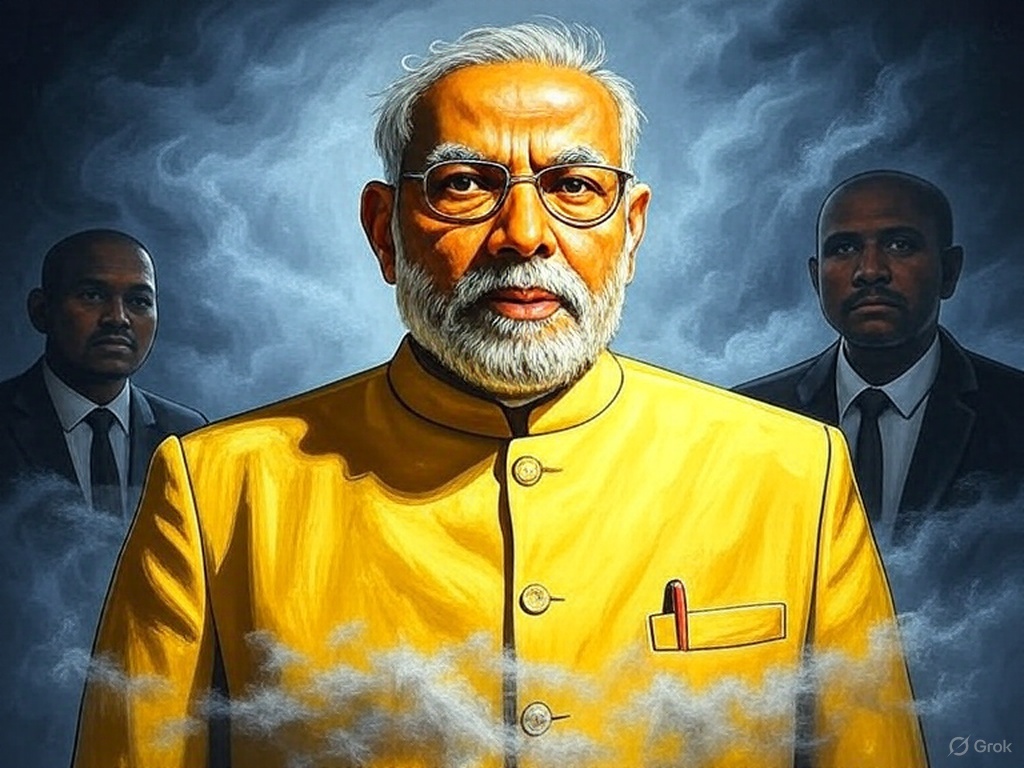
Does Narendra Modi venture into a misadventure to puncture his opponents? Narendra Modi may like to surpass Indira Gandhi by to pursuing action in Pakistan-occupied Kashmir (PoK). Recent tensions between India and Pakistan, particularly following the April 21, 2025, terror attack in Pahalgam, Jammu and Kashmir, which killed 26 people. Modi announced that the attackers will be pursued and will not go unpunished. The Resistance Front (TRF), a Pakistan-based Lashkar-e-Taiba offshoot, took responsibility.
The Government suspended the Indus Waters Treaty, downgrading diplomatic ties, and closing the main border crossing with Pakistan. Pakistan retaliated by closing its airspace to Indian airlines and labelling India’s water treaty suspension as an “act of war.” India’s revocation of Article 370 in 2019 had irked Pakistan and since then activated its covert activities in Jammu and Kashmir. The current “fluid situation” stems from this escalation, with India’s actions signalling a willingness to take a tougher stance. However, any military venture into PoK would be highly risky, given the nuclear capabilities of both nations. The UN on April 24, 2025 urged both the nations restraint.
Indira Gandhi’s leadership led to the creation of Bangladesh in 1971. Gandhi’s actions were bold but calculated, backed by a clear military advantage and Soviet support via the Indo-Soviet Treaty. The 1971 war was a conventional conflict. The Pok is a heavily militarized zone under Pakistan’s control, with China’s strategic interests via the China-Pakistan Economic Corridor. Modi now confronts a nuclear-armed Pakistan with a volatile military command. However, Modi’s move matches with his Bharatiya Janata Party’s (BJP) Hindutva ideology, which prioritizes territorial integrity, though he would want to “excel” Indira Gandhi, given the opportunity to act and it might be a right time for Modi which he would not like to mis.
Modi’s political standing is low at present. His government’s handling of the Pahalgam attack has garnered unanimous support from opposition parties, as noted in an all-party meeting on April 24, 2025, where the government admitted some security lapses. Global leaders, including US President Donald Trump and French President Emmanuel Macron, have expressed solidarity., though most of the countries are against any misadventure of India leading to war and tension in the region, in view of the existing war driven situations in Ukraine and Palestine.
Indian Army and Air Force did take action on the terrorist camps and hide outs in Pok and Pakistan bases on the early hours of 7th May when it destroyed nine such launch pads and training camps successfully under code name ‘Sindoor’ in which terrorist Azhar Masood, his family and his associates was badly hit. It is the beginning of Modi adventure and misadventure is due.
Does Narendra Modi venture into a misadventure to puncture his opponents? Strategy Beyond Bihar
India’s economy, while projected to grow at 6.5-7% in 2025 (per IMF estimates), faces challenges like inflation, particularly in food and fuel prices, which hit the middle and lower classes hard. There is huge public out-cry over rising costs of essentials like vegetables and LPG.
Unemployment remains a burning issue, with the Centre for Monitoring Indian Economy (CMIE) reporting a 7-8% unemployment rate in mid-2024, particularly high among youth. The Agnipath scheme for short-term military recruitment sparked protests in 2022, and Military experts decry the shortage of miliary recruitment about 60,000 personnel per year and similar grievances persist over job scarcity in both public and private sectors.
Modi has been accused of aggravating Hindu-Muslim tensions through policies like the Citizenship Amendment Act (CAA) and rhetoric around “love jihad” or cow protection. The 2024 Ram Temple inauguration in Ayodhya boosted BJP’s Hindu voter base but distanced minorities and now the Waqf Board Amendment Act is contested in the Supreme Court.
The BJP’s 2024 Lok Sabha win relied on coalition partners like JD(U) and TDP, signalling a weaker mandate than 2019. Speculation about Modi’s retirement in early 2025, though downplayed by allies like Amit Shah, reflects internal BJP and RSS dynamics.
Congress’s revival in states like Karnataka and Telangana, Jammu & Kashmir plus opposition unity in Bihar, threatens BJP’s dominance. Modi’s March 2025 RSS headquarters visit suggests efforts to garner ideological support.
Winning the Bihar elections is a priority, as the BJP’s coalition with Nitish Kumar’s JD(U) faces challenges from the RJD-Congress alliance. Modi’s campaign will likely emphasize his tough stance on Pakistan and the Pahalgam response to rally voters around national security. Beyond Bihar, his strategy is to decimate Congress and strengthen BJP’s dominance. Post-2024, the BJP relies on allies like JD(U) and TDP. Modi is struggling to balance coalition demands while pushing Hindutva priorities (e.g., Uniform Civil Code, temple projects) to keep the RSS and core voters energized.
To counter Congress’s welfare promises, Modi may roll out targeted schemes (e.g., farmer subsidies, women-centric programmes and now caste-based census) while showcasing “Viksit Bharat” achievements like infrastructure and digital growth. This will dampen Congress’s appeal in states like Madhya Pradesh, Rajasthan, Uttar Pradesh and Chhattisgarh, where it hopes to recover.
Does Narendra Modi venture into a misadventure to puncture his opponents? Marginalize Congress
To ensure Congress’s irrelevance in future elections particularly Bihar later in Uttar Pradesh, Modi will push issues where Congress struggles—national security, cultural nationalism, and economic self-reliance. By framing Congress as “anti-Hindu” or “pro-Pakistan” he will force it into defensive positions. The PoK narrative keeps Congress on the back foot, as it cannot oppose territorial integrity.
Congress governs states like Karnataka, Telangana, and Himachal Pradesh. Modi will back BJP campaigns to wrest these States, using central schemes, defections, and ED/CBI probes to pressure Congress leaders. In Jammu and Kashmir and Jharkhand, where Congress is a junior partner, Modi will work to fracture opposition alliances.
Modi may position trusted lieutenants like Amit Shah to carry forward his legacy, ensuring BJP’s dominance post-Modi. This weakens Congress’s hopes of capitalizing on a leadership vacuum. Playing the PoK card or aggressive retaliation risks war, economic strain, and global isolation. Modi will likely opt for calibrated strikes or proxy pressure to avoid back lash. If security lapses persist or economic costs (e.g., fuel price hikes from tensions) mount, Congress could gain momentum, Modi will need to balance narrative with Pakistan rhetoric.
Modi serves his political goals but tumbles over complexities. Pakistan’s denial of involvement in Pahalgam and its economic woes suggest non-state actors or internal lapses may be bigger issues than state-sponsored terror. Over-focusing on Pakistan or Congress could distract from governance challenges like unemployment or coalition frictions, which opposition parties may exploit.
Does Narendra Modi venture into a misadventure to puncture his opponents? The Pahalgam venture
The Pahalgam terrorist attack on April 22, 2025, which killed 26 people, mostly tourists, in Jammu and Kashmir, was a pathetic event that raised doubts about security lapses, given prior intelligence inputs. There could be a possible conspiracy linking the attack to a deliberate narrative to bolster a Pakistan attack angle for political gain in the Bihar elections, especially in light of challenges faced by Narendra Modi’s government, such as the Waqf Board Amendment Act and economic issues.
Intelligence agencies had reported the likely terrorist movements. The Prime Minister aborted his visit to Jammu & Kashmir. The Indian Defence Minister reportedly admitted lapses. Mallikarjun Kharge, highlighted the government’s absence from an all-party meeting post-attack, suggesting a focus on electioneering over crisis management.
The announcement of the Modi government of the caste-based census in the midst of the terrorist turmoil raises doubts about the lack seriousness of the attack. Modi cut short of his Saudi visit, but appears in Bihar to give election speech. He is continuously on election sojourns – Kerala, Andhra Pradesh. He needs a strong narrative to face Bihar electorate and consolidate his position and the Pahalgam is the right opportunity.
The Waqf Board Act sparked controversy, with opposition parties and some Muslim groups alleging it targeted minority rights. Government has faced a flak in the Supreme Court when it suspended some of the prominent provisions of the Act. The Court has not given any relief to the Government on 6th May and it would come up again on 15th May before new the Chief Justice Gavai.
The overall economic conditions are not conducive to Modi’s rhetoric, so is the foreign relations. The action on Pakistan is overdue and is in the interest of the BJP cadres who are anxious to the know anticipated ventures of Modi so that they could rejoice and endure.
The conspiracy theory is not yet out and would not come out in future. Take the examples of the Pulwama and the revelations of the then Governor Satya Pal Malik. The government’s handling of the attack invites criticism. The alleged intelligence failure demands substance. The BJP’s tendency to frame such events in communal terms, which risks polarizing voters and alienating minorities is well known and Narendra Modi had also been at the forefront to invoke the voters to vote for his ventures. India needs a statesman and not a politicking politician like Narendra Modi.
The Pahalgam attack has unified parties, but Modi will frame the BJP as the sole guardian of national security. By contrasting his decisive actions (e.g., Article 370 revocation, Balakot) with Congress’s “soft” past (e.g., UPA’s handling of 26/11), he will paint Congress as weak.
Modi will exploit Congress’s internal divisions and Rahul Gandhi’s perceived lack of unified opposition. His government may highlight alleged Congress “intelligence failures” or raise old scandals to discredit them like National Herald case which has since been reactivated. The BJP’s lap-lock media, including friendly outlets and social media, will amplify this and government has punished many of the social media groups like 4PM News network channel.
Does Narendra Modi venture into a misadventure to puncture his opponents? Foreign diplomacy an image building exercise
Modi’s government has engaged in adventurous foreign policy, evident in the 2016 surgical strikes and 2019 Balakot airstrikes following terror attacks. The Pahalgam attack, attributed to Pakistan-linked groups, fits this pattern. A PoK operation, however, would be a significant escalation. However, improving his political standing but Modi loves adventurism and opportunity to strike the opposition.
The establishment narrative, as reflected in Indian media and government statements, emphasizes Modi’s resolve against terrorism and Pakistan’s involvement. Pakistan’s denial of involvement in the Pahalgam attack and its economic delicateness suggest it has little to gain from provoking India, raising questions about whether state-sponsored terrorism is the full story.
At 74, Modi remains India’s dominant political figure, with no clear successor in sight. His centralized control, cult of personality, and BJP’s electoral machine suggest a desire to extend influence. India’s democratic framework, with regular elections and judicial oversight, makes indefinite rule unlikely.
The BJP and RSS have a collective leadership history. Speculation about Modi’s retirement in early 2025, rise leaders like Amit Shah and Yogi Adityanath. His RSS visit in March 2025 suggests he is managing these dynamics, not overriding them. Now the Waqf Board Amendment Act crisis. Moreover, international dynamics—China’s support for Pakistan, the US’s balancing act between India and Pakistan, and Russia’s supportive stance—limit India’s room to manoeuvre. A PoK venture could alienate allies and embolden China, which has stakes in PoK via CPEC.
Does Narendra Modi venture into a misadventure to puncture his opponents? The Conclusion
Modi’s strategy, beyond winning Bihar, will centre on targeted counter-terrorism, diplomatic isolation of Pakistan, and economic pressure via measures like the Indus Waters Treaty suspension. To decimate Congress, he will amplify nationalist rhetoric, undermine its leadership, and weaken its regional strongholds while pushing BJP’s Hindutva and development agenda. The PoK remains a rallying point.
Narendra Modi might exploit the current India-Pakistan tensions post the April 22, 2025, Pahalgam attack to divert attention from domestic challenges—economic crisis, price rise, unemployment, religious polarization, farmer unrest, and political instability—while enhancing his personal image with an eye on lifelong leadership.
Modi could indeed use the Pahalgam crisis to “bury” domestic issues by escalating anti-Pakistan rhetoric, pursuing limited military and dominating the narrative via media. This aligns with his track record of involving security for political gain, as seen in 2019. In Bihar and beyond, he will frame BJP as India’s security savvy to decimate Congress and grab voters. Narendra Modi venture into POJK and Pakistan did take place and his misadventure is due.
However, domestic issues like price rise and unemployment will not perish, and over-dependence on nationalism risks escalation or backlash. Modi seeks a lasting legacy within India’s democratic framework, not indefinite power. His challenge is balancing short-term diversion with long-term governance.
In Bihar, Modi will deploy proven tactics from Haryana, Maharashtra, and Delhi; nationalist rhetoric linking the Pahalgam attack, caste consolidation, welfare schemes to counter economic critiques, Hindutva to unify Hindu votes, and media dominance to sideline Congress.
He will brand Congress as irrelevant within Mahagathbandhan, while aligning with RSS’s agenda to secure their support and counter tensions. However, RJD’s strength, economic realities, and coalition dynamics and the resurgent Congress pose challenges.
The Waqf Act has significantly weakened Nitish Kumar’s Muslim support, with resignations and protests eroding JD(U)’s secular credentials, a blow Modi likely anticipated given BJP’s minimal reliance on Muslim votes. After Pahalgam, Modi is weighing nationalist rhetoric, Hindutva, and caste consolidation to dominate Bihar’s campaign, potentially sidelining Kumar’s governance narrative, much like he did with Shard Pawar, Uddhav Thackeray, Akali Dal, and BJD.
Tactics from Haryana, Maharashtra, and Delhi—nationalism, defections, media dominance, and RSS mobilization—are evident, with the Waqf Act serving as a tool to force Kumar into a Hindutva-aligned corner. However, Kumar’s electoral base (EBCs, Kurmis) and political acceptability make total marginalization unlikely in 2025.