
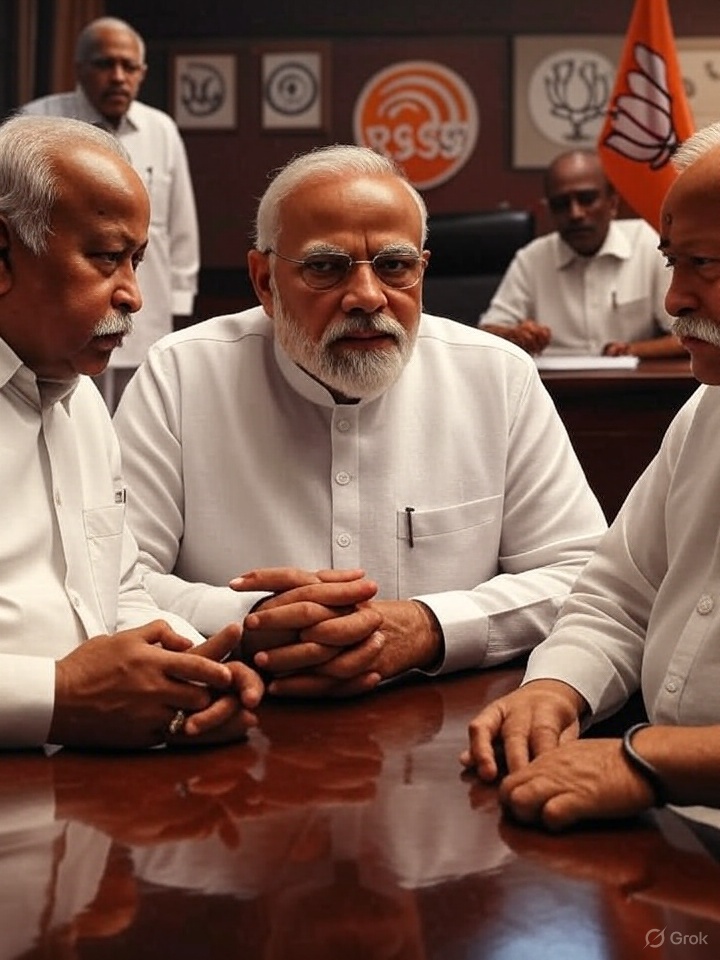
The Rastriya Swayamsevak Sangh has realized the dangers to its survival from Narendra Modi’s leadership. The RSS, the ideological parent of the Bharatiya Janata Party (BJP), has historically set the party’s agenda as the Hindutva. However, tensions between Modi’s centralized leadership and the RSS’s organizational ethos have emerged over Narendra Modi rule.
Reports suggest occasional skirmishes between the RSS and BJP, particularly over Modi’s dominance. It was claimed that Modi has “cut the RSS to size,” indicating that his control over the BJP has reduced the RSS’s influence.
The delay in selecting a new BJP President, with J.P. Nadda continuing on extension since January 2023, has been attributed to disagreements between Modi and the RSS. Modi’s visit to the RSS headquarters in Nagpur on March 30, 2025, was an attempt to improve ties and secure RSS approval for a new BJP Chief, but it failed to resolve the issue.
The RSS’s stated resistance to a caste-based census, contrasted with Modi’s government approving it in May 2025, highlights a potential ideological disagreement. This shift is seen as challenging the RSS’s majoritarian stance, as caste census could empower demands for social justice, potentially diluting the Hindutva’s ideology.
However, the RSS has publicly backed Modi on key issues. For example, RSS Chief Mohan Bhagwat and General Secretary Dattatreya Hosabole issued a joint statement endorsing Modi’s Operation Sindoor against Pakistan-based terror infrastructure in May 2025, signalling support during a national crisis.
Bhagwat’s meeting with Modi after the Pahalgam terror attack in April 2025 and Modi’s visit to the RSS’s Smruti Mandir in Nagpur suggest a public display of unity, even if strategic differences exist.
Modi’s acknowledgment of RSS Swayamsevak’s’ role in events like the Maha Kumbh Mela and his tributes to RSS founders Hedgewar and Golwalkar indicate his agreement with RSS ideology, particularly on cultural and religious fronts.
The RSS recognizes that Modi’s centralized leadership (Modiocracy) and public posing (Modiology) can both accelerate and challenge its influence. While Modi’s policies often go with RSS goals (e.g., the Ram Temple, Article 370 abrogation, or the Waqf bill), his dominance risks losing the RSS’s autonomy.
The term “Modicide” may resonate with critics who see Modi’s policies as divisive. Instead, the RSS appears to balance support for Modi with efforts to maintain its ideological sway, as seen in its grassroots mobilization post-Pahalgam attack.
The Rastriya Swayamsevak Sangh has realized the dangers to its survival from Narendra Modi’s leadership – Congress and Rahul Gandhi’s attacks on RSS
Rahul Gandhi and Congress leaders have consistently criticized the RSS, accusing it of undermining constitutional values and promoting Manusmriti over Dr. Baba Saheb Ambedkar, the main architect of the Constitution of India. Congress President Mallikarjun Kharge called the BJP-RSS “enemies” of Ambedkar’s legacy, and Rahul Gandhi has framed a “50-year battle” against the RSS’s Hindutva agenda.
Congress leaders like Harshvardhan Sapkal and V.S. Ugrappa have questioned RSS demanding Dalit, Muslim, or Women representation as its Chief, and even claimed that the RSS is planning to go easy with Modi due to his declining imagery. These attacks attribute the RSS as a polarizing force, however evaluating its future prospects if Congress gains power.
A generation shift in RSS ideology
The recent RSS statements emphasized cultural preservation and selfless service, with Bhagwat praising swayamsevaks for “simple living” and social upliftment. Jyotiraditya Scindia’s comments on RSS upholding Shivaji’s legacy also frame it as a cultural organization but the Emperor Shivaji was a secular in his character. The RSS’s support for Operation Sindoor and its focus on issues like the Waqf bill and Catholic Church lands suggest it remains committed to its Hindu nationalist agenda, notwithstanding the party in power but for Narendra Modi’s pragmatism.
The RSS’s stubbornness over the years—operating even under bans during Congress regimes—indicates it could adapt to a Congress-led government without abandoning its core ideology. Its vast network allows it to influence public opinion and mobilize support in a better way when the BJP is power.
The Rastriya Swayamsevak Sangh has realized the dangers to its survival from Narendra Modi’s leadership – Is the RSS Seeking to Distance Itself from Modi, Shah, and Nadda?
Congress leader V.S. Ugrappa’s claim that the RSS is planning to remove Modi due to his declining popularity reflects its opposition. The stand of over the BJP President selection, with Nadda’s extended tenure and reported RSS-BJP tensions, suggests the RSS may resist Modi’s preferred candidates to reassert influence. The RSS’s concern about Modi’s “personality domination” weakening organizational strength indicates unease with the Modi-Shah’ control over the BJP.
The RSS’s public endorsements, such as Bhagwat’s meetings with Modi and the joint statement on Operation Sindoor, suggest continued support, especially on national security and cultural issues. Modi’s visit to the RSS headquarters and his tributes to its founders signal a mutual effort to project unity, even if tactical and irritating.
The RSS seeks to reiterate its influence over the BJP rather than outright remove the troika – Modi, Shah, or Nadda. The delay in appointing a new BJP President and the caste census decision suggest the RSS is trying to neutralise Modi’s dominance. The troika remains pivotal to the BJP’s success, and the RSS, as a long-term ideological force, is unlikely to risk destabilizing the party unless a viable alternative emerges may in the name of Nitin Gadkari.
Mohan Bhagwat’s “DNA” Comment
In 2021, Mohan Bhagwat during an event in Ghaziabad stated that all Indians share the same DNA, emphasizing unity amongst communities and religions, despite differences in worship or caste. He further said that any Hindu or non-Hindu claiming otherwise is not a Hindustani.
In 2021, Mohan Bhagwat during an event in Ghaziabad stated that all Indians share the same DNA, emphasizing unity amongst communities and religions, despite differences in worship or caste. He further said that any Hindu or non-Hindu claiming otherwise is not a Hindustani. The statement goes with the RSS’s sole agenda of cultural unity under Hindutva, framing India as a Hindu nation where diversity is inherent under a habituated cultural heritage.
Critics, including opposition leaders, viewed it as a strategic move of the RSS’s image in response to growing fragmentation and accusations of fostering communal hatred, as seen in Congress’s critiques of the RSS. The “same DNA” comment may reflect the RSS’s attempt to balance its ideological commitment to a Hindu state with pragmatic outreach to broader society, especially under attack from opposition leaders like Rahul Gandhi.
Bhagwat’s resentment toward Modi’s leadership
There have been instances where Mohan Bhagwat’s statements or actions have been interpreted as sharp critiques of Narendra Modi’s leadership style, particularly its centralized nature and perceived sidelining of the RSS’s influence within the BJP.
In June 2023, after the BJP’s Karnataka election loss, Bhagwat emphasized humility and consensus-building, saying, “One person cannot do everything,” which some analysts interpreted as a veiled jab at Modi’s personality-driven leadership (Modiocracy). Similarly, his comments on avoiding “unnecessary remarks” were seen as targeting BJP leaders’ deviating tendencies.
Reports indicate RSS-BJP tensions, with the RSS pushing for a President goes with its organizational ethos, while Modi and Shah reportedly favour loyalists. Modi’s March 30, 2025, visit to the RSS headquarters in Nagpur aimed to resolve this but failed, suggesting ongoing friction.
The RSS’s avowed opposition to a caste-based census, viewing it as divisive to Hindu unity, clashed with Modi’s government approving the census in 2025. This diversity donned perceptions of the RSS feeling waylaid. Despite tensions Bhagwat and RSS General Secretary Dattatreya Hosabole issued a joint statement endorsing Modi’s Operation Sindoor against Pakistan-based terror infrastructure in May 2025, signalling endorsement on national security.
Bhagwat’s meetings with Modi, such as after the April 2025 Pahalgam terror attack, and Modi’s tributes to RSS founders Hedgewar and Golwalkar during his Nagpur visit, prompt unity. The RSS’s grassroots mobilization after Pahalgam attack or during the Maha Kumbh Mela, indicates it benefits from Modi’s leadership when matches with its goals.
RSS’s Relationship with Amit Shah
Shah’s role in BJP’s decision-making has been seen as marginalizing RSS cadres. It is claimed that Modi has “cut the RSS to size,” with Shah’s influence over party appointments and strategy reducing RSS influence.
The RSS’s push for a new BJP President reflects uneasiness with Shah’s control over organizational matters, as he reportedly backs candidates loyal to Modi rather than RSS-ideological cadres. Shah’s hardline policies and manipulations—prioritizing electoral wins over ideological pursuits—may irritate RSS hardliners who value long-term cultural agenda.
The RSS feels that Shah as a powerful but potentially dominating figure whose loyalty to Modi sometimes overshadows RSS priorities. While ideological understanding exists, Shah’s role in consolidating Modi’s control over the BJP creates friction, particularly over organizational matters like the BJP Presidency.
RSS Cadre MPs’ Discontent with Modi
The claim that a majority of hardcore RSS cadre MPs are unhappy with Modi, points to internal BJP dynamics and the RSS’s influence over its parliamentary wing. That was the reason why Narendra Modi did convene a BJP meeting to elect him as a leader of the Lok Sabha. He got endorsement from the NDA allies.
RSS-cadre MPs, often rooted in the Sangh’s ideology, may feel sidelined by Modi’s centralized leadership and preference for loyalists over its ideologues. The delay in BJP organizational elections and the dominance of Modi-Shah’s duo in candidate selection and policy decisions could fuel this discontent.
The RSS’s emphasis on collective leadership, as seen in Bhagwat’s 2023 remarks, contrasts with Modi’s Modiocracy, virtually resonating with MPs who prioritize RSS’s ethos. Opposition innuendos, such as Congress leaders’ claims, amplify perceptions of RSS-BJP friction, suggesting that cadre MPs are frustrated with Modi’s “declining popularity” and electoral setbacks
The Rastriya Swayamsevak Sangh has realized the dangers to its survival from Narendra Modi’s leadership – Dr. Subramanian Swamy’s attacks on Modi and Shah
Dr. Swamy has consistently targeted Modi and Shah on various issues, ranging from economic mismanagement to foreign policy and national security, often reasoning their leadership as detrimental to the interests of India and the BJP.
He has accused Modi of lacking economic expertise, calling him an unsuitable leader. In February 2025, Karnataka Congress minister Santosh Lad referenced Swamy’s criticisms, alleging that BJP leaders privately share concerns about Modi’s economic policies but hesitate to speak out due to a “suffocating atmosphere” within the party.
Swamy has repeatedly criticized Modi’s handling of China, alleging that Modi and Shah lied about Chinese incursions in Ladakh, claiming China occupied 4,046–4,067 sq. km of Indian territory since April 2020. He labelled this a “treason” and demanded Modi’s resignation.
Swamy questioned Modi’s frequent international sojourns about a hundred, suggesting they harm India’s global image and rightly seen post Operation Sindoor when nobody came to the support of India. He criticized Modi’s Ukraine visit in 2024 and warned against a potential Pakistan visit. He also slammed Modi and Shah over Canada’s 2024 allegation that Shah ordered a campaign against Khalistani separatist Hardeep Singh Nijjar, demanding a joint press conference or threatening a Public Interest Litigation (PIL).
Swamy has accused Modi of trying to control the BJP by empowering loyalists with no public roots and importing corrupt leaders from other parties, diluting the RSS’s ideological foundation. He called for internal party elections monitored by Sangh-affiliated referees to counter this trend.
Swamy has used harsh rhetoric, calling Modi a “coward” on issues like Maldives and Bangladesh. He warned that Modi risks losing his PM chair if he does not retire at 75. Swamy linked BJP’s 2024 by-election losses to Modi’s leadership. He implied broader party frustration with Modi’s inability to secure victories.
Swamy has emphasized the RSS’s critical role in BJP’s success, warning that Modi and Shah’s attempts to dilute RSS ideology by flocking the party with loyalists who could alienate the cadre. He stated that without RSS support, BJP leaders, including Modi, would “lose their deposit” in elections. Swamy’s critique of Modi’s control over the BJP, sidelining RSS ideology, echoes the RSS’s reported uneasiness with Modi’s centralized leadership (Modiocracy).
Swamy’s attacks on Shah as Modi’s agent go with the RSS’s reported discomfort with Shah’s influence over party appointments and strategy, which alienates RSS cadre. Swamy’s claim of internal dissent may include RSS-affiliated MPs, are unhappy with Modi’s authoritarian approach. The RSS’s emphasis on collective leadership, seen in Bhagwat’s 2023 remarks on humility, contrasts with Modi’s style, virtually fuelling cadre fatigue.
Swamy’s focus on personal attacks and legal threats contrasts with the RSS’s preference for internal dialogue to influence BJP leadership, such as over the BJP President selection. Swamy’s candidness may serve as a pressure point for the RSS, amplifying its concerns without the organization directly confronting Modi. Swamy’s emphasis on RSS ideology and his claim that Modi is “a zero without RSS patronage” suggest he retains some ideological alignment with the Sangh, which may shield him from expulsion.
The RSS is unlikely to endorse Swamy’s aggressive stance but may use his critiques to pressure Modi for greater alignment, as seen in its push for a new BJP President. However, his marginalization within the BJP suggests he lacks the cadres to mobilize significant dissent.
The Rastriya Swayamsevak Sangh has realized the dangers to its survival from Narendra Modi’s leadership – The Conclusion
The RSS is piloting a complex relationship with Modi’s leadership. While “Modiology” and “Modiocracy” may create tensions by centralizing power and occasionally diverging from RSS priorities, the organization continues to back Modi on key issues like national security and Hindutva projects. His “Modicide” moves more with opposition critiques than RSS concerns. Rahul Gandhi’s attacks and the prospect of a Congress-led government may pressure the RSS to soften its stand, but its commitment to a Hindu state remains firm.
Mohan Bhagwat’s “same DNA” comment reflects the RSS’s attempt to project inclusivity within its Hindutva framework, not a departure from it. His occasional jibes at Modi’s leadership, such as on humility or consensus, and the RSS’s frustration over the BJP president delay indicate tensions with Modi’s centralized control (Modiocracy).
The RSS’s relationship with Amit Shah is strained due to his role in consolidating Modi’s dominance, though ideological alignment persists. Hardcore RSS cadre MPs may sponsor discontent with Modi, but this is limited to internal grumbling rather than open revolt, given the RSS’s disciplined structure and shared goals with the BJP. If a Congress-led government emerges, the RSS’s historical firmness suggests it would adapt without fundamentally altering its ideology.
Dr. Subramanian Swamy’s scathing attacks on Modi and Shah highlight real tensions within the BJP, particularly over Modi’s centralized leadership and Shah’s dominance, which aligns with the RSS’s concerns about its fading influence. His claim of significant BJP dissent, supported by figures like Nitin Gadkari or Davendra Fadnavis as alternatives, reflects internal frustrations but lacks backing from party leaders.
The RSS, while sharing some of Swamy’s views, adopts a more practical approach, balancing public support for Modi with efforts to reassert control, such as over the BJP President selection like Bandi Sanjay from Telangana. Swamy’s continued presence in the BJP despite his dissent suggests strategic tolerance, possibly due to his RSS ties or legal utility.