
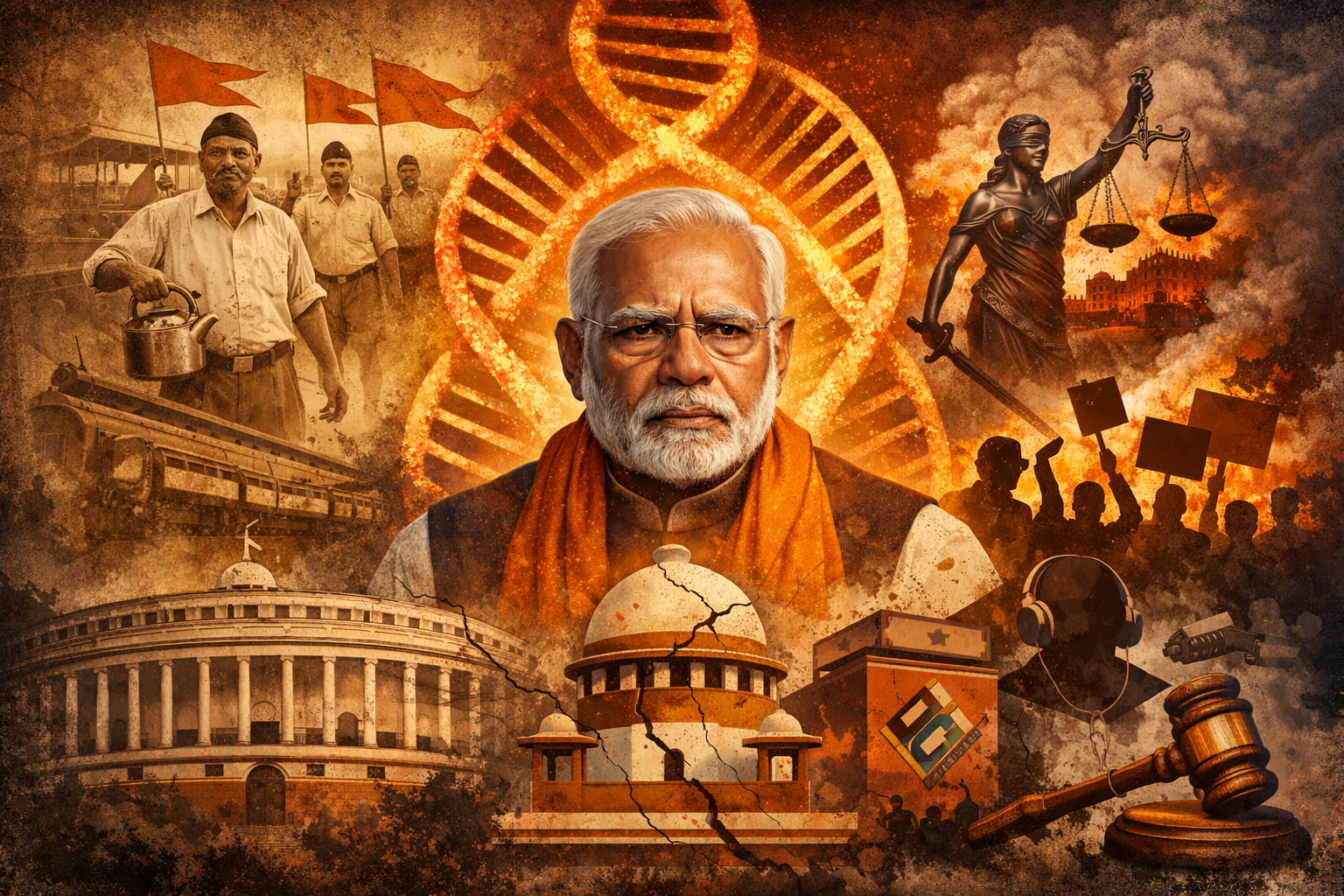
Trauma is the DNA of Narendra Modi? – Trauma, Power, and the Indian State. Since childhood, Narendra Modi suffered a metaphorical and political-psychological trauma. He experienced personal deprivation, emotional isolation, and prolonged ideological conditioning that shaped his personality, political style, and exercise of power. The unresolved trauma became a driving force behind his politics, governance approach, and relationship with opponents- early deprivation and the formation of a political personality.
Narendra Modi’s childhood narrative is one of economic hardship and emotional scarcity. While this story is often celebrated as an inspirational journey, political psychology suggests that early deprivation can foster traits such as emotional rigidity, excessive self-reliance, and intolerance for uncertainty. Leaders shaped by hardship may prioritize control over consultation and authority over deliberation.
In a constitutional democracy like India, however, leadership is expected to operate within the spirit of collective responsibility (Article 75) and deliberative governance. A political culture overly centred on one individual risk, weakening these constitutional norms.
The Indian Constitution is explicitly pluralistic. Its Preamble commits the Republic to justice, liberty, equality, and fraternity. Any ideological framework that prioritizes cultural homogeneity over constitutional pluralism inevitably comes into tension with these foundational values.
He did not enjoy his childhood
Narendra Modi has repeatedly spoken about his impoverished childhood, helping his father sell tea at a railway station. It was presented as a symbol of struggle that created early deprivation often creating emotional rigidity, hyper-competitiveness, and a strong need for control later in life.
Leaders shaped by hardship sometimes develop an intolerance for dissent, viewing disagreement as an obstacle rather than a democratic necessity. Modi’s limited engagement with unscripted press conferences is often cited as reflecting this control instinct.
He did not taste his adulthood
Modi’s early immersion in the Rashtriya Swayamsevak Sangh (RSS), which replaced the usual experiences of youth—relationships, experimentation, or independent self-discovery—with strict discipline and ideological conditioning. RSS life emphasizes obedience, hierarchy, and ideological loyalty. His association with RSS enabled him for centralized decision-making and top-down governance, marginalizing cabinet colleagues and party veterans.
Modi’s early and lifelong association with the RSS replaced the usual social experiences of adulthood—family life, plural social exposure, and independent ideological evolution. While ideological commitment is not inherently problematic, the danger arises when ideology becomes a substitute for empathy.
Modi’s emotional refuge was not personal relationships but ideology, especially a form of hyper-nationalism that divides society into patriots and anti-nationals. Criticism of government policies is often branded as anti-national, and dissenting voices—journalists, students, activists—are targeted using sedition laws or investigative agencies.
He did not enjoy parenthood or family life
Modi’s estranged marriage and lifelong bachelorhood are often presented by supporters as evidence of sacrifice. The absence of familial emotional anchoring can intensify ego-centric worldviews and reduce empathy in public decision-making. Policies like sudden demonetization (2016), replacement of MANRGA (2026) which caused severe hardship to millions, were announced without broad consultation—suggesting emotional distance from everyday suffering.
He created a political web as Chief Minister of Gujarat
He along with Amit Shah created a political environment that enabled Modi to grab power. As Gujarat CM, Modi consolidated power by weakening internal party democracy, cultivating loyal bureaucrats, and aligning corporate interests with political authority. The Gujarat Model emphasized infrastructure and investor-friendly policies at the cost of health, nutrition, and minority welfare.
Modi’s lack of sustained family life has often been portrayed as sacrifice for the nation. The absence of personal emotional anchors can intensify ego-centric leadership, where public institutions become extensions of personal authority. The tendency is visible in the centralisation of power in the Prime Minister’s Office, often at the expense of Cabinet autonomy, Parliamentary debate and Federal principles enshrined in the Seventh Schedule. India’s Constitution envisions the Prime Minister as first among equals, not as an unaccountable executive authority.
Trauma is the DNA of Narendra Modi? – Trauma, Power, and the Indian State. Congress actions triggered his political transformation
The snoop-gate controversy, post-Godhra scrutiny, and cases against him and Amit Shah were turning points that transformed Modi’s insecurity into political aggression. After facing international isolation (visa denial by the US), Modi focused on image reconstruction, later projecting himself as a global statesman while systematically dismantling political opponents.
Modi’s tenure as Chief Minister of Gujarat marked a decisive shift in his political trajectory. Events such as the 2002 communal riots, subsequent legal scrutiny, and international isolation produced a leader increasingly hostile to institutional oversight.
Instead of deepening commitment to constitutional accountability, these experiences appear to have normalised the idea that institutions are obstacles rather than safeguards. This mindset clashes with Judicial review (Articles 32 and 226), Independent investigation and Minority protection under Articles 14, 15, and 25
He developed hatred toward the Gandhi family
Modi’s politics gradually became personalized opposition, centred not on ideology but on symbolic revenge against the Nehru–Gandhi lineage. Repeated public attacks on dynasty politics, despite BJP promoting dynasts elsewhere, indicate that the target is selective and symbolic, not principled.
Political opposition—particularly the Congress Party and the Gandhi family—has been framed not merely as ideological rivalry but as existential antagonism. While criticism of dynastic politics is legitimate, its selective application raises questions of intent. A healthy democracy requires competitive pluralism, not symbolic vendettas. When political competition becomes personalized, governance risks degenerating into permanent electioneering.
Trauma is the DNA of Narendra Modi? – Trauma, Power, and the Indian State. Prime Ministership satisfied ego, vengeance, and control
Modi’s elevation to Prime Minister in 2014 marked the transition from political survival to political domination. The concentration of power in the executive has since been accompanied by diminished parliamentary scrutiny, weakening of standing committees and ordinance-driven governance. This undermines the constitutional principle of checks and balances, essential to preventing executive overreach.
Once in power, Modi moved from political survival to political domination, using state power to neutralize critics and rivals. Use of central agencies (ED, CBI, IT) disproportionately against opposition leaders; weakening of federalism through Governor’s offices.
Governance is secondary to ego satisfaction
The governance outcomes are often sacrificed for spectacle, image, and political messaging. Massive publicity campaigns, personality-centric welfare branding (Modi guarantees), and routine disruptive Parliament functioning being reduced in favour of executive announcements.
The institutional capture is necessary for Modi to sustain his political project, as power itself has become the means of emotional and ideological validation. The Election Commission neutrality is lost. Its purpose has been winning elections for Modi. The Judiciary has been constantly compromised. Its delayed judgements in politically sensitive cases have benefitted the government.
Media reduced to cheerleaders rather than watchdogs
Political leadership is never shaped in isolation. Personal history, ideological conditioning, and institutional opportunity together determine how power is exercised. In the case of Narendra Modi, a growing body of political commentary interprets his leadership through a psychological–political lens, arguing that unresolved personal deprivation and ideological immersion have significantly influenced his style of governance. Modi’s trauma has become central to Modi’s political DNA, and has profound consequences for India’s constitutional democracy.
When institutions appear aligned with executive priorities rather than constitutional mandates, democracy shifts from rule of law to rule by authority. The Supreme Court itself has repeatedly warned that democracy is not merely electoral victory but institutional integrity.
Trauma is the DNA of Narendra Modi? – Trauma, Power, and the Indian State. Trauma as Political Continuity
The trauma is a lifetime disorder shaped by deprivation, ideological insulation, and perceived persecution. It has produced a leadership style that seeks validation through power, control, and permanence.
While undergoing traumatic bouts, Narendra Modi did not bother to heal himself but started enjoying political gains and games. He failed to emulate the economic prowess of Dr. Manmohan Singh; political acumen of PV Narasimha Rao; secular sentiment of Atat Bihari Vajapee and off course the statesmanship of Jawaharlal Nehru. He remained the most disastrous and the most detested Prime Ministers of India.
Trauma is the DNA of Narendra Modi? – Trauma, Power, and the Indian State. The Conclusion
India’s Constitution was designed to protect the Republic from personality-driven governance. Its framers understood that unchecked power—regardless of the leader—poses the gravest threat to democracy.
In a democracy constitutional morality must prevail over individual ambition. The true test of leadership lies not in domination but in restraint, not in control but in accountability.