
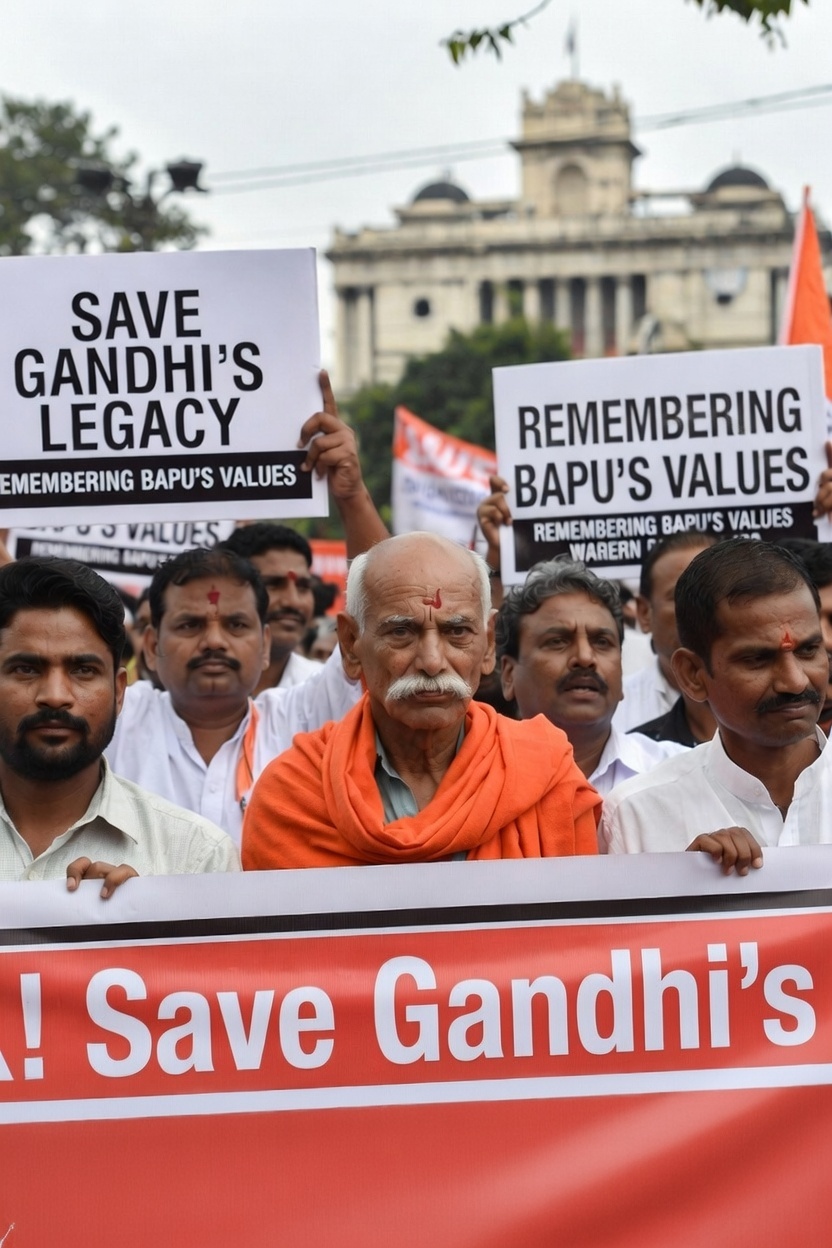
Narendra Modi’s sport is to uproot the Gandhi legacy. Narendra Modi’s government has been employing a multi-pronged attack to uproot the historical and political legacy of the Gandhi family—both Mahatma Gandhi’s philosophical contributions and the Nehru-Gandhi dynasty’s role in post-independence India.
Modi’s methodology has been a blend of symbolic erasure, institutional reconfiguration, and ideological appropriation, aimed at reshaping national narratives to move closely with Hindu nationalist tendencies while reducing the spectacle of Congress-era icons. However, the government defended many of the actions as necessary reforms, modernizations, efforts to honour a broader spectrum of Indian figures and priorities, updates to reflect evolving knowledge, and measures to address inefficiencies like corruption and leakages, rather than intentional erasure.
Narendra Modi’s sport is to uproot the Gandhi legacy- Renaming Spree
Modi’s administration has systematically renamed numerous programmes, places, and honours originally associated with the Nehru-Gandhi family, replacing them with names tied to other national figures or neutral descriptors. Critics argued this eroded the family’s imprint on India’s development story. The government, however, justified the changes as revamping outdated schemes for better efficiency, claiming credit for enhancements, and honouring underrepresented icons rather than dynastic figures.
The Rajiv Gandhi Khel Ratna Award, India’s highest sporting honour was renamed after Major Dhyan Chand Khel Ratna Award in 2021. About 30 government schemes or institutions bearing Nehru-Gandhi names were rebranded, often with references to Hindu nationalist ideologues. For instance, the Nehru Memorial Museum and Library was transformed into the Prime Ministers’ Museum and Library. The government described the change as to include all prime ministers and the propensity to drift toward one family.
Universities named after Nehru-Gandhi family members have had their names replaced. Postage stamps featuring Indira and Rajiv Gandhi in the “Builders of Modern India” series were discontinued. Others include renaming Nirmal Bharat Abhiyan to Swachh Bharat Abhiyan and the rural LPG distribution programme to Ujjwala.
Narendra Modi’s sport is to uproot the Gandhi legacy- Rewriting Educational Content and History
Changes to school curricula and textbooks have been accused of omitting elements that highlight tensions between Gandhi’s ideals and Hindu nationalism that reflect negatively on Modi’s past roles.
In 2023, the National Council of Educational Research and Training (NCERT) revised textbooks to remove references to Mahatma Gandhi’s opposition to Hindu nationalism, hatching a conspiracy to assassinate him and the government’s ban on the Rashtriya Swayamsevak Sangh (RSS) post Gandhi’s assassination by Nathuram Godse in 1948.
The Mughal history was deleted from the books for older students, alongside removals of content about the 2002 Gujarat riots—where over 1,000 people died during Modi’s tenure as chief minister of Gujarat.
Narendra Modi’s sport is to uproot the Gandhi legacy– Redeveloping Historical Sites and Appropriating Symbols
The Sabarmati Ashram in Ahmedabad, where Mahatma Gandhi lived from 1917 to 1930 and launched key freedom movements, has been undergoing about ₹ 12,650 crore ($140 million) redevelopment works. It includes restoring original structures, relocating a road, demolishing later additions, and displacing about 1,000-2,000 residents most of them belong to tribals and the down trodden. The plan is to recreate the ashram as it appeared in the 1920s-1930s based on a 1949 aerial photo.
The government justified the works as doing justice to the site after past governments’ neglect, driven by appeasement politics and a lack of political will to maintain heritage; it wants to renew Gandhi’s legacy with modern facilities.
Modi very often invoked Gandhi in speeches and programmes, such as dedicating the Swachh Bharat campaign to him, which is seen as paradoxical appropriation to vote politics.
Narendra Modi’s sport is to uproot the Gandhi legacy– Modi massacred MGNREGA
The repeal of the Mahatma Gandhi National Rural Employment Guarantee Act (MGNREGA) of 2005 is the latest example. Enacted under the Congress-led UPA government and named after Mahatma Gandhi to symbolize rural empowerment, it guaranteed 100 days of wage employment per year to rural households on demand, with full central funding for wages and unemployment allowances if work was not provided.
On December 18, 2025, the Modi government repealed it via the Viksit Bharat Guarantee for Rozgar and Ajeevika Mission (Gramin) Bill (VB-G RAM G Act), which received Presidential assent shortly after.
Key differences and changes:
The new act increased guaranteed employment to 125 days per year but shifts to a supply-driven model with capped central allocations (e.g., ₹95,000 crore), rather than demand-based. Funding now follows a 60:40 Centre-state split (90:10 for special category states), with states bearing excess costs.
It introduced a 60-day seasonal pause during peak farming periods to avoid labour shortages, raises penalties for violations from ₹1,000 to ₹10,000, and centralizes oversight under a new Central Gramin Rozgar Guarantee Council instead of the Rural Development Ministry.
The government justifies the repeal and replacement by citing the need to address alleged corruption, leakages, and implementation challenges in MGNREGA—such as delays in wage payments and agricultural labour shortages—while introducing a “paradigm shift” for better efficiency, deterrence of malpractices (e.g., via symbolic elements like “Ram” in the name), and integration with broader goals like “Viksit Bharat” (Developed India).
The “assault” on MNREGA has long been a point of contention. Modi government argued, it has been underfunded or administratively weakened over the years, while supporters point to reforms like direct benefit transfers to reduce corruption.
This move has sparked controversy. Proponents, including government allies, frame it as modernization to make the programmes more efficient and aligned with broader economic goals like “Aatmanirbhar Bharat“.
The Congress party called it an ideological attack to erase Mahatma Gandhi’s association with the scheme, which they credit for aiding millions during economic crises like the COVID-19 pandemic. Priyanka Gandhi Vadra questioned the need to remove Gandhi’s name, calling it a “BJP-RSS conspiracy” on the centenary of the Rashtriya Swayamsevak Sangh (RSS).
The MNREGA revamp fits into a documented trend under the Modi government (since 2014) of renaming schemes, institutions, laws, and places originally linked to Mahatma Gandhi, Jawaharlal Nehru, Indira Gandhi, Rajiv Gandhi, or the broader Nehru-Gandhi family.
The actions have intensified debates about India’s historical perspective, with the opposition viewing them as vindictive, while supporters see them as inclusive reforms. The MGNREGA repeal stands out as a recent escalation, directly tying the last shot at the Gandhi legacy.
Narendra Modi’s sport is to uproot the Gandhi legacy – A systematic erasing
The act drops “Mahatma Gandhi” from the name entirely, which Congress leaders like Sonia Gandhi, Rahul Gandhi, and Priyanka Gandhi Vadra have decried as an “attack on the poor” and a deliberate move to neutralise Gandhi’s association with rural upliftment.
It was argued that it undermines workers’ rights by making employment a “favour” rather than a legal entitlement, centralizes power, and burdens states financially—potentially leading to the scheme’s practical demise. The government counters that the changes formalize improvements, incentivize better state-level schemes, and build on MGNREGA’s foundation without erasing its intent.
The changes also include underfunding or reorienting schemes like the Indira Awaas Yojana (housing for the poor, renamed Pradhan Mantri Awaas Yojana) and similar Congress-initiated programmes.
Challenging Dynastic Politics Electorally
Modi has weakened the Gandhi family’s political stronghold by defeating their candidates and promoting anti-dynasty rhetoric, framing it as democratizing Indian politics.
In elections since 2014, multiple Gandhi family members and allies have lost key seats, such as Rahul Gandhi’s defeat in Amethi in 2019. This has been termed as ending “dynastic politics.” Events like hosting celebrations for Hindu nationalist figures at Nehru-associated venues further symbolize this shift.
It also touches on broader debates about Prime Minister Narendra Modi’s governance style—”Modiism”, implying a centralized, development-focused approach with elements of cultural nationalism—and allegations of systematically diminishing the legacies of Mahatma Gandhi and the Nehru-Gandhi family.
This is often interpreted to “rewrite history” by diminishing the Indian National Congress’s historical role in independence and nation-building, while promoting BJP/RSS icons.
Renaming the Rajiv Gandhi Grameen Vidyutikaran Yojana to Deen Dayal Upadhyaya Gram Jyoti Yojana (2015); Nirmal Bharat Abhiyan to Swachh Bharat Abhiyan; and rural LPG distribution to Ujjwala Yojana.
Removing Nehru-Gandhi names from some awards or museums, like reorienting the Nehru Memorial Museum and Library into the Prime Ministers’ Museum (2023). Telangana Congress leader T. Jeevan Reddy accused the BJP of targeting Gandhi and Nehru to “erase” them from public memory.
Government argued those were not erasures but corrections for “historical imbalances,” emphasizing efficiency, inclusivity, or honouring overlooked figures like Deen Dayal Upadhyaya or Syama Prasad Mukherjee.
Renaming does not literally delete historical records—books, archives, and global recognition of the Gandhis remain intact—but it can shift public symbolism and narratives over time. Some users note irony, recalling Modi’s past criticisms of MNREGA as a “monument to failure” before his government relied on it during the pandemic.
Narendra Modi’s sport is to uproot the Gandhi legacy – The Conclusion
The MNREGA rename goes with over a dozen similar actions since 2014, and with the BJP’s strong parliamentary position more could follow if ideologically blend.
Erasing entrenched legacies like Mahatma Gandhi’s or the Nehru-Gandhi family’s is impossible in a democracy with free media, opposition, and civil society. International views remain unchanged.
History is not “rewritten” overnight; it’s debated and evolves. These changes reflect political rebranding more than outright erasure, but they do influence how future generations perceive legacies. If “overwriting with Modiism” means prioritizing Modi’s vision in public policy and symbolism is evident. The MNREGA revamp is a real policy shift with symbolic overtones, but predicting full historical erasure.