
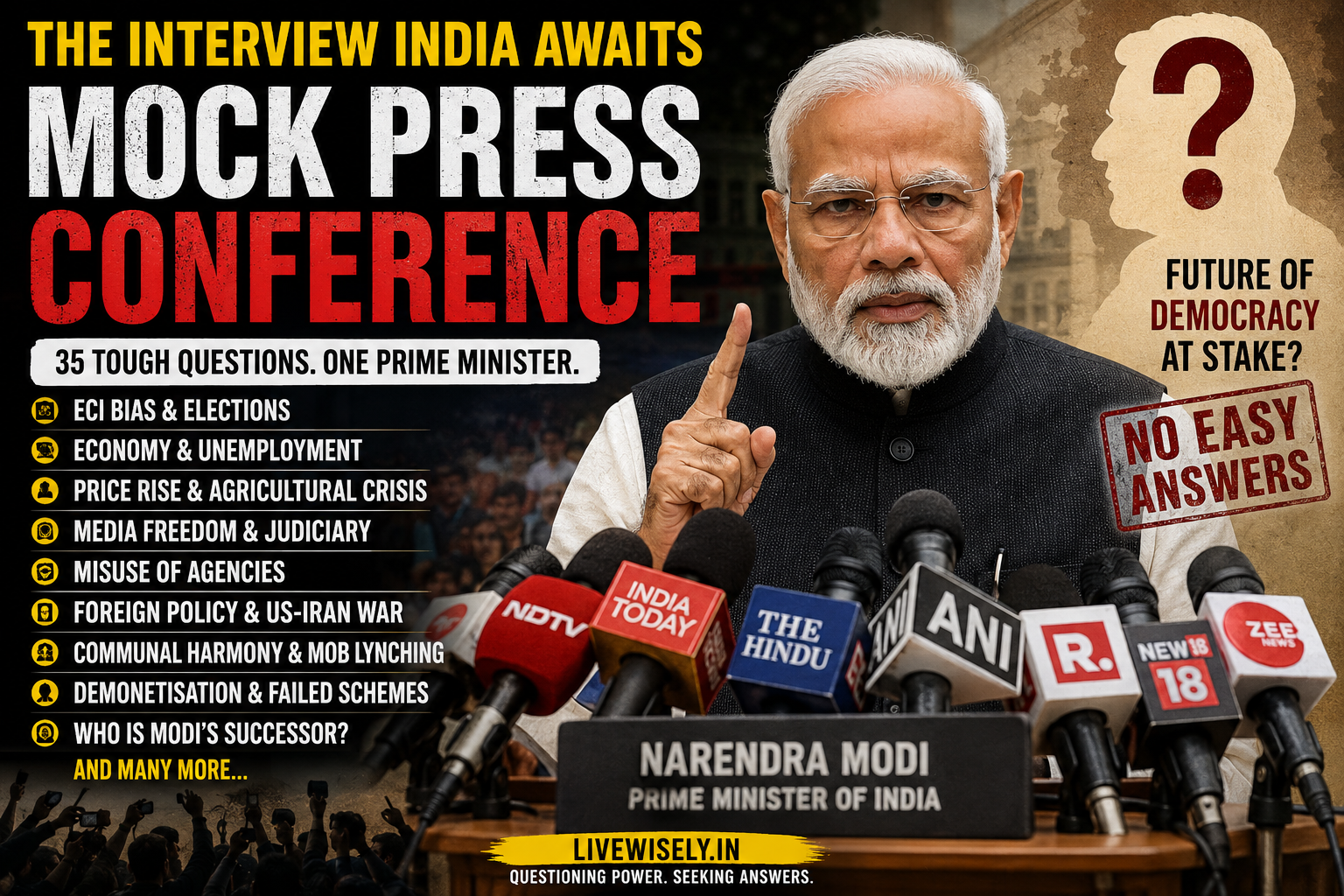
(Part I)
Featuring: Mr. Narendra Modi, Prime Minister of India
Organised by: livewisely.in
Format: Multi-journalist interaction (Indian Media) – Presumed to be told in English
Q1. Mr. Prime Minister in Sweden, a Norwegian journalist questioned you on press freedom, but you avoided a direct answer. Why is your government seen as uncomfortable with press scrutiny?
India is the mother of democracy. Our media is vibrant, diverse, and independent. However, I believe governance should focus on development, not on responding to selective narratives often driven by global perceptions that do not understand India’s complexity.
Q2. Mr. Prime Minister, the Chief Justice of India, reportedly made remarks describing youth in negative terms. Does this reflect a disconnect between institutions and people?
Indian judiciary is independent. The statements should not be taken out of context. Our youth are the backbone of New India, and my government has empowered them through innovation, startups, and digital opportunities.
Q3. Mr. Prime Minister, the Indian Opposition alleges institutional capture, including judiciary and agencies like CBI, ED. How do you respond?
Institutions in India are strong because of the Constitution. Agencies act independently under the law. Those who are corrupt feel targeted; honest citizens feel protected.
Q4. Mr. Prime Minister, Governors are accused of political misuse in opposition-ruled states. Is federalism weakening?
India is a cooperative federal structure. The Governors act within constitutional limits. The Centre and states must work together for development.
Q5. Mr. Prime Minister, the rupee is weakening, GDP growth concerns persist, and imports are rising. Is the economy under stress?
India is the fastest-growing major economy. Temporary fluctuations are part of global trends. Our reforms—digital economy, infrastructure, manufacturing—are building long-term strength. The Short-comings are short, we will bounce back surely but steadily. We are on the warpath of progress for a developmental India.
Q6. Mr. Prime Minister, Micro, Small, and Medium Enterprises (MSMEs) are struggling, and unemployment remains high. What is your response?
The Government of India has launched a multi-pronged strategy to strengthen the Micro, Small, and Medium Enterprises (MSME) sector. These initiatives focus on enhancing credit availability, easing regulatory burdens, accelerating formalization, and upgrading technological capabilities to position Indian MSMEs competitively in the global market.
The MSMEs are the backbone of our economy. Through schemes like Mudra and digital platforms, we have supported them. Employment generation today is more dynamic and not limited to traditional metrics. The backbone of the MSMEs have been strengthened by various initiatives.
Q7. Mr. Prime Minister, the Indian farmers continue to face distress. The new trade agricultural deal with the USA is not a boon. What is your government doing?
It is certainly a boon to our farmers. The Opposition does not anticipate the boom it is going to create in the agricultural sector. We have increased MSP, provided direct income support, and invested in irrigation and infrastructure. Agriculture is moving towards modernization and sustainability.
The intersection of international trade agreements and domestic agricultural distress is one of the most sensitive policy challenges India faces. While trade negotiations often spark deep anxieties among small and marginal farmers, the strategic approach taken during the recent India–US Interim Trade Deal 2026 offers a blueprint of how the government attempts to navigate this balance—and what further options remain to safeguard the agrarian economy.
India’s option is not to completely isolate itself from global trade, but safeguarding vulnerable domestic food security and dairy livelihoods while making international deals to access premium overseas markets for competitive Indian agricultural-exports.
Q8. Mr. Prime Minister the price rise is affecting common people. Why has inflation not been controlled effectively?
To effectively tame the inflation hurting the common person, India’s strategy has to shift away from just monetary tightening by the RBI. It requires aggressive fiscal and structural interventions such as expanding cold-chain infrastructure to prevent food wastage, diversifying energy sources away from imported crude oil, and using timely import-export duties to prevent hoarding and domestic shortages. Global factors such as wars and supply chain disruptions affect prices. Despite the price, India has managed inflation better than the previous governments.
Q9. Mr. Prime Minister, India’s handling of US-Iran tensions and energy security has been questioned. Was there a strategic miscalculation?
Our priority is national interest, energy security, and global peace. We engage with all sides constructively. India managed the fallout by securing a sanction waiver for the strategic Chabahar Port and eventually diversifying its energy imports, balancing ties with both nations.
By complying with US sanctions, India protected its deeper economic and defence ties with Washington and shielded its corporate sector from secondary sanctions. India maintained strategic autonomy by successfully negotiating exemptions for the Chabahar. The USA granted us waiver for Chabahar Port and rapidly diversifying oil sources to secure long-term energy supplies. India follows a balanced and independent foreign policy.
Q10. Mr. Prime Minister critics call your foreign policy “event-driven” rather than strategic. Your response?
I firmly believe that grand events are not mere PR exercises; they are vital to project national power and build domestic consensus. These events serve as highly visible milestones of deep, structural partnerships. India’s foreign policy is “pro-India,” prioritizing its own national security, energy security, and economic development above ideological consistency.
We have taken strong measures like institutional changes under the “Act East” and “Neighbourhood First” policies. Massive cross-border infrastructure projects (highways, digital connectivity, pipelines). Institutionalized defence production and maritime security agreements in the Indo-Pacific. Vaccine diplomacy and disaster response operations established India as a reliable “First Responder” globally.
India as a Vishwa Mitra by hosting extensive G20 events across dozens of Indian cities rather than just New Delhi, the administration’s strategic response was to democratize foreign policy domestically while signalling to the world that India’s geopolitical rise is structural, widespread, and permanent. India’s global standing has increased and a trusted partner globally. This is not event-based—it is vision-based diplomacy.
Q11. Mr. Prime Minister the Election Commission is accused of bias in elections. How do you defend its credibility?
The questioning the ECI is not an attack on a government body, but a direct insult to the honesty of millions of polling booth workers, security forces, and the 140 crore citizens who participate in the democratic process. It is an attack on the grassroots government employees managing the polls. The opposition’s skepticism is disrespect toward ordinary, hardworking Indians.
When they win in states like Karnataka, Telangana, or Himachal Pradesh, and Keralam, the EVMs are fine and the Election Commission is neutral. But the moment they face defeat; they start blaming the referee. India being the mother of democracy is being tarnished by domestic political desperation. The ECI is an independent body completely separate from the Prime Minister’s Office. The Election Commission is respected globally. Allegations come only from those who lose.
Q12. Mr. Prime Minister you are accused of using money and muscle power to influence voters. What would you say?
My government has been carrying out an unyielding crusade against corruption. No one is above the law, regardless of their political stature. The previous governments allowed systemic plunder, whereas his administration is cleaning up the system. The investigative agencies act independently based on evidence, and the government does not interfere with judicial processes.
The opposition parties levelling these charges are dynasty-driven trying to protect their own accumulated wealth. The opposition’s outcry is not a defence of democracy, but a coordinated effort by a club of the corrupt to shield themselves from legal accountability. Look at the consecutive electoral victories as proof of the people’s blessing. My government is not genuinely relying on coercion or illegal money to sustain massive, repeated mandates from hundreds of lakhs of diverse Indian voters.
My government is ensuring strict enforcement of the rule of law to protect public funds. Opposition leaders and critics maintain that the selective timing of raids and arrests—often coinciding with elections—amounts to a deliberate strategy to cripple political rivals and tilt the playing field. People of India vote for development and stability. Their mandate cannot be reduced to such allegations.
Q13. Mr. Prime Minister, your party is accused of eliminating Nitish Kumar to usurp power. Is this ethical politics?
Detractors argue that the constant shifting of alliances by both sides undermines the democratic mandate of the voters. From this perspective, the BJP’s gradual expansion in Bihar is seen as an effort to marginalize regional stalwarts like Nitish Kumar. My efforts always rooted in ‘Sabka Saath, Sabka Vikas’ to pull Bihar out of the era of underdevelopment and corruption. Nitish Kumar remained the Chief Minister of Bihar for years with BJP support, even when the BJP won more seats than the JD(U) in state elections. The BJP has been accommodation-oriented, reliable coalition partner that respects regional leadership. All alliances are based on democratic processes. Political developments reflect the will of elected representatives.
Q14. Mr. Prime Minister, is your government targeting Arvind Kejriwal and dismantling AAP?
The central investigative agencies—such as the Enforcement Directorate (ED) and the Central Bureau of Investigation (CBI)—act independently and strictly in accordance with the law. Being a political figure or an elected official does not grant immunity from criminal investigations.
The AAP regime is an aapda (disaster) for the national capital. A decade of their governance has crippled Delhi’s development. All the ongoing actions against opposition leaders not as political vendettas, but as part of my core mandate to rid India of systemic corruption. Law will take its course. No one is above the law, regardless of position or party.
Q15. Mr. Prime Minister, are you deliberately weakening the INDIA alliance?
It is not my job to awaken or weaken anyone. The citizens of India have awakened. The public sees that on one side is an alliance built purely on the intent to protect dynastic wealth and corruption.
The opposition is trapped in the past, while the youth of India are looking toward the future. The opposition alliance is fundamentally weak and requires outside narratives to sustain itself.
The INDIA alliance as a fragile, contradictory group that lacks a cohesive vision for the country.
Any perceived strength in the opposition is merely media speculation or a temporary alignment of conflicting regional interests, asserting that their internal contradictions will inevitably cause them to collapse under their own weight.
(To be continued)