
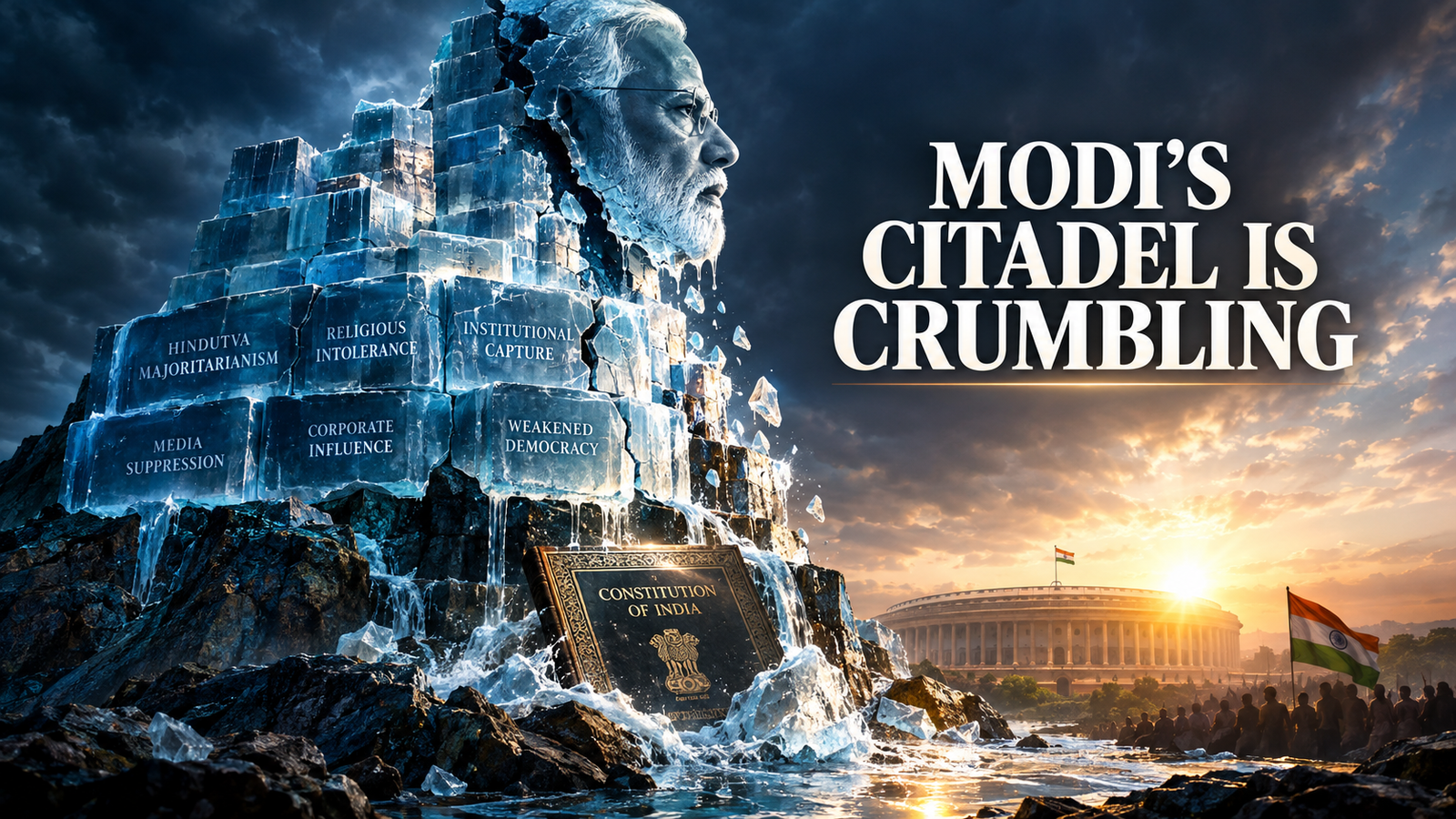
Modi’s citadel is crumbling. The bricks are not merely concrete and steel. They are political ideas, institutions, electoral strategies, ideological narratives, economic alliances, and administrative mechanisms. Some are visible; others are buried beneath the surface. Together, they have helped create an extraordinary concentration of political power around one leader and one political formation- Narendra Modi. But frozen bricks have one inherent weakness: they appear solid only while the temperature remains below zero. When the political climate changes, they begin to melt.
The question before India today is therefore not simply whether Narendra Modi remains politically powerful. The deeper question is whether the political architecture constructed during the last twelve years can continue to withstand the pressures of a more competitive electorate, a restless younger generation – Gen Z, Gen Alpha or Gen Beta, institutional resistance, economic expectations, federal politics and an increasingly assertive Opposition.
Modi’s citadel is crumbling. The First Brick
The ideological foundation of the Modi era has been the growing political centrality of Hindu nationalism and Hindutva. There is nothing illegitimate about a political party advocating a cultural or ideological philosophy. Democracy permits competing visions of India. The problem arises when the political identity of the majority becomes increasingly identified with the identity of the nation itself.
India’s Constitution does not define citizenship according to religion. Yet political rhetoric surrounding Hindutva has increasingly placed religious identity at the centre of electoral mobilisation. The consequences are significant.
Freedom House’s 2026 assessment continues to classify India as “Partly Free”, citing discrimination affecting Muslims, increased pressure on journalists and NGOs, and the use of government institutions against political opponents. It also records continuing concerns about religious polarisation and anti-Muslim rhetoric. (Freedom House) The danger for any democracy is that majority rule gradually becomes majority entitlement. And majority entitlement can eventually become majority domination.
The Second Brick: Capturing the Institutions Without Abolishing Them
The most sophisticated form of democratic erosion does not necessarily abolish institutions. It leaves their buildings standing while weakening their independence. Judiciary, Election Commission, investigative agencies, bureaucracy, universities, public broadcasters and regulatory institutions can continue to exist formally while their perceived autonomy gradually diminishes. This distinction is crucial.
A dictatorship destroys institutions openly. An increasingly centralised democracy may instead preserve the institutions but make them increasingly dependent upon the political executive.
Consider the Election Commission. The Constitution entrusts the Election Commission of India with administering elections. Yet Parliament’s 2023 law altered the appointment mechanism. The selection committee consists of the Prime Minister, a Union Cabinet minister nominated by the Prime Minister and the Leader of the Opposition. (PRS Legislative Research)
The way Modi wins on Bihar and Bengal raises a different and perhaps more fundamental question: How independent must an election-management institution appear to be in order for citizens to trust the democratic process? That distinction matters.
The Third Brick: The Weakening of the Opposition
A powerful government naturally wants a weak Opposition. But a democracy requires a strong Opposition. But things turned around now since the Opposition has become strong whereas the ruling government seems to be weakening. The Modi years have witnessed repeated political battles involving the BJP and regional parties, defections, investigations, coalition rearrangements and changes of government.
But when investigative agencies, financial investigations and political defections become deeply intertwined with electoral competition, citizens inevitably ask whether the playing field remains level. A democracy requires government and Opposition to coexist.
If every effective Opposition leader becomes a target, every dissenting institution becomes suspect and every alternative political formation is systematically weakened, eventually the electoral arena itself becomes narrower.
The Fourth Brick: The Media
Reporters Without Borders places India at 157 out of 180 countries in its 2026 World Press Freedom Index, citing violence against journalists, concentrated media ownership and increasing political alignment of outlets. (Reporters Without Borders) A democracy does not require journalists to oppose the government. It requires journalists to be free to oppose the government. That difference is fundamental.
The media’s responsibility is not to manufacture an Opposition. Its responsibility is to interrogate power. When television journalism becomes excessively dependent upon political access, advertising, ownership interests or ideological loyalty, democracy loses one of its most important informal checks. A development is emerging and the media started questioning the government.
The Fifth Brick: The Corporate-Political Nexus
Another characteristic of the Modi era has been the extraordinary prominence of India’s largest corporate groups in national economic and political discourse. The allegation should not be reduced to the simplistic proposition that “corporates control Modi”. There has been perceptible evidence in this regard.
Political funding has become one of the most important windows through which citizens can examine the relationship between money and power. A democracy in which political parties accumulate enormous resources without adequate transparency risks becoming a democracy in which economic power silently purchases political access.
The Sixth Brick: Planning and Economic Centralisation
The abolition of the Planning Commission is another symbolic milestone. In 2015, the Modi government replaced the Planning Commission with NITI Aayog, describing the latter as a policy think tank intended to promote cooperative federalism. (Press Information Bureau)
But the larger question remains: Has economic policymaking become excessively centralised around the Prime Minister’s Office and the Union executive?
That question becomes particularly relevant when states governed by Opposition parties increasingly confront the Centre over taxation, governors, investigative agencies, federal finances and administrative authority. Indian federalism is not merely a constitutional arrangement. It is a political safety valve. When states become too dependent upon the Centre, that safety valve becomes weaker.
The Seventh Brick: The Laws of Fear
The Modi government has also been criticised for the breadth of India’s new criminal laws and security legislation. Freedom House notes concerns that the criminal laws implemented from 2024 contain provisions that can permit extended detention and use vaguely defined offences in ways critics fear could threaten due process. (Freedom House)
A government needs strong laws to combat terrorism, organised crime and violence. But democracy requires a counter-question: Who watches the government while it exercises extraordinary powers?
The more powerful the State becomes, the more important procedural safeguards become. Otherwise, the citizen slowly changes from a rights-bearing constitutional individual into a subject seeking permission from authority. That is precisely the psychological transition that democratic societies must prevent.
The Eighth Brick: Education and the Battle for Historical Memory
Education may ultimately prove more important than elections. Governments change. Textbooks can influence generations. The debate over the “saffronisation” of education is therefore not merely about textbook chapters. It is about who gets to define India’s history, culture and national identity.
There is nothing wrong with teaching India’s ancient civilisational achievements. Nor is there anything wrong with correcting historical distortions. But if history becomes a weapon for constructing permanent cultural enemies, education ceases to be education. It becomes political conditioning.
Modi’s citadel is crumbling. The Political Tsunami: Generation Z and Beyond
A generation accustomed to smartphones, instant information, global comparisons and questioning authority is unlikely to accept political narratives indefinitely simply because television repeats them.
The emerging generation is less interested in the mythology of political power and more interested in their livelihood and better economic conditions. This is where the phrase “political tsunami” becomes meaningful. A tsunami does not necessarily destroy a building because the building suddenly becomes weaker. It destroys it because the surrounding environment changes. The 2024 elections reminds us that Indian voters can reassert themselves against political inevitability.
The Economic Tsunami: A More Complicated Picture
The “economic tsunami” should not mean an imminent economic collapse. The real danger lies elsewhere. India must convert headline GDP growth into: jobs + wages + productivity + broad-based prosperity.
But if young graduates cannot find secure employment, farmers remain economically vulnerable, household purchasing power weakens and wealth becomes increasingly concentrated, GDP alone cannot protect a government from political discontent. Economic success must eventually be felt in ordinary households.
Foreign Policy: Great-Power Ambition, Great-Power Vulnerability
Modi’s foreign policy has projected India as a major global power. India’s leadership of the BRICKS has achieved nothing but an image building exercise for Modi. But great-power diplomacy requires something more than spectacular summits and personal diplomacy. It requires strategic consistency. India must simultaneously manage relationships with the United States, Russia, China, Europe, the Gulf and the Global South.
The challenge is enormous. Surrender to Trump and Netanyahu and asunder Iran is no diplomacy. A foreign policy centred excessively upon the personality of one leader becomes vulnerable when international circumstances change. Countries deal with India, not merely with Narendra Modi.
Modi’s citadel is crumbling, Is Modi Really Rattled?
Perhaps, he is. It is a demonstrated fact. The more interesting question is whether the Modi political system has entered a defensive phase. The first decade of Modi’s national leadership was characterised by expansion: expand the BJP, expand the ideological footprint, expand central authority, expand electoral dominance, expand the Prime Minister’s personal brand. The next phase may be different: defend, contain, control, consolidate. That is where political systems become vulnerable.
When a government begins interpreting every criticism as conspiracy, every protest as instability, every journalist as hostile, every Opposition leader as an enemy and every institutional question as an attack on national interest, it gradually loses the ability to distinguish dissent from danger. That is the beginning of political somnambulism: power walking while believing itself awake.
The Final Question: Citadel or Constitutional Republic?
The most important question is not whether Modi will win another election. It is whether India will emerge from the Modi era with its democratic institutions stronger or weaker. That will be Modi’s real historical legacy.
But whether the Constitution remained stronger than the personality of the Prime Minister. India was never designed to be a Himalayan monarchy. It was designed as a constitutional republic. Its Prime Minister is powerful—but temporary. Its Parliament is powerful—but accountable.
Its judiciary is independent. Its Election Commission must command confidence. Its media must question authority. Its Opposition must have space to organise. Its states must possess constitutional dignity.
Its minorities must enjoy equal citizenship. And its citizens must remain sovereign. The frozen bricks of political power can therefore melt. They melt when voters refuse to be permanently divided. They melt when young people demand jobs rather than slogans.
They melt when institutions rediscover their constitutional independence. They melt when journalists recover their courage. They melt when courts insist upon constitutional limits. They melt when Opposition parties learn to cooperate rather than merely complain.
And, above all, they melt when citizens remember that government belongs to them—not the other way around.
Narendra Modi may still possess formidable political power. His citadel has not fallen. But the great lesson of political history is that citadels rarely collapse from the outside first. The first cracks normally appear inside the foundations.
The BJP’s reduced parliamentary dominance in 2024, continuing institutional controversies, debates over electoral transparency, concerns about media freedom, minority rights and political centralisation are therefore worth watching—not as proof that Modi’s system has collapsed, but as indicators of a political architecture under increasing stress. (Freedom House)
The ultimate political tsunami may not be a single dramatic event. It may simply be the gradual awakening of citizens who discover that they are more powerful than the political mansion built in their name. And when that awakening becomes sufficiently widespread, the frozen bricks begin to melt. The citadel does not necessarily fall with a bang. Sometimes it simply begins to defrost.