
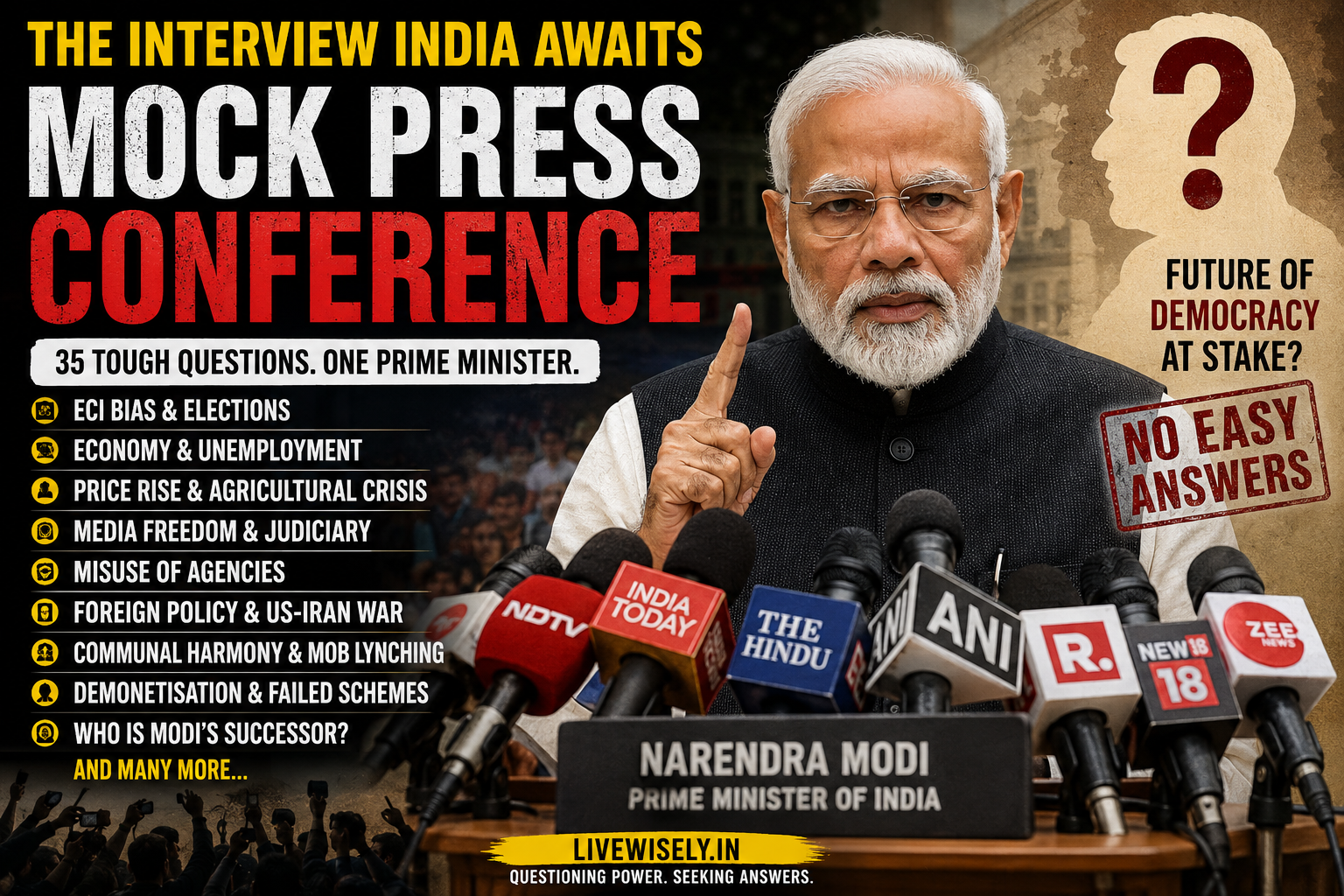
(Part I)
Featuring: Mr. Narendra Modi, Prime Minister of India
Organised by: livewisely.in
Format: Multi-journalist interaction (Indian Media) – Presumed to be told in English
Q1. Mr. Prime Minister in Sweden, a Norwegian journalist questioned you on press freedom, but you avoided a direct answer. Why is your government seen as uncomfortable with press scrutiny?
India is the mother of democracy. Our media is vibrant, diverse, and independent. However, I believe governance should focus on development, not on responding to selective narratives often driven by global perceptions that do not understand India’s complexity.
Q2. Mr. Prime Minister, the Chief Justice of India, reportedly made remarks describing youth in negative terms. Does this reflect a disconnect between institutions and people?
Indian judiciary is independent. The statements should not be taken out of context. Our youth are the backbone of New India, and my government has empowered them through innovation, startups, and digital opportunities.
Q3. Mr. Prime Minister, the Indian Opposition alleges institutional capture, including judiciary and agencies like CBI, ED. How do you respond?
Institutions in India are strong because of the Constitution. Agencies act independently under the law. Those who are corrupt feel targeted; honest citizens feel protected.
Q4. Mr. Prime Minister, Governors are accused of political misuse in opposition-ruled states. Is federalism weakening?
India is a cooperative federal structure. The Governors act within constitutional limits. The Centre and states must work together for development.
Q5. Mr. Prime Minister, the rupee is weakening, GDP growth concerns persist, and imports are rising. Is the economy under stress?
India is the fastest-growing major economy. Temporary fluctuations are part of global trends. Our reforms—digital economy, infrastructure, manufacturing—are building long-term strength. The Short-comings are short, we will bounce back surely but steadily. We are on the warpath of progress for a developmental India.
Q6. Mr. Prime Minister, Micro, Small, and Medium Enterprises (MSMEs) are struggling, and unemployment remains high. What is your response?
The Government of India has launched a multi-pronged strategy to strengthen the Micro, Small, and Medium Enterprises (MSME) sector. These initiatives focus on enhancing credit availability, easing regulatory burdens, accelerating formalization, and upgrading technological capabilities to position Indian MSMEs competitively in the global market.
The MSMEs are the backbone of our economy. Through schemes like Mudra and digital platforms, we have supported them. Employment generation today is more dynamic and not limited to traditional metrics. The backbone of the MSMEs have been strengthened by various initiatives.
Q7. Mr. Prime Minister, the Indian farmers continue to face distress. The new trade agricultural deal with the USA is not a boon. What is your government doing?
It is certainly a boon to our farmers. The Opposition does not anticipate the boom it is going to create in the agricultural sector. We have increased MSP, provided direct income support, and invested in irrigation and infrastructure. Agriculture is moving towards modernization and sustainability.
The intersection of international trade agreements and domestic agricultural distress is one of the most sensitive policy challenges India faces. While trade negotiations often spark deep anxieties among small and marginal farmers, the strategic approach taken during the recent India–US Interim Trade Deal 2026 offers a blueprint of how the government attempts to navigate this balance—and what further options remain to safeguard the agrarian economy.
India’s option is not to completely isolate itself from global trade, but safeguarding vulnerable domestic food security and dairy livelihoods while making international deals to access premium overseas markets for competitive Indian agricultural-exports.
Q8. Mr. Prime Minister the price rise is affecting common people. Why has inflation not been controlled effectively?
To effectively tame the inflation hurting the common person, India’s strategy has to shift away from just monetary tightening by the RBI. It requires aggressive fiscal and structural interventions such as expanding cold-chain infrastructure to prevent food wastage, diversifying energy sources away from imported crude oil, and using timely import-export duties to prevent hoarding and domestic shortages. Global factors such as wars and supply chain disruptions affect prices. Despite the price, India has managed inflation better than the previous governments.
Q9. Mr. Prime Minister, India’s handling of US-Iran tensions and energy security has been questioned. Was there a strategic miscalculation?
Our priority is national interest, energy security, and global peace. We engage with all sides constructively. India managed the fallout by securing a sanction waiver for the strategic Chabahar Port and eventually diversifying its energy imports, balancing ties with both nations.
By complying with US sanctions, India protected its deeper economic and defence ties with Washington and shielded its corporate sector from secondary sanctions. India maintained strategic autonomy by successfully negotiating exemptions for the Chabahar. The USA granted us waiver for Chabahar Port and rapidly diversifying oil sources to secure long-term energy supplies. India follows a balanced and independent foreign policy.
Q10. Mr. Prime Minister critics call your foreign policy “event-driven” rather than strategic. Your response?
I firmly believe that grand events are not mere PR exercises; they are vital to project national power and build domestic consensus. These events serve as highly visible milestones of deep, structural partnerships. India’s foreign policy is “pro-India,” prioritizing its own national security, energy security, and economic development above ideological consistency.
We have taken strong measures like institutional changes under the “Act East” and “Neighbourhood First” policies. Massive cross-border infrastructure projects (highways, digital connectivity, pipelines). Institutionalized defence production and maritime security agreements in the Indo-Pacific. Vaccine diplomacy and disaster response operations established India as a reliable “First Responder” globally.
India as a Vishwa Mitra by hosting extensive G20 events across dozens of Indian cities rather than just New Delhi, the administration’s strategic response was to democratize foreign policy domestically while signalling to the world that India’s geopolitical rise is structural, widespread, and permanent. India’s global standing has increased and a trusted partner globally. This is not event-based—it is vision-based diplomacy.
Q11. Mr. Prime Minister the Election Commission is accused of bias in elections. How do you defend its credibility?
The questioning the ECI is not an attack on a government body, but a direct insult to the honesty of millions of polling booth workers, security forces, and the 140 crore citizens who participate in the democratic process. It is an attack on the grassroots government employees managing the polls. The opposition’s skepticism is disrespect toward ordinary, hardworking Indians.
When they win in states like Karnataka, Telangana, or Himachal Pradesh, and Keralam, the EVMs are fine and the Election Commission is neutral. But the moment they face defeat; they start blaming the referee. India being the mother of democracy is being tarnished by domestic political desperation. The ECI is an independent body completely separate from the Prime Minister’s Office. The Election Commission is respected globally. Allegations come only from those who lose.
Q12. Mr. Prime Minister you are accused of using money and muscle power to influence voters. What would you say?
My government has been carrying out an unyielding crusade against corruption. No one is above the law, regardless of their political stature. The previous governments allowed systemic plunder, whereas his administration is cleaning up the system. The investigative agencies act independently based on evidence, and the government does not interfere with judicial processes.
The opposition parties levelling these charges are dynasty-driven trying to protect their own accumulated wealth. The opposition’s outcry is not a defence of democracy, but a coordinated effort by a club of the corrupt to shield themselves from legal accountability. Look at the consecutive electoral victories as proof of the people’s blessing. My government is not genuinely relying on coercion or illegal money to sustain massive, repeated mandates from hundreds of lakhs of diverse Indian voters.
My government is ensuring strict enforcement of the rule of law to protect public funds. Opposition leaders and critics maintain that the selective timing of raids and arrests—often coinciding with elections—amounts to a deliberate strategy to cripple political rivals and tilt the playing field. People of India vote for development and stability. Their mandate cannot be reduced to such allegations.
Q13. Mr. Prime Minister, your party is accused of eliminating Nitish Kumar to usurp power. Is this ethical politics?
Detractors argue that the constant shifting of alliances by both sides undermines the democratic mandate of the voters. From this perspective, the BJP’s gradual expansion in Bihar is seen as an effort to marginalize regional stalwarts like Nitish Kumar. My efforts always rooted in ‘Sabka Saath, Sabka Vikas’ to pull Bihar out of the era of underdevelopment and corruption. Nitish Kumar remained the Chief Minister of Bihar for years with BJP support, even when the BJP won more seats than the JD(U) in state elections. The BJP has been accommodation-oriented, reliable coalition partner that respects regional leadership. All alliances are based on democratic processes. Political developments reflect the will of elected representatives.
Q14. Mr. Prime Minister, is your government targeting Arvind Kejriwal and dismantling AAP?
The central investigative agencies—such as the Enforcement Directorate (ED) and the Central Bureau of Investigation (CBI)—act independently and strictly in accordance with the law. Being a political figure or an elected official does not grant immunity from criminal investigations.
The AAP regime is an aapda (disaster) for the national capital. A decade of their governance has crippled Delhi’s development. All the ongoing actions against opposition leaders not as political vendettas, but as part of my core mandate to rid India of systemic corruption. Law will take its course. No one is above the law, regardless of position or party.
Q15. Mr. Prime Minister, are you deliberately weakening the INDIA alliance?
It is not my job to awaken or weaken anyone. The citizens of India have awakened. The public sees that on one side is an alliance built purely on the intent to protect dynastic wealth and corruption.
The opposition is trapped in the past, while the youth of India are looking toward the future. The opposition alliance is fundamentally weak and requires outside narratives to sustain itself.
The INDIA alliance as a fragile, contradictory group that lacks a cohesive vision for the country.
Any perceived strength in the opposition is merely media speculation or a temporary alignment of conflicting regional interests, asserting that their internal contradictions will inevitably cause them to collapse under their own weight.
Part – II
Q16. Mr. Prime Minister, there are concerns about communal disharmony and majoritarian politics. How do you address this?
India’s identity as a democracy is absolute. It is “in our DNA.” A government bound by the Constitution cannot discriminate anybody based on caste, creed, or religion. The concept of “majority versus minority” is a political construct used by opposition parties to create vote banks, whereas his administration views all 1.4 billion citizens as equal stakeholders.
My government is for Sabka Saath, Sabka Vikas, Sabka Vishwas, Sabka Prayas. There has been no discrimination in the delivery of welfare schemes. The government benefits reach the poorest citizens irrespective of their religious background. Our secularism is “zero discrimination” in governance Law and order are a state subject under India’s federal structure, and that isolated incidents should not be used to broad-brush the character of the entire nation.
Q17. Mr. Prime Minister, Critics speak of “saffronisation” of education. Is education becoming ideological?
It is a lazy, outdated allegation pushed by political opponents or “Lutyens’ media.” I would substitute it with terms like “Indianisation” or “De-colonisation” of education. For decades after independence, Indian students were taught history and values through a Eurocentric or colonial lens. Bringing Indian culture, ancient science, and local languages into textbooks is not politicization or saffronisation, rather it is restoring a stolen national identity.
The National Education Policy (NEP) was created after years of grassroots consultations involving lakhs of teachers, gram panchayats, and citizens, rather than being dictated by any single organization. I ask the Opposition as to why they feel “allergic” to India’s own heritage, Vedas, or the mathematical genius of Aryabhata, while the rest of the world respects it. They should shed a colonial mindset, and prepare Indian youth to lead the 21st century with “a computer in one hand and the Vedas in the other.”
Q18. Mr. Prime Minister, mob lynching and “love jihad” narratives have created fear. Overseas you embrace the Muslim/Arab leaders whereas the Muslims are disgraced in India. What steps has your government taken?
Violence of any kind is unacceptable. We are committed to ensuring safety and justice. Critics argue that narratives like “love jihad and cow-related vigilantism are used politically to polarize society. They argue these narratives normalize discrimination and instigate fear within the Muslim minority. The government maintains that incidents of mob violence or lynching are isolated, localized law-and-order breakdowns rather than systemic, religiously motivated state policy.
Q19. Mr. Prime Minister, was demonetisation a failure?
Demonetisation helped formalize the economy, increase tax compliance, and reduce black money. Its long-term benefits are visible today. Before the demonetisation, black money was “nameless” and hoarded under mattresses. By forcing it into the banking system, that money was given an “address” and a trail. The data collected from massive cash deposits allowed the Income Tax department to catch tax evaders with precision, drastically increasing the country’s tax base and formal compliance.
A leader focused purely on short-term electoral politics would never take such a risky, disruptive step. The pain borne by ordinary citizens was a shared sacrifice to defeat a corrupt elite. The demonetisation move was a direct strike against the “70 years of loot” by corrupt politicians and bureaucrats, firmly positioning himself on the side of the honest, hardworking middle class and the poor. When our economy was growing fast and was robust; that was exactly the right time to perform this economic surgery to rid the system of a long-festering disease.
Q20. Mr. Prime Minister, many flagship schemes have underperformed. How do you respond?
Many of the government schemes have transformed lives—housing, sanitation, digital inclusion. The scale of change is unprecedented. The previous governments were content with meeting small percentage targets or serving specific vote banks. His administration’s goal is 100% coverage—ensuring the scheme reaches the very last person in the queue.
Any bottlenecks are remaining structural issues from decades of previous mismanagement, but the intent of his government is unassailable. If a scheme is facing implementation hurdles, I will redirect the focus toward the revolutionary backend infrastructure his government built to fix it. Jan Dhan bank accounts, Aadhaar, and Mobile numbers (the JAM Trinity), his government has bypassed traditional middlemen and corrupt local bureaucrats. Hundreds of thousands of crores of rupees have been directly deposited into the bank accounts of the poor via Direct Benefit Transfer (DBT), effectively eliminating systemic leakage.
In a country of 140 crore people, look at what we have achieved: 4 crore houses built under PM Awas Yojana, 12 crore toilets under Swachh Bharat, and free health insurance to 50 crore citizens under Ayushman Bharat. What others couldn’t do in 60 years, we have set in motion in just over a decade.
Q.21. Mr. Prime Minister, what is your stand on “One Nation, One Election”?
It will reduce costs, improve governance efficiency, and ensure policy continuity.
Q22. Mr. Prime Minister, will your government support a caste census?
We are committed to social justice. Decisions will be taken keeping national unity and development in mind.
Q23. Mr. Prime Minister, what is the future of the delimitation process?
It will be conducted constitutionally and fairly, ensuring balanced representation.
Q24. Mr. Prime Minister, who is your successor?
In BJP, the organisation is supreme. Leadership emerges through collective processes.
Q25. Mr. Prime Minister, will you win the 2029 elections?
The people of India will decide. We will continue to work with dedication.
Q26. Mr. Prime Minister what are your retirement plans?
My life is dedicated to the nation. Service is my life.
Q27. Mr. Prime Minister, is your popularity declining on social media?
Social media trends do not define public support. The real strength comes from the people.
Q28. Mr. Prime Minister, who do you consider the strongest opposition leader today?
In democracy, a strong opposition is important. I respect all leaders who work for the country.
Q29. Mr. Prime Minister, critics accuse you of centralising power and weakening democracy.
India’s democracy is stronger than ever. Empowerment of the poor and transparency are our priorities.
Q30. Mr. Prime Minister, what do you consider your biggest achievement?
Transforming governance through transparency, digitalisation, and direct benefit transfer.
Q31. Mr. Prime Minister, how has India’s global image changed under your leadership?
India is now seen as a decisive, responsible, and rising global power.
Q32. Mr. Prime Minister, what is your message to India’s youth?
Dream big, innovate, and contribute to nation-building.
Q.33. Mr. Prime Minister is paper leaks not an issue with the youth in India?
My government passed strict laws (like the Public Examinations Act) to punish mafia elements involved in the paper leaks. The future of our youth is our utmost priority. Anyone playing with the future of our young students will not be spared. We are reforming testing agencies like the NTA and ensuring absolute transparency so that merit is the only criteria for success. It is a direct attack on the hard work of India’s youth, which my government will not tolerate.
Q.34. Mr. Prime Minister corruption is bothering your government?
My government ensured independence of central investigative agencies (like the ED and CBI), asserting that they are finally being allowed to do their jobs without political interference. Those accused of corruption are merely crying foul because the government is closing down their channels of illicit wealth.
Corruption does not bother my government and my government bothers the corrupt. For decades, corruption was institutionalized. Today, strict action is being taken against the corrupt, regardless of how powerful they are, and the looted money is being returned to the poor. My government reiterate Na khaunga, na khane dunga.
Q.35. Mr. Prime Minister Ram Mandir funds are mismanaged?
My government dismiss these allegations as politically motivated and transparency and community-driven nature of the temple’s construction. The Ram Mandir is built not on government funds, but on the holy contributions of crores of devotees. Every single rupee is digitally tracked and audited. Those who tried to stop the temple from being built for decades are now trying to defame it with baseless allegations.
Shri Ram Janmabhoomi Teerth Kshetra trust manages the funds with professional, digital, and audited transparency. It is a long-standing pattern of the opposition trying to derail or diminish the cultural significance of the Ram Mandir.
Q.36. Mr. Prime Minister what would be your message to the Press and Media?
I would urge the media to act as a bridge of constructive feedback. Criticism is vital for a robust democracy, but it should be rooted in facts and aimed at improving governance rather than creating despair. I request to dedicate more space and airtime to stories of grassroots transformation, scientific achievements, and inspiring individual efforts. The core philosophy of the media should be highlighting success stories that foster a collective sense of national confidence.
The media should look beyond localized political squabbles and report on India’s role as a global solution provider—whether in digital public infrastructure, climate action, or economic growth.
I appeal the media to emulate a sense of patriotism and national responsibility, especially on matters of national security and foreign policy.
I would remind the press that while political ideologies may differ, the national interest must remain a unified front. I would urge the media to maintain caution against narratives that could inadvertently weaken social harmony or compromise national security. I should emphasize the media’s duty to maintain credibility, check facts rigorously, and lead the fight against fake news, deepfakes, and disinformation that can disrupt society.
(Concluded)