
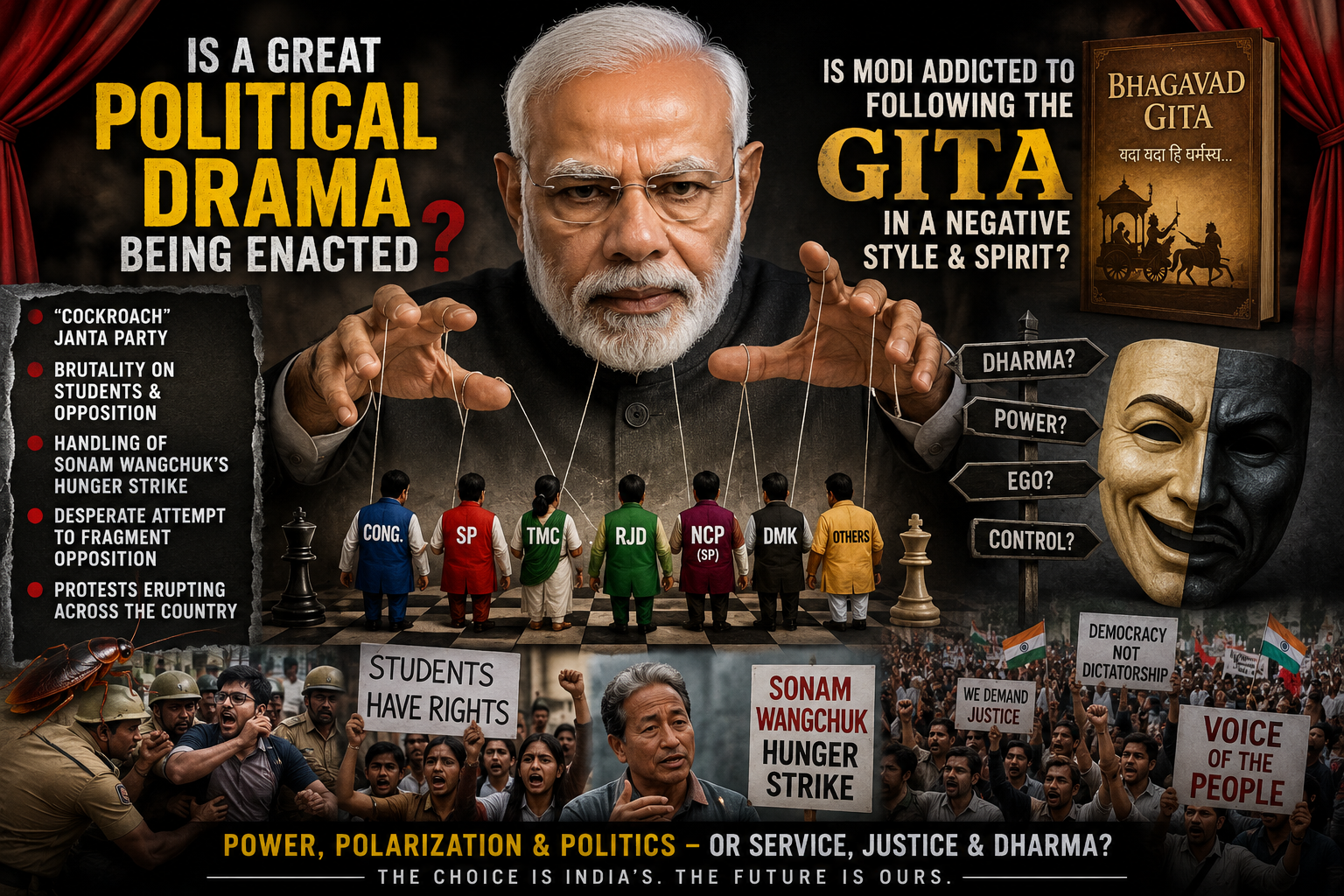
Is a great Political Drama being enacted by Narendra Modi? Politics has often been compared to theatre. Leaders are actors, institutions are the stage, the media provides the lighting, and the public is the audience as well as the judge. Every major political leader, whether admired or criticized, seeks to shape public perception through carefully chosen narratives.
In contemporary India, many observers ask whether Prime Minister Narendra Modi is not merely governing but staging a continuing political drama in which every crisis becomes another act in a larger script.
Politics as Permanent Theatre
In classical theatre, every performance consists of carefully designed acts, scripts, characters, conflict, suspense, and resolution. Modern politics often follows similar patterns. Over the last decade, India has witnessed a succession of highly visible political events like- demonetisation, abrogation of Article 370, citizenship Amendment Act, Ram Mandir inauguration One Nation, One Election proposal, Waqf reforms, National security operations, frequent election campaigns, farmers agitation and political defections in several states
Each event has been presented not merely as an administrative decision but as part of a larger national mission. Supporters regard this as energetic governance capable of maintaining national momentum. Critics argue that permanent political mobilization risks reducing routine governance to a series of dramatic episodes in which public attention shifts rapidly from one issue to another before deeper questions receive sustained examination. Whether one agrees with either perspective, it is undeniable that event management has become a defining characteristic of contemporary Indian politics.
Governments are ultimately judged not only by their communication but also by measurable outcomes. A political narrative may inspire public confidence, yet governance is assessed through indicators such as- employment generation, agricultural sustainability, educational quality, healthcare accessibility, judicial efficiency, institutional independence, economic equality, environmental protection and social harmony.
Critics contend that excessive emphasis on symbolic politics may divert public attention from these long-term governance challenges. Supporters respond that effective communication itself is an essential part of democratic leadership because it helps build public participation and confidence in reforms. The real challenge lies in ensuring that political storytelling complements rather than substitutes for administrative performance.
Unlike many previous Prime Ministers who governed primarily through administrative decisions, Narendra Modi has often preferred politics of continuous mobilization. Examples include Demonetisation (2016) presented as a moral war against black money, Abrogation of Article 370 framed as completing national integration, Ram Mandir inauguration portrayed as civilizational fulfilment, Uniform Civil Code debates, One Nation, One Election, Waqf reforms or National security operations and their public messaging. It is argued that they serve to keep the political event constantly centred on the Prime Minister.
Is a great Political Drama being enacted by Narendra Modi? The Cockroach Janta Party
The Cockroach Janta Party survive difficult conditions, despite defections, investigations, internal splits, electoral defeats and financial constraints. Examples include:
Congress surviving repeated predictions of collapse.
DMK remaining strong in Tamil Nadu, despite losing to Joseph Vijay of TVK
Trinamool Congress losing West Bengal.
Samajwadi Party recovering in Uttar Pradesh.
RJD continuing in Bihar, though routed.
Shiv Sena (Uddhav faction) remaining politically relevant.
NCP (Sharad Pawar faction) retaining influence despite despair.
Political fragmentation has often produced new regional centres of resistance rather than eliminating opposition altogether.
Handling of Student Protests
Student movements have historically influenced Indian democracy. Few examples include –
JP Movement (1974)
Assam Agitation
Mandal protests
Anti-CAA protests
Campus demonstrations at universities such as JNU and Jamia, and
Farmer resistance
Critics argue that recent years have seen a more security-oriented response to campus protests, including police intervention, arrests, atrocities, and restrictions. Supporters counter that governments have a duty to maintain law and order and prevent violence or disruption. The tension illustrates a recurring democratic challenge – balancing public order with freedom of expression.
Is a great Political Drama being enacted by Narendra Modi? Sonam Wangchuk’s Hunger Strike
Social activist and engineer Sonam Wangchuk’s campaigns regarding Ladakh’s constitutional safeguards and environmental concerns drew national attention. His hunger strike became a symbolic appeal for greater autonomy, ecological protection, and democratic consultation. Wangchuk was forcibly lifted from the hunger strike spot at Jantar Mantar, admitted to a government hospital and later to a private hospital. However, he continued his hunger strike. He ended his 28-day hunger strike under the sponsorship of Modi, fearing emergence Rahul Gandhi as a darling of the student movement. Critics argued that the central government’s engagement appeared delayed or insufficient.
Fragmenting Opposition Parties
One criticism frequently made by opposition leaders is that investigative agencies and political inducements have coincided with defections from rival parties. Examples often cited include developments involving Maharashtra, Karnataka, Madhya Pradesh, Goa, Bihar and other states where party realignments have altered governments.
Governments deny that these events are orchestrated, arguing instead that elected representatives exercise independent political judgment. The broader democratic question concerns whether frequent defections strengthen representative government or weaken voter mandates.
Rising Protests Across India
India continues to witness protests on a wide range of issues, including farmers’ demands, unemployment, inflation, caste census, reservation, environmental concerns, regional autonomy, labour rights, education and paper leaks.
Supporters of the government feel that protests are a feature of any vibrant democracy. Critics contend that restrictions on demonstrations, preventive detentions, or criminal proceedings against protesters can have a chilling effect on dissent. The Security forces resorted pellet guns, electric batons or even AK 47 rifles in the resent student protests. The reality is complex and varies across states and situations.
Is a great Political Drama being enacted by Narendra Modi? Is Modi Following the Bhagavad Gita?
The Bhagavad Gita teaches many principles, including duty (dharma), self-discipline, detachment from personal gain, equanimity, compassion, self-control, humility, and action without attachment to results (Nishkama Karma). One frequently quoted verse is: Karmanye vadhikaraste ma phaleshu kadachana (you have the right to perform your duty, but not to the fruits of your actions)
Some critics argue that modern political leaders selectively invoke the Gita’s emphasis on action and duty while paying less attention to its equally important teachings on humility, restraint, compassion, and freedom from ego. For example- if a leader emphasizes decisive action but overlooks openness to criticism, critics may see an imbalance; if political success becomes an end in itself, critics may question whether this aligns with the Gita’s call for detachment from outcomes.
Supporters, however, might argue that decisive governance itself reflects the Gita’s call to perform one’s duty without hesitation, because the Gita is a philosophical and spiritual text, different readers legitimately draw different lessons from it.
There a “Negative Spirit” in Modi’s use the Gita teachings
If a leader follows the Gita in a “negative spirit” is ultimately a matter of interpretation. One possible criticism is that if political action is accompanied by excessive polarization, personalization of power, intolerance of dissent, weakening of institutional checks or concentration of authority- then the ethical ideals of the Gita—particularly humility, self-restraint, and concern for the welfare of all (lokasangraha)—may appear less visible, it is the way of Narendra Modi following the Gita in a negative spirit, one should feel, his way of governance. Conversely, supporters may argue that strong leadership, national security measures, and structural reforms are consistent with acting resolutely in pursuit of what they see as the national interest.
Democracy and Political Drama
Political drama is not unique to India. Leaders across democracies often use symbolism, mass communication, and emotionally resonant activities to mobilize support. The key question is not whether politics contains drama—it almost always does—but whether institutions remain robust enough to accommodate dissent, protect rights, and ensure accountability.
For citizens, the constitutional benchmark is not whether they agree with a particular leader, but whether democratic institutions continue to function independently, elections remain free and fair, civil liberties are protected, and opposition voices can participate meaningfully in public life. All these have been trampled upon by Modi for all these years of his rule.
Is a great Political Drama being enacted by Narendra Modi? Is India Approaching a New Political Phase?
Observers increasingly debate whether India is moving toward a model in which leadership becomes progressively more centralized around a single national figure. Some see this as a natural response to complex national challenges requiring decisive leadership. Others worry that excessive concentration of political authority could weaken institutional checks and reduce the diversity of democratic voices.
Neither optimism nor pessimism alone adequately captures this moment. Democracies evolve through continuous interaction among governments, opposition parties, independent institutions, civil society, the media, and citizens. The resilience of Indian democracy will depend less on any one individual than on the enduring strength of its constitutional framework.
Is a great Political Drama being enacted by Narendra Modi? The Conclusion
Political theatre can inspire, mobilize, and unite. It can also simplify complex issues into emotionally compelling narratives. Yet democratic legitimacy ultimately rests on more enduring foundations.
Whether one admires or criticizes Narendra Modi’s leadership, the larger question extends beyond any single individual. It concerns the kind of democratic culture India wishes to strengthen for future generations. Political drama may dominate headlines, but constitutional values determine the lasting character of a republic.
As Dr. B. R. Ambedkar reminded the nation, the success of a Constitution depends not only upon its text but also upon the conduct of those entrusted with its operation. Institutions flourish when citizens remain vigilant, leaders remain accountable, and public debate remains open.
The future of Indian democracy will therefore be shaped not by the brilliance of political performance alone, but by the continued vitality of constitutional principles, democratic participation, and the collective wisdom of its people.
Narendra Modi’s leadership style is widely regarded as highly centralized, media-savvy, and narrative-driven. Admirers see this as visionary and decisive; critics view it as overly personalized and politically theatrical.
From a constitutional perspective, the enduring measure of any government is not the strength of its narrative but the strength of its institutions. Political theatre may shape public opinion for a time, but democratic legitimacy ultimately rests on accountability, the rule of law, and respect for the rights of all citizens.