
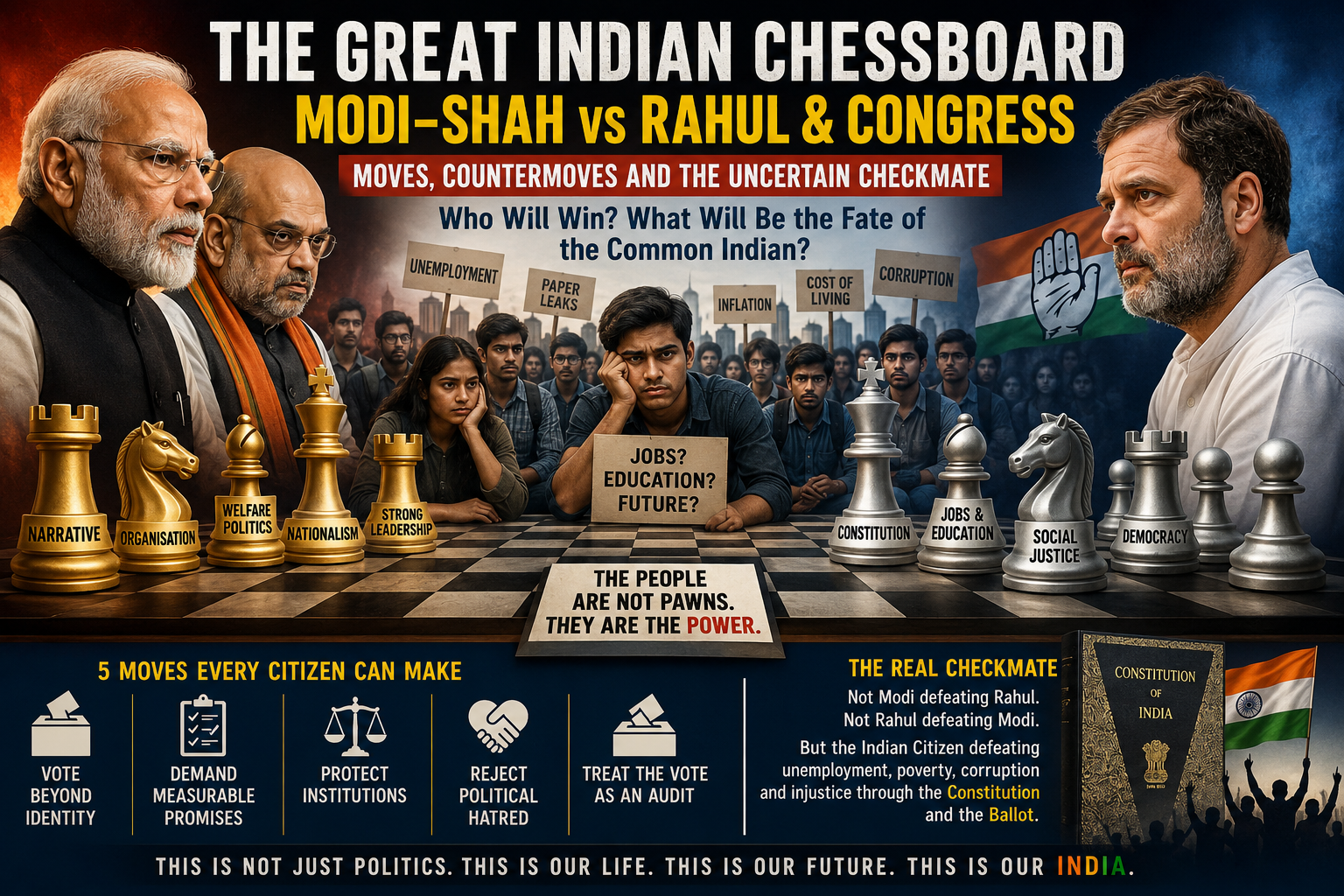
Indian politics resembles a chessboard. On one side stand Narendra Modi and Amit Shah, supported by the BJP’s formidable organisational machinery. On the other, stands Rahul Gandhi, the Congress, and a diverse opposition, including regional parties. But there is a third presence on this chessboard that politicians too often overlook – The Indian people. They are not pawns. They are the sovereign citizens of the Republic. Yet while political leaders spend their nights calculating their next moves, millions of ordinary Indians are struggling with unemployment, inflation, education, healthcare, economic insecurity and uncertainty about their children’s future. It raises the central question – who is really winning this political chess game—and who is paying the price for it?
The 2024 Election Changed the Chessboard
The 2024 Lok Sabha election altered India’s political arithmetic. The BJP remained the largest political party, but its tally fell from 303 seats in 2019 to 240, forcing it to depend on its NDA partners. The Congress, meanwhile, improved its tally to 99. Narendra Modi returned as Prime Minister for a third consecutive term. For the opposition, this created a larger political and parliamentary space. Rahul Gandhi’s position as Leader of the Opposition consequently acquired greater importance. The chessboard had not been overturned. But its configuration had changed.
The greatest strength of the Modi–Shah combination is not one particular political move. It is the ability to influence the shape of the political game itself. Narendra Modi remains the BJP’s principal national face. His political strength lies substantially in his ability to communicate directly with mass audiences and convert complicated questions into relatively simple political narratives (now reseeding) — development, nationalism, welfare, national security.
Amit Shah represents another dimension of the political machine: organisation, electoral arithmetic, alliances, negotiations and execution. The Modi–Shah combination can therefore be described metaphorically as: Modi — narrative and mass mobilisation. Shah — organisation and political manoeuvring. Together they have created one of India’s most formidable electoral machines.
The Pawns
Narratives may look like small pieces on a political chessboard, but they can change the entire game. Nationalism, religion, welfare, corruption, development, security, identity and opposition unity can each become a pawn—and several pawns together can create a powerful political formation.
Rahul Gandhi’s Countermove
Rahul Gandhi’s greatest opportunity is also his greatest challenge. He cannot defeat the BJP merely by becoming anti-Modi. He has to become pro-people. That distinction could decide the next phase of Indian politics. If every opposition argument is simply: “Modi did this.”– the BJP remains at the centre of the political conversation. But if Rahul Gandhi asks –“how has the government affected your life?”- the political battlefield changes: jobs, education, healthcare, agriculture, small businesses, cost of living, economic inequality, institutional accountability, federalism and constitutional democracy. These issues can potentially create an alternative political narrative that does not depend entirely upon Narendra Modi.
The Congress Has Its Own Chessboard to Repair
The Congress cannot expect the BJP to defeat itself. The party has to overcome its own weaknesses. It needs- organisation + credible local leadership + disciplined communication + alliance management + economic credibility + generational renewal.
Rahul Gandhi may be an effective parliamentary challenger, but Parliament alone cannot produce a national alternative. Congress must demonstrate that it can govern effectively where it already holds power. The electorate ultimately asks a very simple question: “you have told me what is wrong. Now tell me what you will do differently”. That is where opposition politics must move from criticism to construction.
The Most Important Piece on the Board: The Voter
In chess, pawns can be sacrificed. In democracy, citizens cannot be sacrificed for political strategy. The Indian Constitution begins with the people: “We, the People of India…“. The ultimate source of democratic legitimacy is therefore not the political party, the Prime Minister, the opposition leader or the government- it is the citizen. Every political party should remember this – the people are not pawns; they are the power.
Gen Z and Gen Alpha: A New Political Question
A new generation is approaching Indian politics with a different set of expectations. A young Indian may not be primarily interested in the traditional political chess game. He or she asks – where is my job? Why is quality education so difficult to obtain? Can I afford a home? Can I obtain employment without political or social connections? Will competitive examinations be conducted fairly? Can I build a future in my own country? Why does political spectacle receive so much attention while everyday problems remain unresolved? These questions cannot be permanently answered through slogans. The young citizen increasingly wants results rather than rhetoric. And that could eventually become India’s most important political transformation.
The Paper-Leak Crisis: A Symbol of a Larger Problem
For a young person preparing for a competitive examination, a paper leak is not merely an administrative failure. It can mean- years of preparation → lost opportunity → financial pressure → delayed career → shattered confidence → declining trust in institutions.
A politician may see it as an issue to attack the government. A government may see it as an administrative problem. But the student sees something much more personal – “My future is being gambled with.” That is why employment, recruitment and examination integrity could become politically more important than many traditional ideological battles.
The Possible Moves of Modi–Shah
The BJP’s rational political strategy is likely to involve several familiar moves.
Move One: Keep the contest leadership-centred
Make elections primarily about Modi’s leadership rather than merely the government’s record.
Move Two: Keep the opposition fragmented
Differences between Congress and regional parties can reduce the opposition’s collective effectiveness.
Move Three: Keep Rahul Gandhi on the defensive
Political controversies involving Rahul Gandhi can force the opposition leader to respond rather than set the agenda.
Move Four: Strengthen welfare politics
Direct benefits can create a personal connection between the government and beneficiaries.
Move Five: Maintain ideological mobilisation
Nationalism, religion, cultural identity and security can consolidate the BJP’s core electorate.
Move Six: Exploit opposition disunity
A divided opposition can lose even when dissatisfaction with the incumbent government exists.
Rahul Gandhi’s Necessary Countermoves
The opposition therefore needs a different style of chess.
Countermove One: Stop Playing Only on Modi’s Board
Rahul Gandhi and Congress must establish an independent political agenda (he is on the right path now)- Jobs, Education, Healthcare, Agriculture, Inflation, Small businesses, Institutional accountability. These should not merely be subjects for criticism. They must become the foundation of a governing programme.
Countermove Two: Replace Allegations with Evidence
The opposition becomes stronger when it follows – document → number → affected citizen → responsible authority → proposed solution. That is much harder to dismiss than political rhetoric.
Countermove Three: Create a National Youth Charter
A serious opposition should present a practical programme for – examination integrity; recruitment calendars; filling government vacancies; apprenticeships; manufacturing employment; vocational education; technology and AI skills; startup opportunities; women’s employment and gig-worker protection.
Countermove Four: Build State-Level Proof
Congress needs to demonstrate – “This is what we promise—and this is what we have already accomplished.” Successful governance is more persuasive than thousands of speeches.
Countermove Five: Respect Regional Partners
Regional parties possess something Congress cannot manufacture overnight – local credibility and social roots. A national opposition therefore needs coalition-building rather than political domination.
The Invisible Chess Player: The Economy
Perhaps the most important player on the board is not Modi, Shah or Rahul Gandhi. It is the Indian economy. If ordinary citizens feel – “My life is improving – “incumbency becomes powerful. If they feel – “My life is becoming harder while politicians are busy fighting each other,” – anti-incumbency can become powerful. That is why economic performance is ultimately more important than political theatre – Employment, wages, household purchasing power, investment, education, healthcare and social security are not merely economic statistics. They are electoral forces.
Who Can Checkmate Whom?
At present, neither side possesses an automatic checkmate. Modi–Shah have the established advantage – incumbency; organisational depth; national visibility; a powerful political brand; a disciplined campaign structure; a committed core electorate and extensive political experience Rahul Gandhi and Congress possess a different opportunity – the institutional position of the Leader of the Opposition; greater opposition space than Congress had in 2014 or 2019; the possibility of uniting constitutional and democratic concerns; and growing public concern about employment & inequality; the possibility of becoming a genuine governing alternative.
The 2024 election demonstrated that BJP dominance is not invincible. But neither does the result guarantee a Congress comeback. The next outcome will depend upon performance, alliances, organisation, economic conditions, leadership and the mood of the voter. Therefore, the honest answer is – the BJP begins with the advantage, but the opposition now has sufficient space to make the next political contest genuinely consequential.
But What If Nobody Really Wins?
The most disturbing possibility could be: suppose BJP wins; suppose Congress wins; suppose a coalition wins; but unemployment continues; education remains inaccessible to many; healthcare remains unequal; farmers remain vulnerable; young people remain frustrated and institutions lose public confidence. Then we must ask – Who actually won? A political party may win the election. The citizen may still lose the game. That is why Indian democracy must never be reduced to:
BJP versus Congress.
The deeper contest should be – good governance versus bad governance; accountability versus impunity; institutions versus personality cults; employment versus political spectacle; constitutional democracy versus excessive concentration of power.
Five Moves Every Citizen Can Make
The ordinary Indian is not powerless.
- Vote Beyond Identity – do not ask only- “Which party represents my religion, caste or community? And Ask: “Which government can improve my life while protecting the rights of people who are different from me?”
- Demand Measurable Promises – Ask politicians- how many jobs? By when? At what wages? How will you fund them – Not merely: “What is your vision?”
- Protect Institutions – Democracy requires institutions capable of scrutinising whoever occupies power.
- Reject Political Hatred – A citizen who hates another citizen because of political identity is often helping the politician more than helping himself.
- Treat the Ballot as an Audit – Election Day should not merely be a celebration of personality. It should be an audit of performance. The voter should ask: What did you promise? What did you deliver? What remains unfinished?
Change the Game, Not Just the Players
Perhaps India’s greatest political requirement is a transition from personality-centred politics to performance-centred politics. Imagine an annual public scorecard for every government. Then, democracy becomes much simpler. The voter need only ask: “Show me your work.”
The Real Checkmate
In chess, the objective is to checkmate the opponent’s king. But constitutional democracy has a different purpose. A government must be capable of losing. An opposition must be capable of winning. And after winning, it must itself be capable of losing. That is democratic alternation. Therefore, the ultimate checkmate should not be Modi defeating Rahul Gandhi, nor Rahul Gandhi defeating Modi. The real checkmate should be against – unemployment, poverty, corruption, communal hatred, institutional weakness and political impunity.
The Conclusion
The Indian political chessboard is crowded with kings, queens, rooks, bishops, knights and pawns. But there is one fundamental difference between chess and democracy. The Indian people are not pawns. They are the owners of the board.
Narendra Modi and Amit Shah may calculate their next political move. Rahul Gandhi and Congress may calculate their counter-move. Regional parties may calculate their bargaining position. Political strategists may calculate electoral arithmetic. But millions of Indians are calculating something much more. That is the real political chessboard. And sooner or later, both sides will have to answer the same question – “You have spent years planning your next political move. What move have you planned for my future?” Perhaps that is the question that will finally decide India’s next great political game. Not Modi versus Rahul; Not BJP versus Congress. But Politics versus the people’s future.
And the ultimate democratic checkmate should be achieved by the Indian citizen—not against another Indian citizen, but against everything that prevents the Republic from fulfilling its promise of justice, liberty, equality and fraternity.