
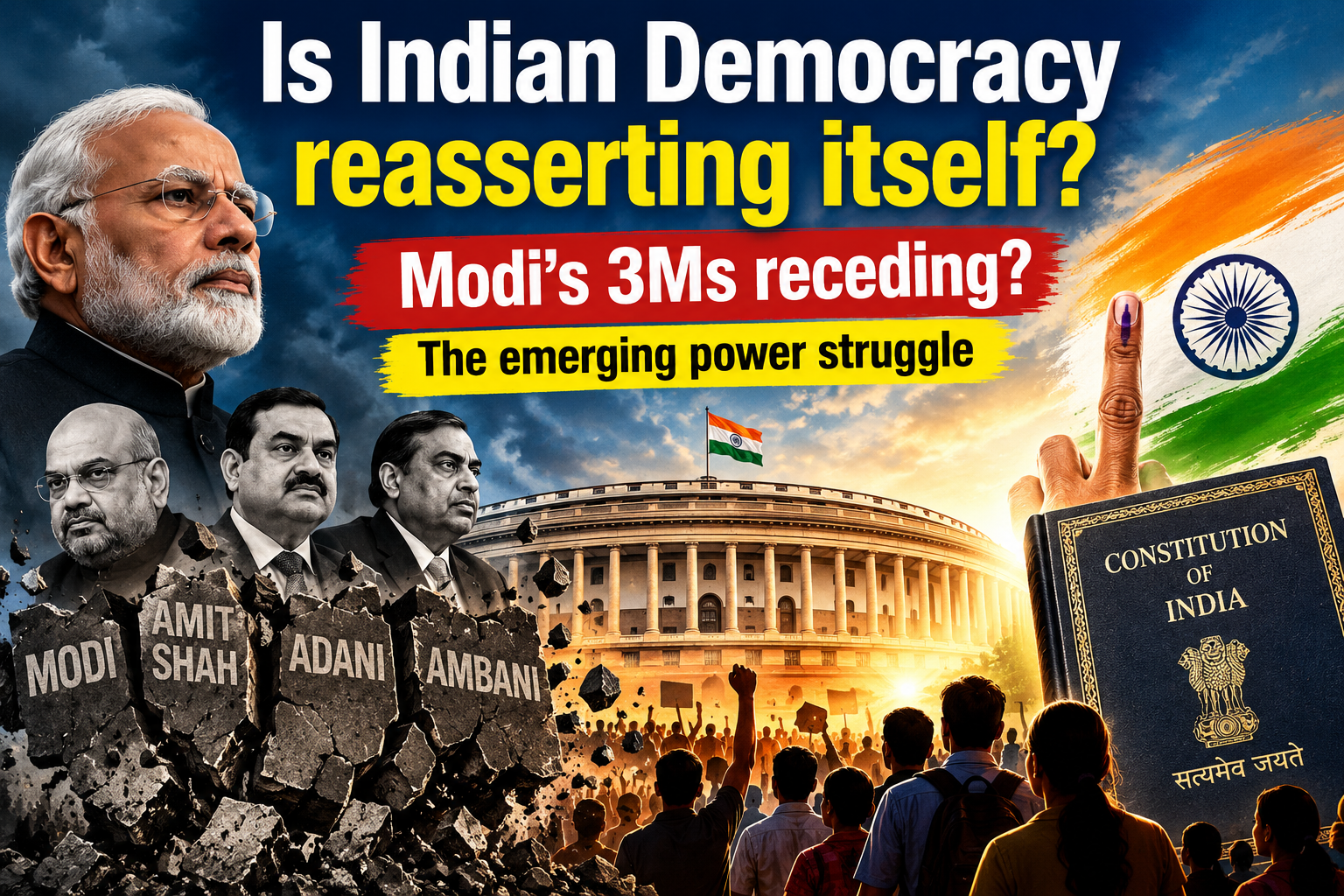
Is Indian Democracy reasserting itself? Modi’s 3Ms receding? The emerging power struggle India’s political landscape raises several interconnected questions: Is the country’s democratic system recovering its institutional independence? Is the relationship between Narendra Modi and Amit Shah undergoing a change or is Shah asserting himself as the only successor to Modi? Is Uttar Pradesh becoming an arena of competing political and organisational interests involving Modi, Shah and Yogi Adityanath? And could differences over the Election Commission influence the BJP’s long-term electoral calculations? These questions deserve serious examination.
The political developments that frame the debate
Democracy is not simply the replacement of one political leader by another. It is the ability of citizens to question the government, organise protests, obtain reliable information, vote without unlawful obstruction, challenge administrative decisions and secure impartial consideration of their grievances.
- Modiology: a political framework centred on Modi’s leadership, personality, political messaging and claims of national transformation.
- Modiocracy: a system in which political authority, party decision-making and public institutions become excessively concentrated around one leader or leadership circle.
- Modicide: systematic weakening, absorption or displacement of regional and opposition parties through political inducements, defections and organisational pressure.
The July demonstrations indicate that student grievances can develop into a broader political accountability issue. The October demonstrations show that electoral administration and voter registration can become subjects of mass public mobilisation. The demonstrations can encounter resistance outside the formal party system. When citizens organise around examination fairness, employment, voter registration and accountability, they bring governance questions into the public arena.
The protest movements can create pressure for explanations, investigations and policy changes. The state must protect public order while respecting lawful assembly, due process and freedom of expression. Arrests, restrictions or police action should be assessed against the circumstances, applicable law and judicial scrutiny rather than automatically treated as proof either of democratic collapse or of justified enforcement.
The dispute over electoral rolls is particularly consequential because the legitimacy of an election depends not only on how votes are counted, but also on whether eligible citizens can participate. Alleged exclusions must be examined through transparent records, correction mechanisms and independent scrutiny.
The Supreme Court’s reported notices concerning challenged Election Commission decisions add a further institutional dimension. The courts should assert its constitutional responsibility. Democratic reassertion is a plausible interpretation of the renewed public mobilisation, but its durability will depend on institutional remedies, transparent election administration and the protection of civil liberties—not merely on the size of demonstrations.
Has the Cold War between Modi and Shah been suspended?
Modi and Shah have worked together for decades. Their political partnership has involved national leadership, party organisation, electoral strategy and the management of the Union government. Such a partnership can contain differences without producing an open split.
Modi and Shah may have reason to coordinate closely when facing student unrest, disputes over electoral administration and the approaching Uttar Pradesh election. Even leaders with different institutional interests may prefer cooperation when a common political challenge demands it. Differences over succession, state leadership, appointments or campaign strategy could coexist until Modi declares him as his successor.
Have the July and October agitations backfired—and has Modi given Shah a free hand?
It is reported that the student-led protests over examination failures and corruption offered the opposition an opportunity to raise concerns about youth employment and accountability. The police response attracted further attention, while the government faced pressure to address the original grievances.
If the objective of a restrictive response was to prevent the demonstrations from becoming a larger political event, the subsequent expansion of public attention would suggest that the response did not fully contain the controversy.
The October demonstrations over the Election Commission present a different problem. They concern not only the government’s response to dissent but also the credibility of the process through which citizens exercise their voting rights.
Opposition allegations about voter-list revisions have generated demands for the CEC’s resignation. The Commission and the BJP dispute claims of politically motivated exclusions, while legal challenges and public scrutiny continue.
If the controversy results in transparent verification, correction of wrongful exclusions and clearer public explanations, institutional confidence could improve. If eligible voters remain unable to resolve registration problems, distrust could deepen.
What about Shah’s alleged free hand?
Amit Shah’s position as Union Home Minister makes his Ministry relevant to questions involving central security agencies and Delhi policing. The Supreme Court reportedly urged petitioners in August to allow an inquiry committee examining allegations of excessive force during the protests to proceed with its work. Police atrocities on the girls and the boys are clear evidence that the higher authorities had given them the instructions to crush the demonstrations as a warning not do so in future.
Is Modi sandwiched between Yogi Adityanath and Amit Shah ahead of the Uttar Pradesh elections?
The 2027 Assembly election will test the party’s ability to coordinate its national leadership, state government, social coalition and local organisation. The three leaders are already locked in a personal struggle.
Modi’s political interests include national visibility, the performance of the Union government and the BJP’s broader electoral victories. The Uttar Pradesh result would be significant because the state has the country’s largest population and sends 80 members to the Lok Sabha.
A state campaign that reinforces the national leadership’s message may suit Modi. A campaign dominated by competing leadership narratives could make coordination more difficult. These are structural considerations, not evidence of a private disagreement. Modi, in fact, Shah wanted to unseat Yogi but both could not succeed. Considering the ground, Modi decided to make Shah, a de facto man-in-charge the UP to manage the elections, despite Yogi’s resistance.
Yogi has his own public profile, governing record and political base. His statements ahead of the election show that he is actively articulating a campaign narrative, while his meetings with Modi form part of the visible coordination between the state and national leadership.
As Chief Minister, he has an institutional interest in presenting the state government’s record and retaining influence over its political direction. Whether the national leadership shares every aspect of his preferred strategy is a separate question. Yogi’s public emphasis on an “80-20” political contest where he illustrates the electoral narrative being advanced in Uttar Pradesh.
Does Modi want to remove Gyanesh Kumar while Shah wants to retain him until 2029?
As of 11 October 2026, there is a documented controversy surrounding Chief Election Commissioner Gyanesh Kumar. The current dispute concerns the Special Intensive Revision (SIR) of electoral rolls, the transparency of Election Commission decisions and allegations of improper voter exclusions.
On 5 October, the Supreme Court declined to suspend Kumar on an interim basis while issuing notices concerning the challenged decisions. It was reported, in the media that the Court had been asked to examine allegations that certain Election Commission decisions had been taken unilaterally. Meanwhile, opposition leaders have demanded Kumar’s resignation, while the BJP and the Election Commission have disputed allegations that voter-list changes were politically motivated.
Why the BJP have an interest in continuity?
The CEC’s continuity could be attractive to a government facing a contentious electoral-administration debate. Equally, a leadership might conclude that a change would help address public concerns or restore confidence. The constitutional objective is not to protect the CEC because one political leader wants continuity or another wants a change. It is to ensure that the Election Commission acts lawfully, transparently and impartially, regardless of which party benefits. The Election Commission’s credibility depends on demonstrable impartiality. The government’s credibility depends on allowing legitimate scrutiny.
The larger question: Is Modiocracy encountering institutional resistance?
The recent demonstrations raise questions about electoral administration, youth grievances and the treatment of dissent. Judicial proceedings provide opportunities to test specific allegations. The Uttar Pradesh election will provide another arena in which voters assess the performance of the government and competing political claims. Nevertheless, three distinctions must be maintained.
First, protest is evidence of dissent, not proof of democratic recovery. Its long-term significance depends on whether institutions respond to legitimate grievances. Second, internal disagreement is not necessarily democratic accountability. A conflict between political leaders may reflect competition for authority rather than a commitment to constitutional principles. Third, electoral success is not the sole measure of democratic health. A government must also respect individual rights, institutional independence and the lawful participation of political opponents.
The Conclusion: A test of institutions, not merely a contest of leaders
India’s current political developments raise legitimate questions about the relationship between leadership, dissent and institutional independence. The July student protests drew attention to examination-related grievances, corruption concerns and youth employment. The October demonstrations brought electoral administration and voter-list revisions into sharper public focus. The controversy surrounding Gyanesh Kumar has also become a subject of legal and political scrutiny. Meanwhile, the approaching Uttar Pradesh election places renewed attention on the relationship between national leadership, party organisation and state-level authority.
The concepts of Modiology, Modiocracy and Modicide invites readers to examine whether political authority has become excessively centralised, whether institutional checks are effective and whether opposition parties can compete on fair terms. Its strongest application would be one that tests these propositions against documented decisions, legal records, election data and independent reporting.
The alleged cold war between Modi and Shah, the claim that Modi has granted Shah a free hand, the suggestion that Modi is caught between Shah and Yogi, and the proposed disagreement over Gyanesh Kumar.
Ultimately, the most important question is not whether Modi prevails over Shah, whether Yogi gains greater autonomy, or whether one constitutional office-holder remains in place until 2029. It is whether institutions can perform their duties independently, whether citizens can exercise their rights effectively and whether political power remains subject to constitutional restraint. Democratic reassertion becomes meaningful when citizens’ rights are protected by institutions, not when one powerful individual defeat another.