
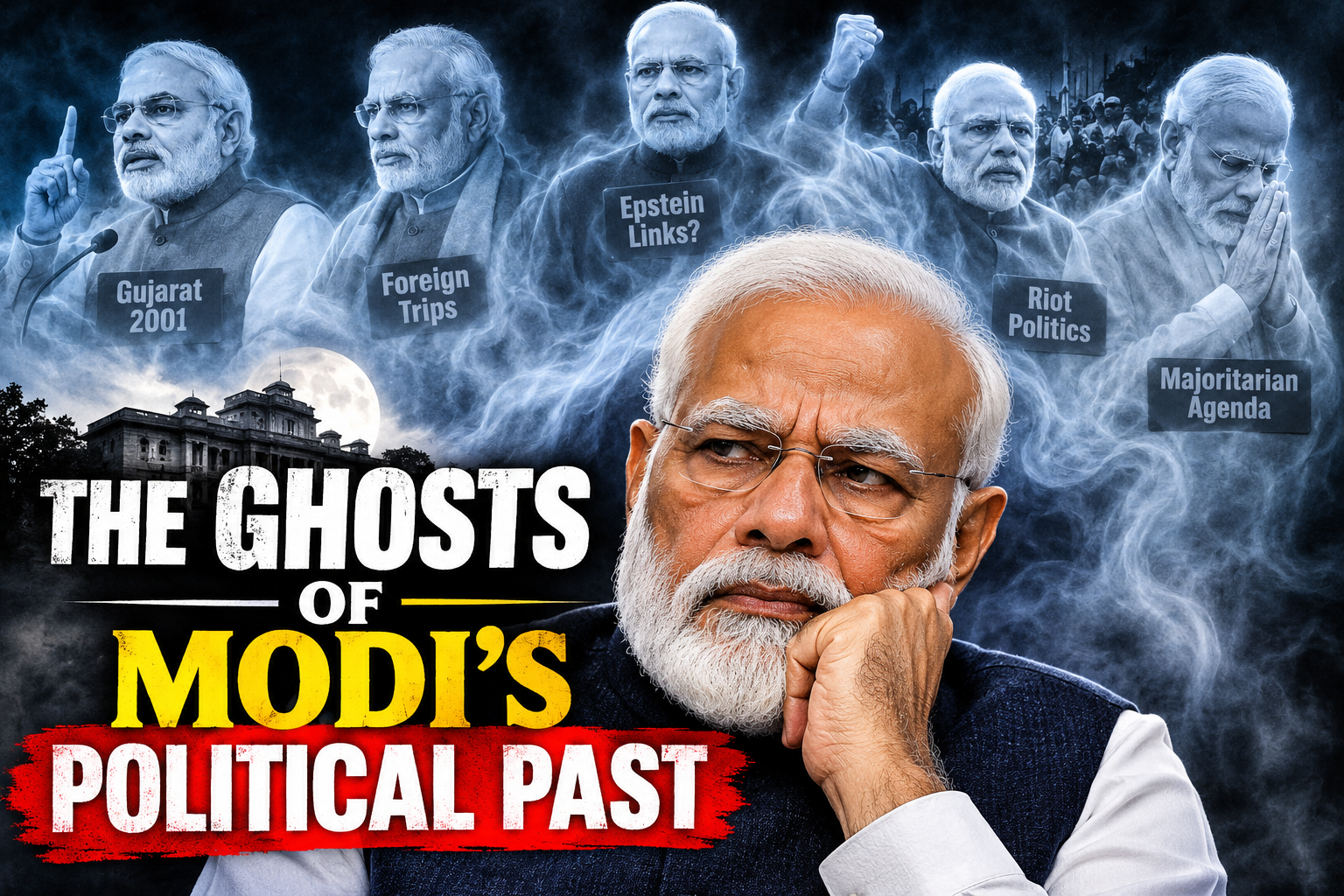
From Snoopgate and Pegasus to Epstein — Is India’s Most Powerful Leader Facing an Accountability Test?
Introduction: Do the ghosts of Modi’s political past ever disappear?
The ghosts of Modi’s political past. Political leaders often discover that their past does not necessarily remain in the past. Old associations, controversial decisions, unexplained episodes and unanswered questions can return at unexpected moments, particularly when a leader occupies a powerful constitutional position.
Narendra Modi, India’s Prime Minister since May 2014. His political journey from an organisational functionary of the RSS and BJP to Chief Minister of Gujarat and subsequently Prime Minister is remarkable. Yet a number of controversies have followed him through different phases of his career.
Some concern his international engagements; others involve his relationship with influential foreign personalities, allegations of surveillance, questions about the functioning of government institutions and criticism from individuals within his own political establishment.
The latest discussion surrounding Jeffrey Epstein’s files has revived questions about his international connections. The Pegasus controversy has kept surveillance and privacy in the public debate. Snoopgate, dating back to his Gujarat Chief Ministership, continues to invite questions about the alleged use of state machinery. His relationship with Benjamin Netanyahu and the criticisms of Dr Subramanian Swamy add further dimensions.
- The American connection: Before and after Gujarat
Narendra Modi’s international exposure did not begin when he became Prime Minister. During his earlier political career, he developed connections with the Indian diaspora and political supporters abroad. His organisational work within the BJP and the Sangh Parivar provided opportunities for international networking. His relationship with the United States, however, acquired an entirely different dimension after the Gujarat riots of 2002.
In March 2005, the United States refused his application for a diplomatic visa and revoked his existing tourist/business visa. The US State Department invoked a provision of its Immigration and Nationality Act concerning foreign government officials responsible for, or directly involved in, particularly severe violations of religious freedom.
The American ambassador explained that the decision was connected with Modi’s responsibility as head of the Gujarat government during the period of violence and the findings concerning the failure of state institutions to control the situation. This was a significant diplomatic setback.
Nevertheless, following his election as Prime Minister, Modi visited the United States in September 2014 and subsequently established a highly visible relationship with successive American administrations.
- China: From business admiration to strategic confrontation
Modi’s engagement with China also predates his premiership. As Gujarat Chief Minister, he visited China in November 2006 with an industrial and official delegation. The purpose was to study Chinese industrial development, special economic zones and investment opportunities. He undertook another significant visit in November 2011, seeking to promote Gujarat as an attractive destination for Chinese investment. After becoming Prime Minister, Modi continued to pursue diplomatic and economic engagement with Beijing. His May 2015 visit to China was an important milestone in bilateral relations.
However, the relationship subsequently encountered serious difficulties. The Doklam confrontation in 2017 and the deadly Galwan Valley clash in June 2020 Cinas’s encroachment on Indian land in Arunachal Pradesh and Ladhak exposed the limitations of personal diplomacy and economic engagement.
India’s relationship with China remains strategically complicated, involving border security, trade dependence, regional influence and competition in Asia. The important question is not why Modi visited China. Such visits are necessary for any Indian leader. The question is whether the expectations created by extensive diplomatic engagement were matched by tangible strategic results.
- The Epstein files: An uncomfortable international reference
The appearance of Modi’s name in material associated with Jeffrey Epstein has created a particularly sensitive political controversy. Epstein was an American financier and convicted sex offender whose network involved numerous influential personalities from politics, business and other fields.
A reported email dated July 9, 2017, attributed to Epstein and addressed to an individual identified as Jabor Y, referred to Modi’s visit to Israel. Epstein claimed that Modi had taken his advice and undertaken diplomatic gestures in Israel for the benefit of the American President. The timing is significant. Modi visited Israel from July 4 to 6, 2017, becoming the first sitting Indian Prime Minister to undertake such a visit. Modi’s surprise visit to Israel just before the American attacks was suspected to be a uncalled for a state visit
- The NVIDIA episode: Technology, influence and political proximity
On September 4, 2023, NVIDIA CEO Jensen Huang met Narendra Modi. Their discussion concerned India’s potential in artificial intelligence, technological development and the country’s skilled workforce.
There is nothing suspicious about a Prime Minister meeting the head of a major international technology company. India has a legitimate interest in semiconductor development, artificial intelligence and access to advanced computing infrastructure. Huang’s resignation involving in a sex scandal is worth questioning.
- Pegasus: Were Indian citizens being watched?
Among all the controversies examined here, Pegasus deserves particular attention because it concerns constitutional rights directly. Pegasus is sophisticated spyware developed by the Israeli NSO Group. It can potentially gain access to sensitive information on mobile devices, including communications and stored data.
In July 2021, an international media investigation brought allegations of possible surveillance involving journalists, political figures, activists and other individuals into the public domain. The controversy generated serious concerns about whether state agencies had used sophisticated surveillance technology against citizens.
In October 2021, the Court appointed an independent technical committee under the supervision of retired Supreme Court judge Justice R. V. Raveendran. In August 2022, the Court disclosed that the committee had examined 29 mobile phones.
It found no conclusive evidence of Pegasus infection in those devices. Five showed some form of malware, but this did not establish that Pegasus was responsible. However, the Supreme Court also noted that the Government of India had not cooperated with the committee.
Recently Rahul Gandhi alleged tapping of his mobile after he challenged Modi for a direct debate on national and internation issues.
- Modi and Netanyahu: Strategic friendship or excessive political intimacy?
Narendra Modi’s relationship with Benjamin Netanyahu has become one of the most visible aspects of India’s foreign policy. India established full diplomatic relations with Israel in 1992, and successive governments developed defence, agricultural, technological and intelligence cooperation.
Modi, however, took the relationship to a new level of public visibility. His July 2017 visit to Israel was historic because he became the first sitting Indian Prime Minister to visit the country. Netanyahu’s subsequent visit to India in January 2018 further strengthened bilateral ties. The increasing public warmth between Modi and Netanyahu has raised questions about whether India’s traditional diplomatic balance has been sufficiently maintained.
India’s relationship with Israel should be assessed on the basis of national interests, international law, strategic autonomy and democratic accountability—not merely the personal chemistry between two leaders.
- Subramanian Swamy: When criticism comes from within
Dr Subramanian Swamy’s relationship with Modi is politically interesting. Swamy was once an enthusiastic supporter of Modi’s political rise. He subsequently became an outspoken critic of several decisions and policies of the Modi government.
His criticism has touched upon black money, economic management, foreign policy and defence procurement. He questioned the government’s progress in recovering black money, arguing that the promises made before the 2014 elections had not been fulfilled adequately.
In August 2023, he publicly accused Modi of failing to take meaningful action against alleged holdings of black money abroad. He also raised questions concerning the Rafale defence deal.
In 2016, his attacks on senior government figures, including Finance Minister Arun Jaitley and RBI Governor Raghuram Rajan, created embarrassment within the BJP. The party leadership reportedly attempted to restrain his public criticism. What makes Swamy’s interventions interesting is that he has not always spoken as an ordinary opposition politician. He has been part of the BJP establishment and has held senior public positions.
Dr. Swamy’s critique of Sonia Gandhi is well known and his recent outburst on Sonia’s memoir – Belonging, a journey love is pathetic when he says that the book is full lies.
- Snoopgate: The Gujarat surveillance controversy that refuses to disappear
Snoopgate is perhaps the most politically significant episode connecting Modi and Amit Shah before they entered the Union government. The controversy emerged in November 2013, when media organisations published purported recordings of telephone conversations between Amit Shah, then Gujarat’s Minister of State for Home, and senior police officers.
The recordings allegedly concerned the surveillance of a woman architect in Gujarat in 2009. The published material suggested that the woman was being followed, her movements monitored and information about her activities collected.
The recordings reportedly contained references to an individual described as ‘Saheb’, whom the publishers alleged was Narendra Modi. Amit Shah was alleged to have directed the surveillance operation.
The recordings were attributed to IPS officer G. L. Singhal, but their authenticity and interpretation were disputed. The woman’s father publicly maintained that Modi was a family friend and that he had requested protection for his daughter.
The Gujarat government constituted an inquiry commission in November 2013. However, in October 2014, the Gujarat High Court quashed the commission following a legal challenge by the woman’s father. The Court held that the commission was not in the public interest.
The Conclusion- the ghosts of Modi’s political past
Is Narendra Modi being haunted by the ghosts of his political past? A leader may outlive controversies, but can democracy outlive the erosion of accountability? Perhaps the more accurate observation is that his past is increasingly being examined through the lens of his present political power.
The American visa episode, his engagement with China, the Epstein email, the NVIDIA meeting, Pegasus, Netanyahu, Subramanian Swamy and Snoopgate do not establish one continuous conspiracy or prove a common pattern of personal wrongdoing.
They are different episodes requiring different standards of evidence. Some are established historical events. Some involve credible institutional concerns. Others remain disputed allegations. But there is one question that connects them all:
Who watches the watchers, and who holds the most powerful political leaders accountable?
The Indian Constitution provides an answer through Parliament, the judiciary, independent institutions, a free press and the citizens themselves. These institutions must not become instruments of political convenience. If the government has nothing to hide, transparency should strengthen rather than weaken its credibility.
If allegations are false, they should be disproved through evidence and due process. If wrongdoing has occurred, it should be investigated without fear or favour. Neither Modi nor any other Prime Minister should be presumed guilty. But neither should any Prime Minister be presumed beyond accountability.
The real measure of democratic leadership is not how successfully a leader silences criticism, survives controversies or dominates political opponents. It is how confidently the leader allows questions to be asked and answered.
The ghosts of the past may or may not haunt Narendra Modi. But the erosion of accountability, if allowed to continue, could haunt Indian democracy for generations.